

Revolutionary Portable 3D Bioprinter Accelerates Skin Healing for Severe Wounds and Burns
The future of regenerative medicine is rapidly unfolding, and one of its most promising frontiers, the 3D bioprinting of skin, is now firmly within reach. This groundbreaking advancement comes from the collaborative efforts of dedicated researchers at the University of Toronto and Sunnybrook Health Sciences Centre. They have successfully developed a truly portable bioprinter, an innovative device capable of creating functional sheets of skin directly onto wounds. This technology promises to dramatically accelerate the healing process for individuals suffering from severe wounds and devastating burns, offering a beacon of hope where conventional treatments often fall short.
Designed with practicality and ease of use in mind, the device’s intuitive handling and compact form factor bring to mind a standard glue gun, making it accessible for clinical environments. Beyond its ergonomic design, it ingeniously incorporates a roller mechanism, essential for the precise and even distribution of bio-ink material across the wound surface. This innovative bioprinter is poised to revolutionize treatment paradigms in hospitals, emergency care facilities, and even remote healthcare settings. Its potential applications extend beyond routine wound care, offering a viable solution for the most challenging skin problems and addressing critical limitations encountered in traditional skin transplant procedures.
The journey to this remarkable invention began in 2018, when Richard Cheng and Professor Axel Guenther embarked on a project driven by a critical observation: existing bioprinters, while technologically advanced, were fundamentally impractical for daily clinical use. They noted that conventional bioprinting systems were excessively bulky, prohibitively slow, and astronomically expensive, rendering them incompatible with the fast- paced, resource-constrained environment of a hospital. Their initial prototype aimed to overcome these significant hurdles, focusing on portability, speed, and affordability.
Just two years later, their relentless dedication bore fruit. The researchers proudly demonstrated that their portable bioprinting solution possessed the tangible capability to heal wounds effectively. Crucially, they developed a specialized bio-ink that proved instrumental in accelerating the body’s natural healing process. This innovation presents a powerful alternative to autologous transplants, a common surgical procedure where healthy skin is harvested from one part of the patient’s body to cover a wound elsewhere. While effective for smaller wounds, autologous transplants are often not a viable solution for very severe burns. In such critical cases, doctors frequently face the grim reality of being unable to remove enough “healthy” skin from the patient’s own body to adequately cover the extensive damage, leaving patients vulnerable to prolonged recovery, infections, and significant scarring. The portable bioprinter offers a way to bypass this severe limitation by creating new skin tissue on demand.
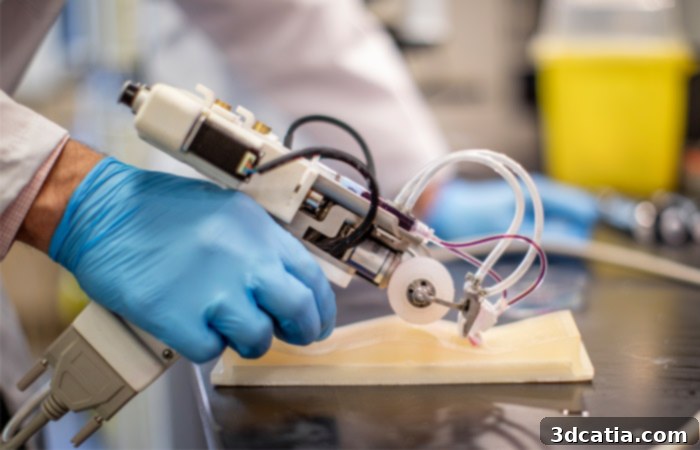
The portable bioprinter has gone through several iterations and is equipped with a roller | Credits: Nick Iwanyshyn
While the concept of a portable 3D bioprinter is not entirely novel, what truly distinguishes this particular innovation from other “mobile” solutions on the market is its ingenious use of an integrated roller. This unique feature plays a pivotal role in the application process, meticulously spreading the bio-ink onto a sheet of material that is then carefully placed upon the wound to facilitate healing. This method ensures a uniform and controlled application, which is critical for effective tissue regeneration. The material itself is deposited with remarkable precision by a single-use microfluidic print head, a design choice specifically implemented to guarantee absolute sterilization and prevent any risk of infection – a paramount concern in wound treatment. Furthermore, the flexible roller is engineered to precisely follow the contours and undulations of the print head’s track, allowing for superior control and adaptability, especially when addressing larger or irregularly shaped wounds, ensuring consistent coverage and optimal therapeutic effect.
At the heart of this groundbreaking technology lies the meticulously formulated bio-ink. The researchers explain that this proprietary material is composed of mesenchymal stem cells (MSCs), powerful progenitor cells known for their exceptional capabilities in promoting tissue repair and regeneration. MSCs possess remarkable immunomodulatory and anti-inflammatory properties, making them ideal candidates for accelerating healing and minimizing scar formation. When applied to a wound, these cells actively contribute to the regeneration of damaged skin tissue, stimulating the growth of new cells, blood vessels, and extracellular matrix components essential for complete and functional skin restoration. This targeted approach leverages the body’s natural healing mechanisms, enhanced by directed cellular therapy, promising more complete and aesthetically pleasing outcomes for patients.
Richard Cheng emphasizes the profound impact they envision: “Beyond merely helping wounds heal, our primary goal is to significantly reduce the incidence and severity of scarring. Scarring not only represents a cosmetic concern but can also lead to functional impairments, discomfort, and significant psychological distress for patients. By promoting more natural and efficient skin regeneration, we aim to mitigate these long-term consequences.” He elaborates on the strategic direction for their research: “Our main focus in the coming years will be on the in-vivo side, translating our success in laboratory settings to direct application on living tissue in clinical trials. This crucial step will validate the printer’s efficacy and safety in real-world scenarios.”
Cheng expresses strong confidence in the timeline for clinical integration, stating, “I believe that within five years, our portable 3D bioprinter will be ready for widespread adoption in hospitals and clinics. Once it is integrated into the operating room environment, it will undoubtedly be a game-changer, fundamentally transforming lives. A device like this will revolutionize the way we currently approach and provide care for the seriously burned and injured, offering a faster, less invasive, and more effective treatment pathway.” This optimistic outlook is grounded in rigorous development; since its inception, the bioprinter has undergone approximately ten intensive iterations, with the current version representing the culmination of extensive engineering refinement and biological optimization. Each iteration has brought the team closer to a perfected device that meets the stringent demands of medical application. While we will most likely have to patiently await a few more years before witnessing this groundbreaking portable 3D bioprinter become a standard tool in our hospitals, the encouraging results and clear vision for its future underscore its immense potential. This innovation stands as a testament to the power of interdisciplinary research in addressing some of healthcare’s most pressing challenges.
The development of this portable bioprinter is a monumental step forward in regenerative medicine, offering hope for patients with severe burns and chronic wounds. Currently, treatments for extensive burns often involve complex and painful surgical procedures, prolonged hospital stays, and a high risk of complications including infection and significant scarring. The inability to source sufficient donor skin for large areas, as mentioned, is a critical bottleneck. This new bioprinter circumvents these issues by providing an on-demand solution for creating new skin directly at the point of care. Furthermore, the inclusion of mesenchymal stem cells in the bio-ink offers therapeutic benefits beyond mere coverage, actively promoting the body’s intrinsic healing capabilities and potentially leading to better functional and cosmetic outcomes. This technology could significantly reduce the burden on healthcare systems by shortening recovery times and minimizing the need for multiple painful surgeries, thereby improving the overall quality of life for countless individuals.
Looking ahead, the clinical translation of this technology will involve rigorous testing and regulatory approvals to ensure its safety and effectiveness for human use. Researchers will focus on optimizing the bio-ink composition, refining the printing parameters, and conducting extensive preclinical and clinical trials. This will include assessing long-term durability, integration with existing tissues, and scar reduction capabilities in diverse patient populations. The potential impact extends beyond just burns, offering promising applications for chronic wounds, diabetic ulcers, and even reconstructive surgery, where traditional grafting techniques are limited. This innovative device not only represents a leap in 3D bioprinting but also embodies a paradigm shift towards personalized and immediate medical interventions, bringing advanced regenerative therapies directly to the patient’s bedside.
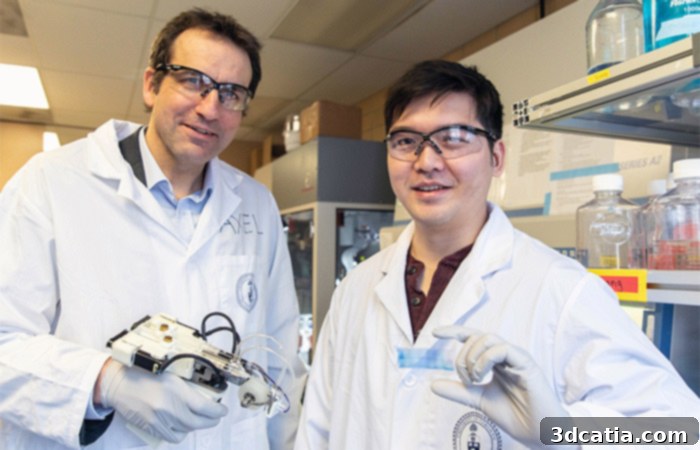
On the left, Richard Cheng and Professor Axel Guenther
What are your thoughts on this revolutionary research in portable 3D bioprinting and its potential to transform wound care? We invite you to share your insights and engage with us in the comments section below! You can also join the conversation and connect with our community on our Facebook and Twitter pages. Don’t miss out on the latest advancements and news in the world of additive manufacturing and 3D printing; sign up for our free weekly Newsletter to have all the essential updates delivered straight to your inbox!
As a reminder, we have an important webinar approaching on the 26th of February, which will focus on practical strategies for adopting additive manufacturing into your projects. This is an excellent opportunity to learn from industry experts and understand how to leverage these innovative technologies. You can sign up for this informative session completely free of charge, starting today. Register HERE to secure your spot!