

Revolutionizing Vision: 3D Printing Pioneers Personalized Treatment for Color Blindness
Color blindness, scientifically known as color vision deficiency (CVD), is a common inherited eye disorder that impacts millions worldwide. Far from rendering the world in black and white, this condition typically involves a reduced ability to distinguish between certain colors, most commonly shades of red and green, though yellow-blue color blindness also exists. This deficiency stems from an abnormality or absence of one or more of the three types of cone cells in the eye’s retina, which are crucial for perceiving color. For individuals living with CVD, everyday tasks that most take for granted—like interpreting traffic lights, identifying ripe fruit, or even navigating certain career paths—can present significant challenges. Until recently, corrective solutions have been limited, often offering only partial improvement or acting as filters rather than true corrections.
However, the landscape of vision correction is rapidly evolving, thanks to the transformative power of additive manufacturing. While 3D printing has already demonstrated its immense potential in various sectors, from aerospace to medical prosthetics, its application in ophthalmology has primarily been confined to the aesthetic design of products like eyeglass frames. These customizable frames offer unparalleled comfort and style, yet the functional component—the lenses themselves—remained largely untouched by additive processes for complex vision disorders. This paradigm is now shifting dramatically, following a groundbreaking study conducted by researchers at Abu Dhabi’s Khalifa University of Science and Technology (KU).
This pioneering team has successfully harnessed 3D printing technology to develop functional lenses capable of significantly improving the daily lives of individuals affected by color blindness. Their innovative approach moves beyond mere aesthetic customization, offering a tangible corrective solution that promises to enhance color perception and visual clarity for those with CVD. This development represents a monumental leap forward, illustrating how advanced manufacturing techniques can be tailored to address highly specific and personal medical needs, opening new avenues for personalized medicine and vision care.
The Scientific Breakthrough: Engineering 3D-Printed Lenses for Enhanced Color Perception
The core of Khalifa University’s innovation lies in its sophisticated material science and precision manufacturing techniques. The research team embarked on a mission to create lenses that could selectively filter specific wavelengths of light, thereby compensating for the deficiencies in the cone cells of colorblind individuals. Their method involved a meticulous combination of a transparent resin and two specialized wavelength-filtering dyes, which were carefully mixed to achieve the desired optical properties. This proprietary blend forms the very essence of the corrective power within these new lenses.
For the fabrication process, the team utilized a Prusa SL1 printer. This choice was deliberate, as the SL1 is a Stereolithography (SLA) resin 3D printer known for its exceptional precision and ability to produce objects with incredibly smooth surface finishes. Such characteristics are paramount when manufacturing optical components like lenses, where surface imperfections can severely distort vision. The SLA process, which uses a UV laser to cure liquid resin layer by layer, allowed the researchers to embed the light-filtering dyes uniformly throughout the lens material, ensuring consistent optical performance across the entire lens surface. This precision manufacturing capability is what differentiates 3D printing from conventional lens production, enabling intricate designs and tailored filtering profiles that were previously difficult, if not impossible, to achieve.
Beyond the functional lenses, the research team also leveraged 3D printing for the accompanying frames. Using Solidworks software for design and Selective Laser Sintering (SLS) 3D printing technology for fabrication, they were able to create eyeglass frames that are not only identical in appearance to existing market offerings but also highly customizable and durable. SLS printing, which fuses powdered material with a laser, offers superior strength and design freedom, allowing for lightweight yet robust frames that can be personalized to fit each individual’s facial structure comfortably. This dual application of additive manufacturing—for both the corrective lenses and the frames—highlights the holistic potential of 3D printing in producing fully integrated and personalized eyewear solutions.
Rigorous Testing and Promising Results
A critical aspect of developing any medical device, especially one involving chemical components, is ensuring its safety and long-term stability. Prior research into lens correction methods had highlighted potential issues with dye toxicity and leaching, which could pose health risks to users. Recognizing these concerns, the Khalifa University team implemented rigorous testing protocols to validate the safety and durability of their 3D-printed lenses. Their precautions began with a thorough examination of the stability of the wavelength-filtering dyes embedded within the resin.
One key test involved submerging the 3D-printed glasses in water for over a week. Crucially, throughout this extended period, no dye leakage was observed, indicating excellent encapsulation and stability of the coloring agents within the transparent resin matrix. This is a vital finding, as it assures that the dyes will not leach into the wearer’s eyes or surrounding tissues, maintaining both safety and the intended optical properties. An additional test focused on the lenses’ durability under ambient conditions, where they were left exposed for another week. The results further confirmed their robustness, demonstrating that the lenses maintained their structural integrity and optical performance, proving them to be durable and reliable for long-term use in various environments.
Following these stringent material tests, the newly developed glasses were put to the ultimate test: human trials. Volunteers suffering from both red-green and yellow-blue color vision deficiencies participated in the study. The feedback was overwhelmingly positive, with participants reporting significant benefits in terms of both comfort and vision improvement. Compared to commercially available corrective lenses for color blindness, the 3D-printed alternatives offered a noticeable enhancement in color discrimination and overall visual experience. This superiority stems from the ability of 3D printing to precisely control the distribution and concentration of the dyes, allowing for a more selective and effective filtering of undesired wavelengths of light.
Dr. Haider Butt, an associate professor of mechanical engineering who played a pivotal role in this project, elaborated on the scientific robustness of their findings. “Our results showed that 3D printing had no influence on the wavelength-filtering properties of the dyes,” he stated. “In fact, the dyes remained unchanged as they were integrated with the resin and 3D printed. When we compared the optical performance of our glasses with commercial colorblind glasses, our results indicated that our 3D-printed glasses were more selective in filtering undesired wavelengths than the commercially available options.” Dr. Butt further emphasized the transformative potential: “They have great potential in treating colorblindness, and their ease of fabrication and customization means they can be tailored to each individual patient.” This highlights a key advantage of additive manufacturing: the ability to produce highly personalized medical devices with unprecedented precision and efficacy. The original press release with more details can be found HERE.
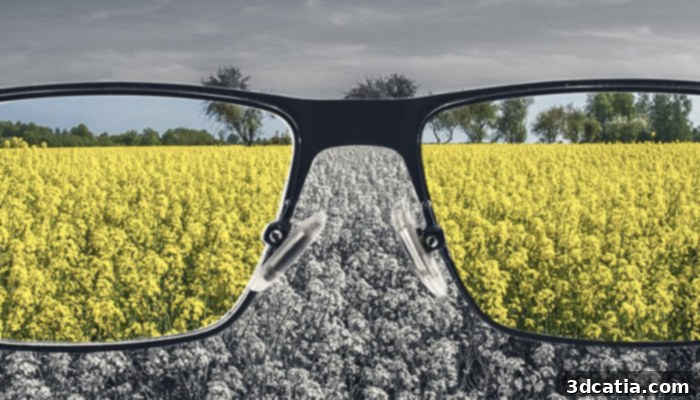
Tinted lenses to treat yellow-blue color blindness (photo credits: Médocoptic)
The Future of Personalized Vision Care Through Additive Manufacturing
The implications of Khalifa University’s research extend far beyond the immediate development of corrective lenses for color blindness. This breakthrough serves as a powerful testament to the burgeoning role of 3D printing in personalized medicine. The ability to customize a medical device—from its precise optical properties to its ergonomic fit—to the unique needs of each patient opens up a new frontier in healthcare. For individuals with color vision deficiency, this means a future where off-the-shelf solutions are replaced by bespoke corrective lenses, potentially offering a more profound and natural restoration of color perception.
Consider the daily impact: improved performance in educational settings, enhanced career opportunities in fields requiring accurate color discrimination (e.g., graphic design, electrical engineering, certain medical professions), and simply a richer, more vibrant experience of the world. The ease of fabrication and customization inherent in 3D printing could also lead to more accessible and potentially more affordable solutions in the long run, reducing the barriers to effective treatment for millions globally.
Looking ahead, this study lays robust groundwork for further advancements. Future research may focus on optimizing dye formulations for even greater specificity and effectiveness across a broader spectrum of color vision deficiencies. Clinical trials on a larger scale will be crucial to solidify these findings and pave the way for widespread adoption. Moreover, the methodology developed could potentially be adapted for other ophthalmic applications, such as specialized filters for light sensitivity or innovative designs for managing other visual impairments. The integration of advanced materials, precise manufacturing, and individualized patient data through additive manufacturing is truly revolutionizing how we approach vision care.
What are your thoughts on the groundbreaking use of 3D printing technologies to treat color blindness? We invite you to share your perspectives in a comment below or join the conversation on our LinkedIn, Facebook, and Twitter pages! Don’t forget to sign up for our free weekly Newsletter here to receive the latest 3D printing news straight to your inbox! You can also find all our engaging videos on our YouTube channel, where we explore the most exciting developments in additive manufacturing.
*Cover Photo Credits: Médocoptic