
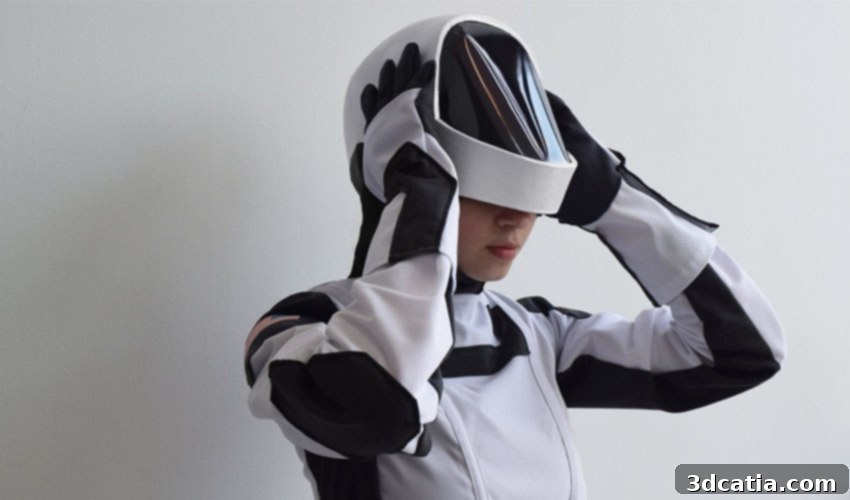
Revolutionizing Space Exploration: The Impact of 3D Printed SpaceX Helmets and Additive Manufacturing
The convergence of space travel and additive manufacturing represents a monumental leap forward in innovation, pushing the boundaries of what’s possible beyond Earth’s atmosphere. This synergistic relationship is perhaps best exemplified by the iconic 3D printed SpaceX helmets worn by astronauts. Elon Musk, a visionary known for turning science fiction concepts into reality, once again captured global attention with the successful launch of Dragon, the first commercially developed crewed spacecraft. While the spacecraft itself and its profound commercial implications have been extensively discussed, the sophisticated design of the spacesuits, and particularly the integral role of their 3D printed helmets, warrants a closer examination. The remarkable progress in desktop 3D printers even enables enthusiasts to independently replicate these advanced designs, offering a tangible connection to the future of space exploration.
When NASA astronauts Doug Hurley and Bob Behnken embarked on their historic journey aboard the Dragon capsule, they were clad in custom-tailored suits designed for optimal performance and protection in the unforgiving environment of space. These cutting-edge spacesuits boast several remarkable features, including touchscreen-compatible gloves for seamless interaction with spacecraft controls, a flame-resistant outer layer to safeguard against unforeseen hazards, and, most notably, meticulously crafted 3D printed helmets. Each helmet is a marvel of engineering, integrating a high-performance visor, precise valves for pressure control, secure locks, and clear microphones for crucial communication. The aesthetic appeal and functional elegance of these suits can be attributed to the renowned Hollywood costume designer Jose Fernandez, whose impressive portfolio includes iconic outfits for blockbusters such as The Avengers, Batman Vs Superman, and X-Men. Clearly, Elon Musk’s ambition was to imbue these suits with a ‘superhero’ vibe, and it is widely acknowledged that he achieved this vision with resounding success. Beyond their striking appearance, these suits underwent rigorous reverse engineering and exhaustive testing to meet the stringent requirements of human spaceflight, ensuring they could withstand the extreme conditions of launch, orbit, and re-entry.
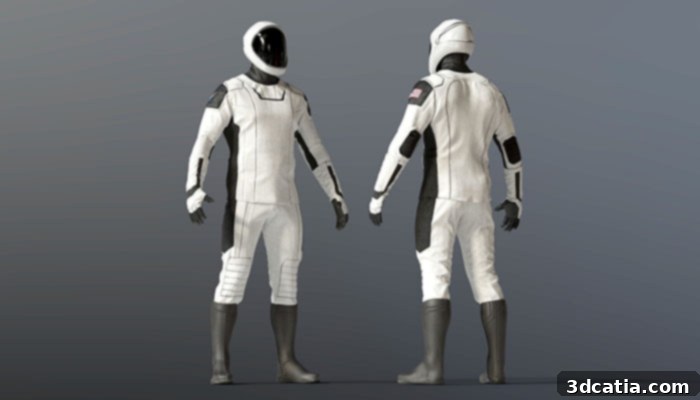
credits: ArtStation
The decision to leverage 3D printing technology for the production of these critical helmets was a strategic one, driven by the unique advantages that additive manufacturing offers for complex, high-performance components. While specific official details remain proprietary, industry experts widely speculate that the Fused Deposition Modeling (FDM) method was primarily employed for printing the helmets. FDM, a robust and versatile 3D printing process, involves extruding a thermoplastic filament layer by layer to build a three-dimensional object. This method is particularly well-suited for producing parts with advanced materials, especially those engineered for demanding applications. One such advanced material is PEKK (Polyetherketoneketone), a high-performance, semi-crystalline thermoplastic that has seen increasing adoption across various sectors of the additive manufacturing market, including aerospace. PEKK offers an exceptional combination of properties essential for space-grade equipment. It is inherently non-flammable, a critical safety feature for any component used in a confined spacecraft environment, and does not emit toxic fumes during the printing process, ensuring safer manufacturing conditions. Furthermore, PEKK exhibits outstanding resistance to abrasion, which is an invaluable characteristic for a space helmet that must endure potential impacts from micro-meteoroids or surface contact. Its superior mechanical strength, high temperature resistance, and excellent chemical resistance also contribute to its suitability for extreme conditions. While FDM is a strong candidate, it is worth noting that PEKK has also been successfully adapted for the Selective Laser Sintering (SLS) process, another additive manufacturing technique that could offer alternative benefits in terms of part density and surface finish for specific components.
The increasing accessibility of FDM 3D printers on the consumer market has democratized the ability to engage with complex engineering, even allowing enthusiasts to relatively easily print their own replica of a SpaceX helmet at home. This shift reflects a broader trend where advanced manufacturing techniques become available to the general public, fostering innovation and learning. A plethora of websites, such as Yeggi, STLFinder, Cults3D, and Adafruit, now serve as vibrant hubs for digital designs, offering readily downloadable STL files for SpaceX helmet replicas. These files are typically optimized for printing on standard FDM machines, requiring only basic knowledge of 3D printing software and hardware. For independent projects and hobbyists, the pressure of utilizing the most advanced and often costly materials like PEKK is entirely eliminated. Replicas do not need to withstand the vacuum of space, extreme temperatures, or radiation, thus opening up a vast array of more affordable and accessible filament options. Therefore, individuals embarking on such a project have the freedom to explore various widely available thermoplastics, such as PLA (Polylactic Acid) for ease of printing and biodegradability, ABS (Acrylonitrile Butadiene Styrene) for its durability and impact resistance, or PETG (Polyethylene Terephthalate Glycol) for a balance of strength and flexibility. The key is to choose a filament that best suits the specific aesthetic and structural needs of the replica, without incurring the significant expense associated with aerospace-grade materials. This accessibility not only allows for creative expression but also educates the public about the underlying technologies propelling space exploration forward.

Adafruit industries 3D prints a SpaceX helmet replica with Led lights
The integration of 3D printing into the development of critical components like the SpaceX helmets underscores its transformative potential for the future of space exploration. Beyond spacesuits, additive manufacturing is poised to play an even more expansive role, enabling the creation of lightweight and structurally optimized rocket parts, specialized tools for in-space repairs, and even potential habitats for lunar or Martian settlements. The ability to print parts on demand, reducing the need to transport every single component from Earth, promises significant cost savings and increased mission flexibility. Furthermore, as technologies for in-situ resource utilization (ISRU) advance, astronauts may one day be able to use raw materials found on other celestial bodies to 3D print necessary items, truly revolutionizing self-sufficiency in deep space. These 3D printed space helmets are more than just protective gear; they are a symbol of human ingenuity and the groundbreaking capabilities of modern manufacturing. They represent a tangible link between cutting-edge technology and humanity’s enduring quest to explore the cosmos.
What are your thoughts on these innovative 3D printed space helmets and the role of additive manufacturing in space exploration? Are you inspired to try and replicate one of these engineering marvels yourself, or perhaps imagine the next generation of 3D printed space equipment? We invite you to share your insights and comments below, or engage with us on our Facebook and Twitter pages! Don’t miss out on the latest advancements and breakthroughs in the world of additive manufacturing and space technology – sign up for our free weekly Newsletter and have all the crucial 3D printing news delivered straight to your inbox!