

Additive Manufacturing Market Surges: SmarTech Publishing Reports Strong Growth and Ambitious Forecasts
The global landscape of industrial production is undergoing a profound transformation, largely driven by the rapid advancements and widespread adoption of additive manufacturing, commonly known as 3D printing. While industry players like Materialise offer insights into emerging trends, it is crucial to look back at past performance to truly grasp the momentum of this dynamic sector. In this regard, the comprehensive report from the US-based firm SmarTech Publishing provides invaluable data, revealing a robust and expanding market. According to their findings, the additive manufacturing market generated an impressive $9.3 billion in 2018, marking a substantial 18% increase from the previous year. This significant revenue figure encompasses all critical components of the industry, including cutting-edge machinery, sophisticated software solutions, a diverse range of materials, and specialized services. Looking ahead, SmarTech Publishing’s forecasts are even more ambitious, projecting that the market is poised to exceed an astounding $41 billion by 2027, underscoring the immense potential and expected acceleration in this transformative technology.
The year-end report from SmarTech Publishing serves not only as a comprehensive retrospective, tracing the key milestones and achievements of the past year but also as a forward-looking guide, highlighting crucial trends expected to shape the additive manufacturing sector over the next decade. The data unequivocally points to a period of sustained and accelerated growth across the entire global additive manufacturing market. This upward trajectory is evident irrespective of specific industry verticals or the diverse array of technology application cases. While certain sectors have historically been early adopters and continue to be significant drivers, the report identifies both established strongholds and emerging opportunities. It is becoming increasingly clear that aerospace, healthcare, and automotive industries will remain pivotal markets, acting as anchors for innovation and adoption. Concurrently, new frontiers in consumer goods and energy sectors are emerging as highly promising areas, presenting compelling opportunities for focused investment and significant market penetration in the coming years.
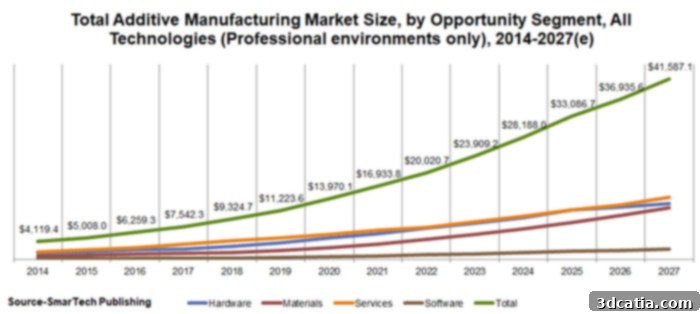
There is growth in all segments of the additive manufacturing market
Decoding 2018: A Year of Balanced Growth and Strategic Advancements in Additive Manufacturing
The Additive Manufacturing Market in 2018: A Detailed Assessment
SmarTech Publishing’s incisive assessment of the year 2018 highlights a critical evolutionary shift within the additive manufacturing market: a return to balanced growth. This signifies a mature and healthy development trajectory where all primary market components are progressing and developing seamlessly. This synchronized advancement suggests a shared vision and a concerted effort to deliver solutions that effectively meet the diverse and evolving needs of various industries. The report particularly underscores the commendable performance of two industry titans, 3D Systems and Stratasys, both of whom demonstrated positive financial results despite operating within an intensely competitive landscape. This competition was notably fierce within the polymer segment, which witnessed significant disruptions and new entries. A prime example of this dynamic shift was the impactful arrival of HP, a major player that successfully entered the market and rapidly captured a substantial share, thereby reshaping competitive dynamics. This intense activity contributed to the polymer additive manufacturing sector alone achieving revenues nearing an impressive $5.5 billion in 2018, underscoring its pivotal role and robust expansion within the broader market.
Key Trends Fueling Market Expansion
The comprehensive study conducted by the US firm SmarTech Publishing meticulously identifies two overarching and powerful trends that have been instrumental in driving the accelerated growth observed in the additive manufacturing market. The first fundamental trend is the strategic and widespread adoption of this transformative technology by large international corporations. These global enterprises are actively seeking to leverage additive manufacturing to significantly accelerate their product development cycles, enhance manufacturing efficiency, and broadly promote its integration across their operations. Their engagement often involves substantial investment in research and development, fostering the creation of innovative new processes, advanced materials, and novel application methodologies, thereby expanding the technological frontier.
The second equally significant trend revolves around the intelligent integration of additive manufacturing technologies with existing, more traditional machine tools and manufacturing processes. This synergistic approach, often referred to as hybrid manufacturing, is unlocking unprecedented levels of capability. By combining the strengths of both additive and subtractive or forming technologies, manufacturers can develop more complex, functionally optimized, and highly varied applications across virtually every industrial sector. This integration allows for enhanced design freedom, improved material utilization, and streamlined post-processing, making additive manufacturing a more versatile and economically viable solution for a broader spectrum of production challenges. These two trends collectively underscore a maturing market where additive manufacturing is moving beyond niche applications to become a fundamental pillar of modern industrial strategy.
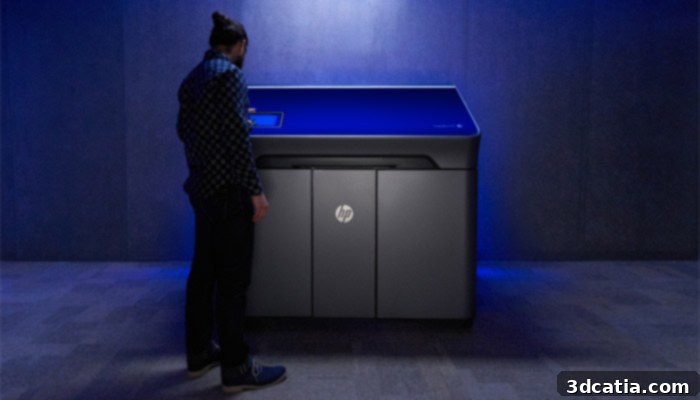
HP’s arrival in the additive manufacturing market has contributed to the growth of the market
Future Outlook: Strategic Markets and Unlocking New Potentials for Additive Manufacturing by 2027
The ambitious forecast by SmarTech Publishing, predicting that the additive manufacturing market will surge past $41 billion by 2027, paints a vivid picture of a sector on the cusp of exponential expansion. This growth will not be uniform but strategically concentrated in industries where 3D printing offers distinct competitive advantages and solves complex manufacturing challenges. Among these, aerospace, healthcare, and automotive are consistently identified as the bedrock markets that will continue to drive significant innovation and adoption. These sectors inherently demand high precision, customization, lightweighting, and complex geometries – all capabilities where additive manufacturing excels.
Aerospace: Redefining Design and Performance
In the aerospace industry, additive manufacturing is revolutionizing how components are designed and produced. The ability to create intricate, lattice structures allows for significant weight reduction without compromising strength, directly translating to improved fuel efficiency and reduced operational costs. Manufacturers are leveraging 3D printing for complex parts such as turbine blades, brackets, and ducts, benefiting from part consolidation which reduces assembly time and supply chain complexity. Furthermore, additive manufacturing plays a crucial role in maintenance, repair, and overhaul (MRO) operations, enabling on-demand production of obsolete or hard-to-source parts, thus extending the lifespan of aircraft and reducing downtime.
Healthcare: Precision, Customization, and Life-Saving Innovations
The healthcare sector is another domain where 3D printing is making a profound impact. The technology’s unparalleled ability to create highly customized products is invaluable for patient-specific medical devices. This includes custom prosthetics and orthotics that perfectly fit an individual’s anatomy, surgical guides that enhance precision during complex operations, and personalized implants tailored to unique patient requirements. Beyond these applications, the nascent field of bioprinting holds immense promise for the future, aiming to create tissues and organs, although this remains a long-term research goal. The immediate benefits lie in improved patient outcomes and more effective medical interventions.
Automotive: From Prototyping to Production and Personalization
The automotive industry, traditionally a pioneer in advanced manufacturing, is increasingly integrating additive solutions. While rapid prototyping remains a foundational application, 3D printing is expanding into tooling, jigs, and fixtures, streamlining production lines and reducing lead times. More significantly, it is enabling the creation of custom, high-performance parts for luxury vehicles and motorsports, where lightweighting and optimized designs are critical. The future holds potential for mass customization of vehicle interiors and exterior components, offering consumers personalized experiences and opening new avenues for design innovation and supply chain flexibility.
Emerging Opportunities: Consumer Goods and Energy
Beyond these established heavyweights, the report highlights consumer goods and energy as burgeoning sectors ripe for additive manufacturing adoption. In consumer goods, 3D printing allows for rapid iteration of product designs, personalized items, and localized, on-demand production, catering to evolving consumer preferences and reducing inventory waste. The energy sector, encompassing traditional power generation, renewables, and oil & gas, can benefit from additive manufacturing for producing complex turbine components, specialized heat exchangers, and robust tooling designed for harsh environments, enhancing efficiency and reducing the cost of highly specialized parts.
The Broader Impact and Future Trajectory of Additive Manufacturing
The impressive growth figures and future forecasts for the additive manufacturing market are not merely about economic expansion; they reflect a fundamental shift in how industries conceive, design, and produce goods. Additive manufacturing is a cornerstone of the broader digital transformation occurring across global industries. It facilitates truly digital workflows, from design optimization using artificial intelligence and simulation software to automated production, enabling unprecedented levels of efficiency and innovation.
Furthermore, the technology’s influence extends to global supply chains. By enabling localized and on-demand manufacturing, it offers resilience against disruptions, reduces reliance on distant factories, and minimizes transportation costs and carbon footprints. This decentralization of production has profound implications for global trade and sustainability. Environmentally, additive manufacturing contributes to sustainability by reducing material waste, optimizing material usage, and enabling the creation of lighter, more efficient components, especially in sectors like aerospace and automotive.
As the market matures towards the projected $41 billion by 2027, key challenges such as standardization, cost reduction for mass production, and the development of a skilled workforce will need to be addressed. However, the continuous investment in R&D, coupled with increasing industry adoption and technological advancements, suggests that these hurdles will be overcome, paving the way for additive manufacturing to become an even more indispensable technology in the global industrial landscape.
You can delve deeper into these insights and discover the full scope of the report on SmarTech Publishing’s official website Here. We encourage you to explore the detailed findings and projections that underpin the exciting future of 3D printing.
What are your thoughts on the remarkable growth observed in the additive manufacturing market? Do you envision even faster adoption, or are there specific challenges you believe need immediate attention? We invite you to share your perspectives and insights in a comment below. You can also join the conversation and connect with our community on our Facebook and Twitter pages. For all the latest news, breakthrough innovations, and essential updates in the world of 3D printing, don’t miss out – sign up for our free weekly Newsletter, delivered straight to your inbox!