
Unlocking Growth: The High-Performance Polymer 3D Printing Market Set for Significant Expansion
The landscape of additive manufacturing is continuously evolving, with high-performance polymers (HPPs) emerging as a critical driver of innovation and growth. A recent comprehensive study by BlueWeave Consulting, a distinguished strategic consulting and market research firm, sheds light on the robust expansion anticipated within the high-performance polymer 3D printing market. The findings from this insightful report are overwhelmingly positive, projecting the market to reach an impressive valuation of $184.5 million by the year 2029. This growth trajectory is underpinned by a compelling Compound Annual Growth Rate (CAGR) of 8.5 percent over the forecast period, signaling a lucrative future for this specialized segment of the 3D printing industry.
But what exactly constitutes a high-performance polymer in the context of this study, and why is its rise so significant? BlueWeave Consulting’s research encompasses a diverse range of materials, crucially including the polyamide family alongside other well-known engineering plastics such as Polyetherimide (PEI) and Polyether Ether Ketone (PEEK). This grouping might appear surprising at first glance, given the distinct printing, thermal, and mechanical profiles of these materials. However, this inclusive approach reflects the broader market’s definition of advanced polymers used in demanding applications. Despite the initial impact of global events like the recent pandemic, which significantly affected various industrial sectors, this market segment has demonstrated remarkable resilience and is now poised for substantial recovery and growth.
Understanding High-Performance Polymers: The Pinnacle of Additive Manufacturing
High-performance polymers represent the cutting edge of plastic materials, distinguished by their superior thermal, mechanical, and chemical properties. While these characteristics make them ideal for critical applications, they also render them among the most challenging plastics to print and process using additive manufacturing techniques. Their demanding profiles necessitate specific machinery and highly precise environmental controls, particularly regarding temperature management. For instance, successfully 3D printing high-performance polymers typically requires a closed enclosure to maintain a stable environment, a heated build plate to ensure proper adhesion and minimize warping, and crucially, a heated printing chamber to manage residual stresses and facilitate optimal layer fusion. The technical complexity of these printing parameters is a significant barrier to entry, but the resulting parts offer unparalleled properties, making the investment in specialized equipment and expertise entirely worthwhile.
The benefits derived from 3D printing with HPPs are profound, enabling the creation of components with exceptional resistance to high temperatures, aggressive chemicals, and even smoke and fire. These properties are indispensable for sectors where material integrity under extreme conditions is non-negotiable. Industries such as aerospace, automotive, medical, and defense heavily rely on HPPs to produce lightweight, robust, and durable parts that can withstand the rigors of operational environments. From aircraft components that must endure extreme thermal cycling to automotive parts operating under the hood at high temperatures, HPPs are revolutionizing design and manufacturing possibilities, pushing the boundaries of what’s achievable with 3D printing.
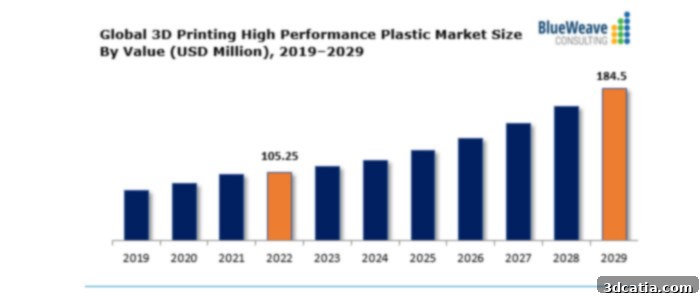
Photo Credits: BlueWeave Consulting
BlueWeave’s Market Segmentation: A Deep Dive into HPP Categories
BlueWeave Consulting’s comprehensive study meticulously segments the high-performance polymer 3D printing market, focusing on several key material categories. These include Polyamide, Polyetherimide (PEI), Polyether Ether Ketone (PEEK), and various reinforced HPPs. The analysis further considers these materials in their diverse forms—whether as filaments for Fused Deposition Modeling (FDM), granules for pellet extrusion, or powders for Selective Laser Sintering (SLS) and Multi Jet Fusion (MJF). The research specifically scrutinizes extrusion-based additive manufacturing and laser sintering technologies, identifying their respective roles in processing these advanced polymers.
Polyamide: Market Leader and Versatile Performer
Among the material categories examined, polyamides, commonly known as nylons, currently command the largest market share. This dominance is not unexpected, primarily due to their relative ease of printing compared to other HPPs and their widespread adoption across various industries. Polyamides strike an excellent balance between mechanical properties, processability, and cost-effectiveness, making them an attractive choice for many additive manufacturing applications. Their versatility makes them ideal for use in powder bed fusion machines, such as SLS and MJF, which are currently experiencing a significant boom within the additive manufacturing landscape. These technologies enable the production of complex geometries with excellent surface finish and mechanical properties, making polyamides a go-to material for functional prototypes and end-use parts.
The polyamide family is particularly favored in the medical sector, where biocompatibility, sterilization capabilities, and durability are paramount. They are extensively used to produce a wide array of medical devices, including custom prostheses and orthoses, surgical instruments, and specialized tooling. Beyond medical applications, polyamides find significant utility in automotive prototyping, consumer goods, and industrial components where good strength, flexibility, and impact resistance are required. Their continuous development, including fiber-reinforced variants, further enhances their suitability for even more demanding roles.
PEI (Polyetherimide): The Future Growth Leader
While polyamides hold the current largest market share, BlueWeave Consulting’s report forecasts that Polyetherimide (PEI) will lead the market in terms of rapid growth. PEI is a high-performance thermoplastic renowned for its exceptional properties, making it an increasingly popular choice for critical applications. Key attributes of PEI include superior heat and flame resistance, inherent strength, and impressive durability. It also offers an attractive strength-to-weight ratio, making it a compelling alternative to metals in scenarios where weight reduction is crucial without compromising structural integrity.
Furthermore, PEI boasts excellent dimensional stability, ensuring that printed parts retain their shape and accuracy even under varying environmental conditions or mechanical stress. These characteristics position PEI as a material of choice in highly demanding sectors such as aerospace, automotive, and railway. In aerospace, PEI is used for lightweight interior components, ducts, and structural elements. In automotive, it is vital for under-the-hood components, electrical connectors, and fluid handling systems that require high heat resistance and chemical inertness. For the railway sector, PEI’s flame retardancy and strength are critical for safety-related parts. These industries, which were significantly impacted by the recent health crisis, have shown robust signs of recovery over the past several months, with PEI playing a pivotal role in their resurgence and innovation efforts through advanced additive manufacturing.
PEEK (Polyether Ether Ketone): The Ultimate Performance Frontier
Polyether Ether Ketone (PEEK) represents the apex of high-performance thermoplastics, offering an unparalleled combination of properties that make it indispensable for the most extreme applications. Although it presents significant challenges in 3D printing due to its extremely high melting point and processing temperatures, the benefits it delivers are unmatched. PEEK is characterized by its exceptional thermal stability, allowing it to maintain its mechanical properties at very high continuous operating temperatures. It also exhibits outstanding chemical resistance, making it suitable for environments exposed to aggressive fluids and solvents.
Beyond thermal and chemical resistance, PEEK offers excellent mechanical properties, including high strength, stiffness, and creep resistance, even under elevated temperatures. Its inherent wear resistance and low friction coefficient further expand its utility in dynamic applications. Moreover, PEEK is biocompatible and can be sterilized, which makes it a preferred material for medical implants (e.g., spinal cages, cranial plates) and surgical instruments. In the aerospace sector, PEEK is utilized for critical structural components, engine parts, and electrical connectors. The oil & gas industry benefits from PEEK’s resistance to harsh chemicals and high pressures for seals, valves, and downhole tools. The ability to 3D print PEEK opens doors for highly customized, complex, and lightweight components that were previously unachievable with traditional manufacturing methods, solidifying its status as a cornerstone of advanced additive manufacturing.
Reinforced HPPs: Enhancing Mechanical Performance
The study also highlights the growing importance of reinforced high-performance polymers. By incorporating reinforcing fibers such as carbon fiber or glass fiber, the mechanical properties of HPPs can be significantly enhanced. These composite materials offer increased stiffness, strength-to-weight ratio, and improved dimensional stability, allowing them to replace metal components in even more demanding applications. Reinforced HPPs are particularly valuable in industries where light weighting and structural integrity are paramount, such as high-performance automotive parts, advanced aerospace components, and robust industrial tooling. The synergy between HPPs and advanced reinforcing agents is pushing the boundaries of what is possible with additive manufacturing, enabling parts with tailored properties to meet specific engineering challenges.
Key Market Drivers and Regional Insights
The growth of the high-performance polymer 3D printing market is propelled by several potent factors. Prominently, North America is identified as a key driver, with particular emphasis on the increasing demand for sophisticated automotive components. The study elaborates on the factors contributing to this regional growth:
A rise in the standard of living, as well as new automobile technologies, are a few of the factors driving the market in the United States. The 3D printing high-performance plastic market industry in the United States has been significantly strong for a few years, and it is expected to grow further during the projected period due to rising consumer demand in the automotive hub.
This quote underscores the interplay between economic development, technological innovation, and consumer demand. As living standards improve, so does the expectation for advanced, fuel-efficient, and safer vehicles. The rapid evolution of automobile technologies, including electric vehicles (EVs), autonomous driving systems, and lightweighting initiatives, creates an insatiable demand for materials that can deliver superior performance while reducing weight and complexity. High-performance polymers, especially when 3D printed, offer unparalleled design freedom and material properties that are perfectly suited to meet these evolving requirements. The robust automotive manufacturing base in the United States, coupled with its strong research and development ecosystem, positions it as a significant catalyst for the HPP 3D printing market.
The Road Ahead: Future Outlook and Continuous Innovation
The future trajectory of the high-performance polymer 3D printing market is closely intertwined with the ongoing evolution of the automotive industry and other critical sectors. As manufacturers continue to push the boundaries of design and performance, the demand for advanced materials capable of addressing complex engineering challenges will only intensify. While challenges remain, such as the high cost of certain HPP materials, the need for specialized and often expensive 3D printing equipment, and the complexity of process optimization, continuous innovation is rapidly addressing these hurdles. New material formulations, more user-friendly machinery, and enhanced software are making HPP 3D printing more accessible and efficient.
The BlueWeave Consulting report paints a clear picture of a market poised for substantial and sustained growth. The unique combination of superior material properties, coupled with the design freedom and manufacturing flexibility offered by additive manufacturing, positions high-performance polymers as indispensable for the next generation of industrial applications. As industries continue to embrace customization, lightweighting, and on-demand manufacturing, the role of HPPs in driving innovation will only expand.
In conclusion, the high-performance polymer 3D printing market is experiencing a significant surge, driven by technological advancements, increasing demand from critical industries, and a robust recovery from global disruptions. The insights from BlueWeave Consulting highlight the pivotal roles of materials like Polyamide, PEI, and PEEK in shaping the future of additive manufacturing. This expansion promises to unlock new possibilities for engineers and designers, enabling the creation of components that redefine performance standards across various sectors.
You can find more detailed information and comprehensive data in the full study by BlueWeave Consulting HERE.
What are your thoughts on the burgeoning growth of the high-performance polymer market in 3D printing? Share your insights and comments below or connect with us on ourLinkedIn,Facebook, andTwitter pages! Don’t miss out on the latest advancements in additive manufacturing—sign up for our free weeklyNewsletter here to get the freshest 3D printing news delivered straight to your inbox! You can also explore all our informative videos on our dedicatedYouTube channel.
*Cover Photo Credits: Stasskol