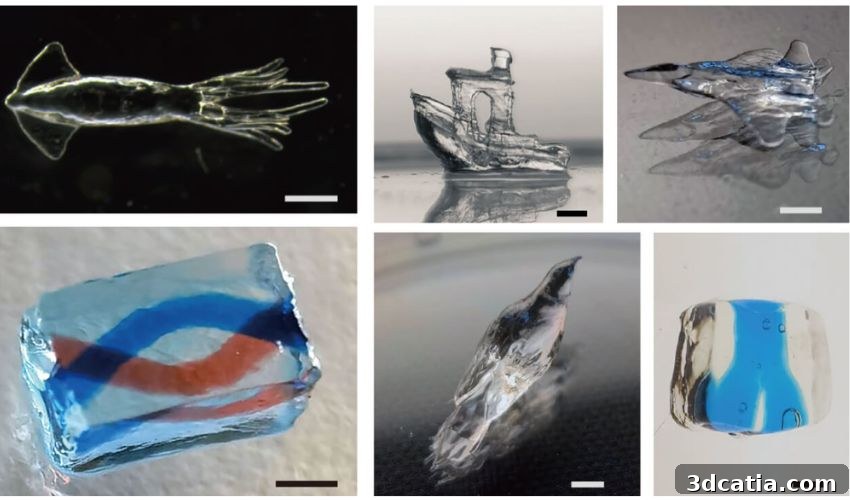
One of the founding ideas of additive manufacturing is building objects layer by layer. Volumetric 3D printing challenges that assumption. Instead of stacking slices, volumetric methods cure an entire object simultaneously inside a vat of photosensitive resin, producing three-dimensional forms in a single step rather than as a sequence of layers.
Introduced in 2019 with research on computed axial lithography, volumetric 3D printing is still an evolving field. Most implementations remain in research labs and early-stage companies, but progress is accelerating. The technology’s potential—ultra-fast production, high-resolution results without visible layer lines, and reduced need for support structures—has attracted interest across industries, including bioprinting, optics, microfluidics, and rapid prototyping.
Below are six noteworthy volumetric 3D printing projects from universities and funded research programs that illustrate how the technology has advanced recently. These initiatives highlight innovations in speed, predictability, biocompatibility, and open access to computed axial lithography (CAL) techniques.
DISH at Tsinghua University: Sub-Second Printing with a Rotating Light Field
Researchers at Tsinghua University developed DISH (digital incoherent synthesis of holographic light fields), a volumetric printing approach that rotates the light field instead of the resin or print. Using a high-speed rotating periscope to project holographically shaped patterns from a 405 nm laser, DISH cures complex millimeter-scale objects in a stationary bath of resin.
The team reported printing intricate structures in as little as 0.6 seconds at 19-micrometer resolution over a 1 cm depth range, achieving a volume printing rate of 333 mm³/s. Because the method does not require spinning the print, it works with thinner resins than many traditional volumetric systems, improving sharpness and detail. DISH has been demonstrated across engineering plastics, photonic devices, and bioprinting scaffolds, indicating potential for both industrial and biomedical applications as the technique matures.
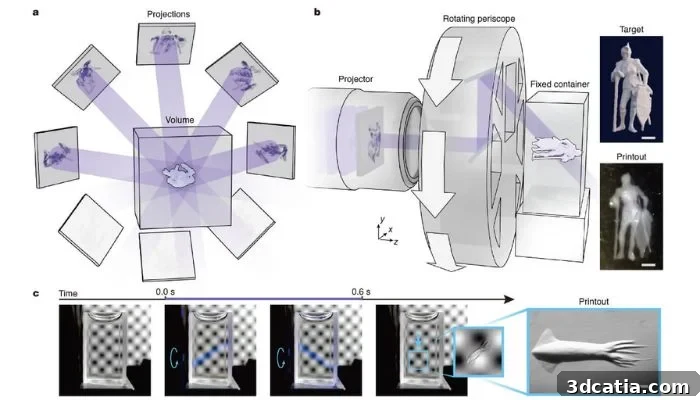
Image Credit: Tsinghua University
MTV at TU Eindhoven: Modeling Volumetric Printing for Predictability
Speed is a hallmark of volumetric printing, but predictability remains a challenge. The MTV project (Multiphysics Modelling of Tomographic Volumetric Additive Manufacturing Processes for Predictive Product Properties) brings together the Materials Innovation Institute, Eindhoven University of Technology, and imaging specialists to develop computational models and software tools that forecast print outcomes.
Funded through a Dutch strategic program, the initiative aims to replace trial-and-error workflows with reliable simulations that account for material behavior, resolution, mechanical properties, and precision. By validating models with industrial use cases, MTV intends to make volumetric manufacturing more reproducible and accessible for production environments.

Image Credit: TU Eindhoven
TVAM at EPFL: Low-Power Bioprinting of a Life-Sized Ear
EPFL’s Laboratory of Applied Photonic Devices developed a volumetric bioprinting technique that reduces optical exposure by modulating the phase of laser light rather than its intensity. This holographic phase-control approach achieves equivalent sculpting precision while using dramatically less power, protecting living cells during fabrication.
With just a 150 mW laser diode, the team solidified millimeter-scale objects in seconds and centimeter-scale constructs in minutes. They demonstrated a 64 mm³ gelatin-based ear containing living human cells; after six days the cells survived and began forming organized networks. This work advances volumetric bioprinting toward applications in reconstructive medicine and tissue engineering, while ongoing research seeks sharper projection fidelity and higher cell-density capability.
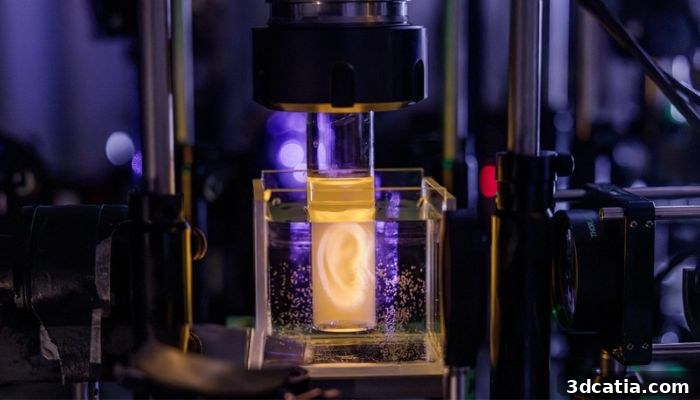
Photo Credit: EPFL
SONOCRAFT in Barcelona: Building Functional Cardiac Tissue
SONOCRAFT is a collaborative Horizon Europe project focused on producing heart tissue that mimics the structure and function of native myocardium. Coordinated by the Universitat de Barcelona and involving partners across Europe, the initiative combines volumetric printing with ultrasonic particle manipulation. Sound waves align and position cardiac cells while volumetric exposure forms the surrounding scaffold.
This integration enables centimeter-scale cardiac constructs with embedded artificial vasculature, supporting oxygen and nutrient transport—an architectural fidelity that traditional bioprinting struggles to achieve. The approach could impact tissue engineering, drug testing, and regenerative therapies for heart disease.
Bioxolography at ETH Zurich: Engineering Contractile Skeletal Muscle
Bioxolography is a high-resolution, light-based volumetric technique developed to control cell orientation during printing—critical for tissues like skeletal muscle that depend on aligned cellular architecture. An interdisciplinary consortium led by ETH Zurich is combining photochemistry, muscle physiology, tissue engineering, and machine learning to produce 3D muscle models that replicate native structure and performance.
Beyond regenerative medicine and drug screening, controllable contractile muscle constructs could contribute to bio-hybrid robotics and cultured meat production. The project aims to establish a machine learning-driven biofabrication pipeline for predictable, functional muscle actuators.
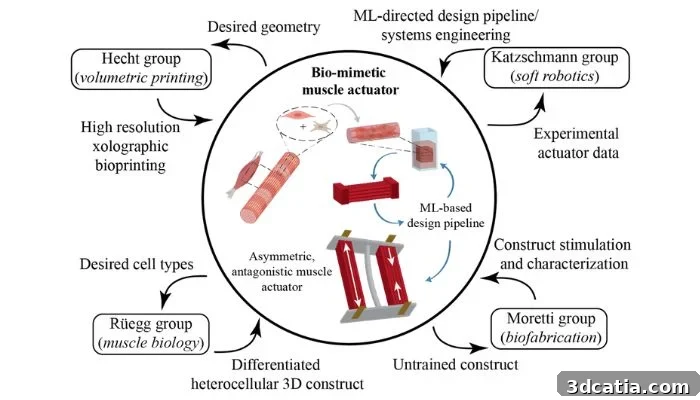
Researchers are developing a machine learning-based pipeline for controllable and contractile muscle actuators. (Image Credit: Hecht, Rüegg, Moretti, and Katzschmann).
OpenCAL: Making CAL Printing Accessible
OpenCAL is an open-source effort to democratize computed axial lithography. Launched with contributions from a large community, OpenCAL V2.0 provides build plans, installation guidance, and software for constructing a CAL-based volumetric printer. The project also collaborated with resin manufacturers to supply a ready-to-use photopolymer formula optimized for CAL, removing a major barrier for builders who otherwise would need to formulate their own chemistry.
OpenCAL acknowledges early-stage limitations—assembling and tuning a volumetric printer requires hands-on effort and iterative troubleshooting—but the fully documented project, source code, and an active community aim to make volumetric printing approachable and foster wider innovation.
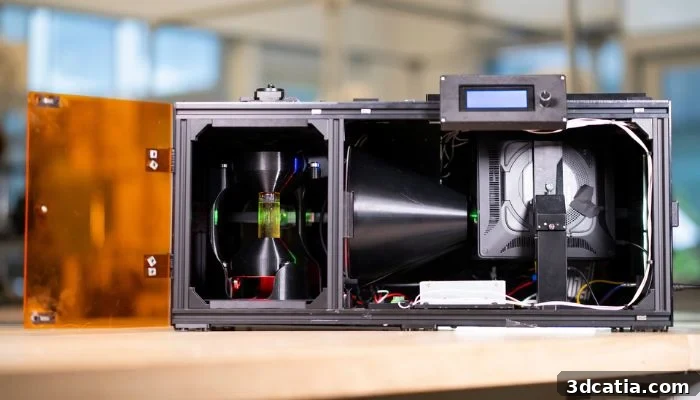
The OpenCAL V2 setup while printing. (Photo Credit: OpenCAL)
These projects illustrate the broad directions volumetric 3D printing is taking: dramatically faster fabrication, improved predictability through modeling, safer bioprinting via low-power optics, and community-driven access to CAL technology. As research continues and tools become more available, volumetric printing is poised to expand from specialized labs into practical industrial and biomedical applications.
*Cover Image: 3D printed models from Tsinghua University’s DISH project. (Photo Credit: Tsinghua University.)