

The Future of Fabrication: 8 Compelling Reasons to Choose High-Performance Polymers in Additive Manufacturing
High-performance polymers (HPPs) have long been indispensable materials in industrial sectors, primarily utilized in traditional manufacturing methods such as injection molding and machining. However, in recent years, these advanced materials have transcended their conventional roles and are now making a significant impact in the realm of additive manufacturing. Unlike conventional polymers, HPPs are characterized by a superior set of properties, including exceptional strength, remarkable wear resistance, and outstanding durability. Among the most prominent HPPs employed in modern additive processes are the polyaryletherketone (PAEK) family, which encompasses well-known polymers like PEEK and PEKK, as well as polyetherimide (PEI), widely recognized by its trade name, ULTEM.
The processing of HPPs in 3D printing continues to evolve and become more sophisticated. Their role is increasingly crucial in addressing complex real-world challenges across intricate value chains, where demands for shorter lead times and optimized costs are paramount. This article delves into eight compelling reasons why high-performance polymers are the material of choice in additive manufacturing. Our aim is to illustrate why these materials are rapidly transitioning from experimental alternatives to indispensable advanced manufacturing resources, unlocking new possibilities in various industries.
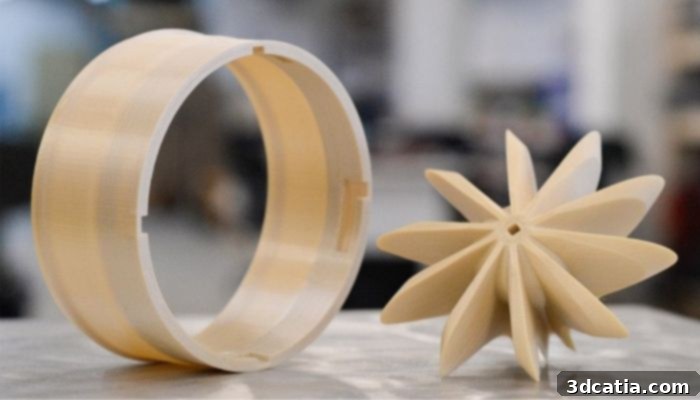
3D-printed parts in PEEK. (Photo Credit: Elecrow)
#1: Exceptional Thermal Resistance
One of the most defining characteristics of high-performance polymers is their extraordinary thermal stability, allowing them to maintain structural integrity and mechanical properties even under extreme temperature conditions. While common plastics like ABS typically begin to lose their critical mechanical properties around 90–100 °C, advanced materials such as PEEK are capable of sustained continuous use up to 250 °C and can even withstand intermittent temperature spikes exceeding 300 °C. Similarly, PEKK and PEI exhibit comparable thermal resilience, with heat deflection temperatures well above 200 °C. This makes them an unparalleled choice for applications where consistent thermal stability is non-negotiable, particularly in harsh industrial environments. Examples include crucial components situated near high-heat engines in automotive applications, or structural supports within aerospace turbines and downhole tools in the oil and gas industry, where reliability under intense heat is paramount. This robust thermal performance not only ensures operational safety but also extends the lifespan of components in demanding conditions.
The practical application of their thermal prowess is also evident in high-stakes fields like motorsports. NASCAR, for instance, has leveraged 3D printing with ULTEM™ 9085 to produce NACA ducts. These specialized components, installed on the engine’s lower panel, are expertly designed to channel and efficiently expel the significant amounts of hot air generated during intense racing conditions, preventing overheating and ensuring peak engine performance. The ability of HPPs to withstand such environments is a testament to their engineering superiority.
#2: Superior Chemical Resistance
Chemical resistance is another fundamental attribute that distinctly positions high-performance polymers above conventional materials. While many standard polymers are prone to rapid degradation when exposed to aggressive substances such as organic solvents, hydrocarbons, strong acids, bases, or industrial fluids, HPPs exhibit remarkable inertness. They consistently maintain their structural integrity and critical functionality, virtually unchanged, in environments where most thermoplastics would quickly fail or corrode. This makes them exceptionally well-suited for a diverse range of challenging applications. These include critical components in chemical engineering processes, reliable fluid transport systems for aggressive media, and essential parts for medical equipment that require rigorous chemical disinfection or sterilization protocols. Their enduring resistance ensures longevity and reliability, reducing downtime and maintenance costs in corrosive or chemically active settings.
#3: Robust Mechanical Properties
High-performance polymers are celebrated for their exceptional balance of strength, stiffness, and toughness, making them ideal for functional parts subjected to sustained and intense mechanical stress. Unlike standard thermoplastics, these advanced materials offer mechanical properties that can rival—and in some cases, even exceed—those of lightweight metals such as aluminum, but with the added advantage of significantly lower density. For example, PEEK can achieve impressive tensile strengths ranging from 90 to 100 MPa, which is notably higher than PLA’s typical 60 MPa. Beyond static strength, their fatigue resistance is a critical mechanical property, allowing HPPs to consistently maintain performance over countless cycles of loading and unloading, even under dynamic conditions and fluctuating temperatures. Furthermore, HPPs are inherently impact-resistant; a component manufactured from PEKK, for instance, can absorb sudden loads and impacts without fracturing or cracking, providing enhanced durability and safety. It is important to note that achieving the full potential of these mechanical properties often requires specific post-processing steps, such as annealing or Hot Isostatic Pressing (HIP) treatments, to relieve residual stresses, enhance layer cohesion, and maximize material density in 3D-printed parts. These post-treatments are crucial for optimizing the final component’s performance and ensuring it meets demanding application specifications.
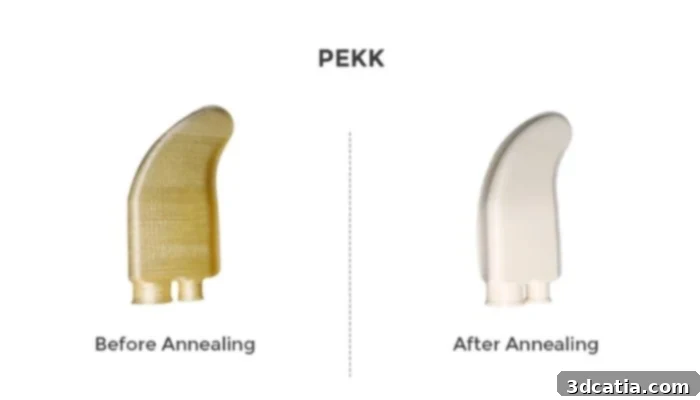
A PEKK part before and after the annealing step.
#4: Effective Metal Replacement
One of the most transformative applications emerging in additive manufacturing is the increasing use of high-performance polymers as direct replacements for traditional metal components. These materials offer an incredibly attractive alternative due to their unique combination of high chemical resistance, superior thermal stability, exceptional mechanical strength, and significantly reduced weight compared to equivalent metal parts. While the 3D printing of HPPs still presents certain processing challenges, the advantages they offer over traditional metal manufacturing are substantial. Consider the vast amounts of material waste generated by metal machining and the often prohibitive costs associated with specialized tooling, which frequently struggle to produce complex geometries or intricate internal channels. High-performance polymers circumvent these limitations, offering design freedom and material efficiency. Another critical factor is the inherent corrosion resistance of HPPs, a common and often debilitating weakness for many metals, especially in harsh operational environments. By leveraging HPPs, industries can achieve parts that are not only lighter and more complex but also more durable and resistant to environmental degradation.
It is important to acknowledge that although high-performance polymers can deliver mechanical properties comparable to certain metals, most are processed via Fused Deposition Modeling (FDM) or Fused Filament Fabrication (FFF) technologies. This processing method means that 3D-printed parts may exhibit some degree of anisotropy, with mechanical properties varying depending on layer adhesion and print orientation. This factor must be meticulously considered during the design phase for components intended for critical load-bearing applications. However, with careful design optimization and strategic print orientation, this characteristic does not limit their widespread utility but rather guides their intelligent application in engineering.
#5: Advanced Medical Compatibility
Among all the diverse applications of high-performance polymers, the medical field has arguably benefited the most profoundly from their unique and indispensable properties. In particular, PEEK is extensively recognized for its exceptional biocompatibility, signifying its safety and suitability for prolonged and intimate contact with the human body without adverse reactions. With a mechanical strength remarkably similar to that of human cortical bone, PEEK is increasingly employed in the production of custom implants, such as cranial, spinal, and orthopedic devices. These individualized implants offer numerous benefits, including reduced postoperative complications, improved patient comfort, and seamless integration with surrounding biological tissues. The 3D printing of PEEK in healthcare is rapidly gaining ground, with manufacturing procedures continually being refined and standardized. A significant milestone was achieved by 3D Systems, which last year received FDA approval for the world’s first 3D-printed VSP PEEK cranial implant, showcasing the material’s viability and safety. Furthermore, the ability to produce these sophisticated implants directly within hospitals using sterile 3D printing equipment revolutionizes point-of-care manufacturing, offering unprecedented customization and speed for urgent medical needs.
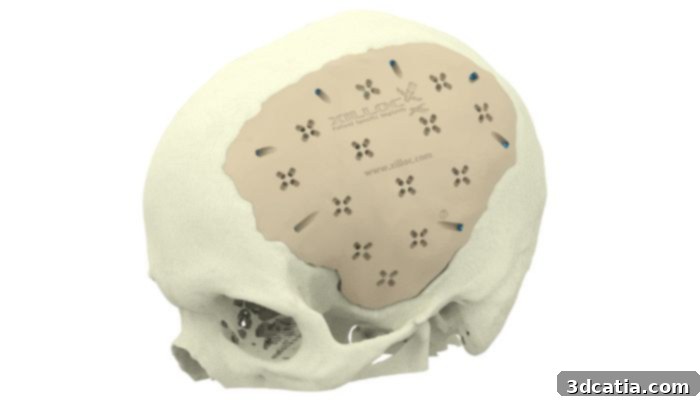
A PEEK cranial implant. (Photo Credit: Xilloc Medical)
#6: Enhanced Reinforcement Capability
High-performance polymers also offer the significant advantage of being readily reinforced with various types of fibers, such as carbon or glass fibers, which further dramatically enhances their inherent properties. This inherent versatility makes them highly adaptable and valuable across a broad spectrum of demanding industrial environments, ranging from advanced aerospace and defense applications to high-performance automotive and industrial machinery. The combination of fiber reinforcement with additive manufacturing techniques unlocks advanced design strategies previously unattainable. For instance, engineers can precisely align continuous fibers along specific load directions within a 3D-printed part, meticulously optimizing its mechanical performance for targeted stresses. This capability results in components with unparalleled strength-to-weight ratios, increased stiffness, improved creep resistance, and enhanced dimensional stability, pushing the boundaries of what is possible in lightweight, high-performance engineering.
#7: Unprecedented Design Freedom for Critical Applications
The true transformative value of high-performance polymers in 3D printing is most evident in their ability to enable and optimize critical applications, where the failure of any material could lead to severe consequences concerning safety, financial costs, or operational continuity. Through the precision and flexibility of 3D printing, HPPs not only consistently meet stringent performance requirements but also facilitate the creation of complex geometries and innovative designs that would be utterly impossible to achieve using traditional manufacturing methods for these very same polymers. Their ability to produce intricate, optimized structures makes them especially valued for developing advanced applications in highly regulated and demanding sectors such as aerospace, automotive, and rail industries, where performance and reliability are paramount.
The widespread adoption of HPPs in these critical sectors is further bolstered by the fact that many of these advanced materials hold stringent international certifications. These certifications provide robust assurance of their reliability and safety in the most demanding operational environments. For example, ULTEM™ 9085 is certified to meet FAR 25.853 standards, which dictate requirements for flammability, smoke emission, and toxicity (FST) in aircraft interiors, as mandated by both the Federal Aviation Administration (FAA) and the European Aviation Safety Agency (EASA). Similarly, PEEK is extensively approved by the FDA and ASTM for its safe and effective use in implantable medical devices and surgical instrumentation, highlighting its trusted status in life-critical applications.
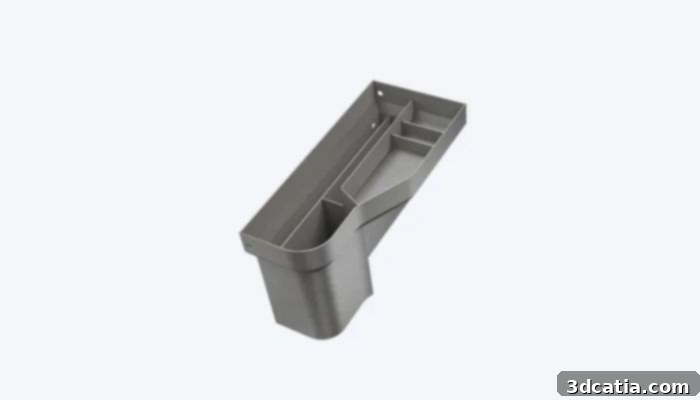
A 3D printed aircraft interior part made from ULTEM. (Photo Credit: Roboze)
#8: Optimal Balance of Weight and Performance
Finally, high-performance polymers deliver an optimal and often unparalleled balance between lightweight construction and superior technical performance. Unlike many metals, which, despite their strength, possess inherently high densities, HPPs can provide comparable mechanical properties in a multitude of cases while simultaneously reducing component weight by an impressive margin—up to 70 percent—when compared to equivalent parts manufactured from lightweight alloys such as aluminum. In industries like aerospace, this weight reduction advantage is not just beneficial but absolutely critical; cutting even a single kilogram from an aircraft’s total weight can translate into significant fuel savings, potentially thousands of liters over the aircraft’s operational lifetime, leading to substantial cost reductions and environmental benefits. Similarly, in automotive and motorsports, lighter components enhance vehicle agility, improve fuel efficiency, and contribute to higher overall performance. This unique combination of strength and low density makes HPPs a game-changer for applications where every gram counts and performance cannot be compromised.
Do you already incorporate high-performance thermoplastics into your additive manufacturing processes? We invite you to share your experiences and insights in a comment below or connect with us on our LinkedIn or Facebook pages! Furthermore, don’t miss out on the latest advancements in 3D printing by signing up for our free weekly Newsletter, delivered directly to your inbox. You can also discover a wealth of educational and informative content by visiting our YouTube channel.
*Cover Photo Credit: VESTAKEEP