
Revolutionizing Manufacturing: HRL Labs’ Breakthrough in 3D Printing High-Strength Aluminum Alloys
The idea of hopping on a plane for a direct flight from London to Sydney, without layovers or soggy sandwiches, might sound like a distant dream. Currently, our technological limitations often dictate lengthy, multi-leg journeys, leaving travelers exhausted and disillusioned. A significant hurdle in achieving truly long-range, efficient travel has been the weight and structural complexity of aircraft, largely due to the materials and manufacturing processes involved. But what if a revolutionary advancement in materials science could fundamentally change how we build everything, from aeroplanes to automobiles?
HRL Laboratories, a joint venture between General Motors and Boeing, has achieved just such a breakthrough: a pioneering method to reliably 3D print high-strength aluminum alloys. This innovation not only promises to transform the aerospace industry but also holds immense potential across numerous sectors, paving the way for lighter, stronger, and more efficient designs than ever before imaginable. By overcoming long-standing challenges in metal additive manufacturing, HRL Labs is heralding a new era where the impossible becomes achievable.
Current Challenges in Aircraft Manufacturing
Modern aircraft are engineering marvels, yet their construction is surprisingly conventional in many respects. Thousands upon thousands of small metal rivets and fasteners are meticulously used to assemble aircraft fuselages and wings. This labor-intensive process is a direct consequence of a fundamental material challenge: aluminum alloys, the backbone of aerospace construction due to their excellent strength-to-weight ratio, have historically been considered unweldable using traditional methods. The conventional welding of these alloys frequently results in a critical flaw known as “hot-cracking” – a metallurgical phenomenon where cracks form in the weld as it solidifies, severely compromising structural integrity.
This reliance on mechanical fasteners adds considerable weight, complexity, and manufacturing costs to aircraft. Each rivet represents a potential point of failure, requiring meticulous inspection and maintenance. Furthermore, the sheer number of parts increases assembly time and limits design freedom, preventing engineers from creating truly optimized, lightweight structures that additive manufacturing could enable. These limitations ultimately translate to heavier planes, higher fuel consumption, increased operational costs for airlines, and subsequently, higher ticket prices and longer, less convenient travel experiences for passengers. The impact isn’t just felt by a hungry traveler stuck in a bustling airport during a long layover; it affects the entire ecosystem of global transport and contributes significantly to environmental concerns related to aviation’s carbon footprint.
The video below illustrates the innovative alloys-creating process that is set to redefine possibilities in advanced manufacturing:
HRL’s Game-Changing Innovation: Overcoming Hot Cracking
The research team at HRL Laboratories in Malibu has engineered a sophisticated method that circumvents the long-standing problem of hot-cracking during the additive manufacturing of aluminum alloys. By pioneering a specific approach to 3D print these notoriously challenging materials, they have successfully managed to print two commonly used, high-strength, yet lightweight aluminum alloys: 7075 and 6061. These alloys are celebrated for their exceptional properties but have historically resisted advanced welding and 3D printing techniques due to their inherent susceptibility to “hot-cracking”.
This achievement is monumental because it unlocks the full potential of additive manufacturing for critical structural components. Where traditional methods relied on complex multi-part assemblies joined by thousands of fasteners, HRL’s innovation allows for the creation of single, monolithic structures directly from a 3D model. This capability significantly reduces material waste, simplifies supply chains, and opens up unprecedented opportunities for design optimization that were previously impossible with conventional manufacturing processes. The ability to directly print these robust alloys with such reliability represents a seismic shift in materials science and engineering, promising to redefine the manufacturing landscape.
The Science Behind Nano-Coating: A Closer Look
The core of HRL’s breakthrough lies in an ingenious technique involving nano-coating. The researchers discovered that by coating the raw metal powder particles with specially selected nanoparticles, they could fundamentally alter the solidification behavior of the molten alloy during the 3D printing process. Specifically, these nanoparticles serve as nucleation sites, influencing the microstructure of the material as it cools and solidifies layer by layer.
When the intense laser (in a process like selective laser melting or electron beam melting) melts the coated aluminum powder, the molten alloy flows and then solidifies around the pattern established by these embedded nanoparticles. This controlled solidification process effectively negates the conditions that typically lead to hot-cracking in aluminum alloys. By promoting a finer, more uniform grain structure and preventing the formation of susceptible liquid films at grain boundaries, the nano-coating ensures the integrity and strength of the printed part. This precise control at the nanoscale is what enables the reliable production of complex geometries with the desired mechanical properties, setting a new benchmark for additive manufacturing of difficult-to-process metals.
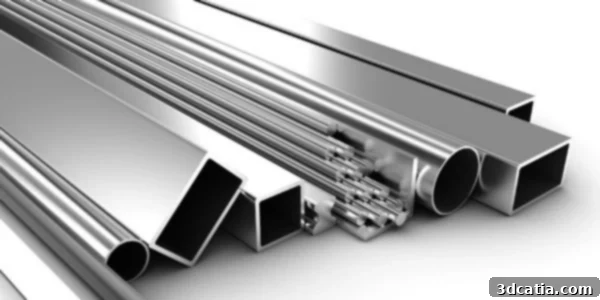
Lightweight, strong aluminum alloys enabling more efficient and reliable air travel.
Transforming the Skies: Impact on Aviation
The ability to reliably 3D print high-strength aluminum alloys has profound implications for the aerospace industry. The most immediate and significant impact is the potential for significantly lighter aircraft. By replacing multi-component assemblies held together by rivets with single, geometrically optimized 3D-printed parts, designers can drastically reduce the overall weight of an aeroplane. This reduction in weight translates into a cascade of benefits:
- Extended Range and Direct Flights: Lighter planes require less fuel to achieve the same range, meaning they can fly for longer distances without needing to refuel. This directly addresses the problem of inconvenient layovers, making direct long-haul flights from the UK to Australia, for instance, a more feasible reality. Passengers will enjoy shorter travel times and a much more comfortable journey.
- Enhanced Fuel Efficiency and Environmental Benefits: Reduced weight directly correlates with lower fuel consumption. This not only results in substantial cost savings for airlines but also leads to a significant reduction in carbon emissions and other pollutants. As the aviation industry strives for greater sustainability, 3D printed lightweight components offer a powerful tool to achieve ambitious environmental targets.
- New Design Possibilities: Additive manufacturing excels at creating complex, organic geometries that are impossible to produce with traditional methods. Engineers can now design parts that are optimized for maximum strength with minimal material, incorporating internal lattice structures or topological optimizations that further reduce weight while enhancing performance. This design freedom could lead to entirely new aircraft architectures that are more aerodynamic and efficient.
- Simplified Manufacturing and Supply Chains: Printing complex parts as a single unit eliminates the need for numerous individual components, fasteners, and their associated assembly processes. This streamlines manufacturing, reduces lead times, minimizes waste, and simplifies the supply chain, leading to significant cost reductions and improved production efficiency.
- Improved Safety and Durability: 3D printed parts, especially when designed with optimal internal structures, can exhibit superior fatigue resistance and overall durability compared to riveted assemblies. The reduction in the number of joints and fasteners inherently minimizes potential failure points, contributing to enhanced aircraft safety and reduced maintenance requirements.
Beyond Aerospace: Widespread Industrial Applications
While the immediate excitement often centers on aviation, the implications of HRL’s breakthrough extend far beyond the skies. The ability to 3D print high-strength aluminum alloys with precision and reliability is a game-changer for a multitude of other sectors:
- Automotive Industry: Lighter vehicles translate directly to better fuel economy (for internal combustion engines), increased range (for electric vehicles), and improved performance characteristics. Complex, topologically optimized parts can be integrated into chassis, suspension systems, and engine components, pushing the boundaries of vehicle design and efficiency.
- Defense Sector: Military applications demand materials that are both lightweight and incredibly robust. 3D printed aluminum alloys can be used for aerospace components in military aircraft, naval vessels, armored vehicles, and even soldier gear, providing enhanced protection, reduced logistical burdens, and improved operational capabilities.
- Space Exploration: Every gram saved is crucial for space missions. Rockets, satellites, and extraterrestrial landers can benefit immensely from lightweight, high-strength aluminum components, allowing for larger payloads, greater scientific instrumentation, and extended mission durations at reduced launch costs.
- Manufacturing and Tooling: Custom jigs, fixtures, and specialized tools can be rapidly prototyped and produced with complex geometries and integrated functionalities, leading to more efficient production lines and reduced downtime.
- Medical Devices: While not directly for implants, 3D printing of high-strength, lightweight materials could be explored for external prosthetics, custom orthopedic braces, or specialized medical equipment where weight and strength are critical.
This is truly only the beginning. As HRL Laboratories continues to refine its techniques and explore new material combinations, the scope of applications will undoubtedly grow, touching nearly every industry that relies on advanced metal components.
A Glimpse into Tomorrow: The Future of Additive Manufacturing
The success with aluminum alloys opens the door to even more ambitious goals. In the future, researchers anticipate being able to further improve these techniques to create and reliably 3D print a wider array of even more complex and challenging metal alloys, such as nickel-based superalloys, advanced steels, and titanium alloys. Each of these materials presents its own unique set of metallurgical challenges, but the foundational principles established by HRL’s work could provide a roadmap for overcoming them.
The continued advancement of additive manufacturing, coupled with breakthroughs in materials science like nano-coating, promises a future where design limitations are significantly minimized. Imagine fully functional components, or even entire product assemblies, emerging from a 3D printer, perfectly optimized for performance, weight, and durability, with minimal waste and unprecedented speed. This vision extends beyond mere parts; it points towards a paradigm shift in how we conceive, design, and produce everything around us.
The integration of artificial intelligence and machine learning will further accelerate this progress, enabling the rapid design and optimization of complex structures and the precise control of printing parameters to achieve desired material properties. As we move forward, the “age of stale turkey sandwiches in airports” is indeed nearing its end, replaced by an era of innovation where 3D printed planes, cars, and countless other products offer superior performance, sustainability, and convenience.
Conclusion: Soaring Towards a Lighter, Brighter Future
HRL Laboratories’ breakthrough in 3D printing high-strength aluminum alloys marks a pivotal moment in materials science and manufacturing. By ingeniously leveraging nano-coating technology to prevent hot-cracking, they have unlocked the reliable additive manufacturing of materials crucial for lightweight, high-performance applications. The profound impact on aerospace, enabling lighter, more fuel-efficient, and longer-range aircraft, is just one facet of this monumental achievement.
The ripple effect will be felt across diverse industries, from automotive to defense and space exploration, driving innovation and sustainability. As this technology matures and expands to encompass even more complex metal alloys, we stand on the precipice of a manufacturing revolution. The future promises not only cheaper and more convenient travel but also a world built with greater efficiency, less waste, and unparalleled design freedom. The age of 3D-printed possibilities has truly dawned.
Have any opinions on the future of aircraft due to 3D printing, or the broader implications of this materials science breakthrough? We’d love to hear your thoughts! Let us know in a comment below or join the conversation on our Facebook and Twitter pages! Don’t forget to sign up for our free Newsletter to get all the latest news in 3D printing straight to your inbox!