
Revolutionizing Lupus Treatment: How 3D Printing Creates Personalized Light-Sensing Medical Devices
In a testament to its transformative power, 3D printing continues to emerge as a pivotal technology for addressing complex challenges within the medical field. This innovative manufacturing method allows for the creation of highly customized and intricate devices, pushing the boundaries of what’s possible in patient care. A remarkable recent example comes from the University of Minnesota Twin Cities, where a collaborative team of engineers and medical doctors leveraged 3D printing to develop a groundbreaking light-sensing medical device. This cutting-edge technology holds immense promise for individuals living with Lupus, a chronic and often debilitating autoimmune disorder. Designed to be worn directly on the skin, the device offers real-time feedback, enabling a precise correlation between an individual’s light exposure and the occurrence of disease flare-ups. This capability is expected to revolutionize how doctors approach Lupus management, paving the way for significantly more personalized treatments and informed patient guidance, ultimately improving the quality of life for millions worldwide.
Lupus, medically known as Systemic Lupus Erythematosus (SLE), is a complex autoimmune disorder where the body’s immune system mistakenly attacks its own healthy tissues and organs. Unlike a healthy immune response that targets foreign invaders, Lupus causes the immune system to produce autoantibodies that lead to widespread inflammation and tissue damage throughout the body. According to credible sources such as the Mayo Clinic, the resulting chronic inflammation can affect virtually any body system, including the joints, skin, kidneys, blood cells, brain, heart, and lungs. The symptoms of Lupus are incredibly varied and often mimic those of other conditions, making it notoriously difficult to diagnose. Furthermore, treating Lupus presents a significant challenge because no two cases are exactly alike; each patient experiences a unique combination of symptoms, severity, and triggers. With the Lupus Foundation of America estimating that 1.5 million Americans and at least 5 million people globally contend with some form of the disease, the urgent need for innovative diagnostic tools and personalized treatment approaches is undeniably critical. Current treatments often involve immunosuppressants and anti-inflammatory drugs, which can have significant side effects and don’t always address the specific triggers for each patient’s flares.

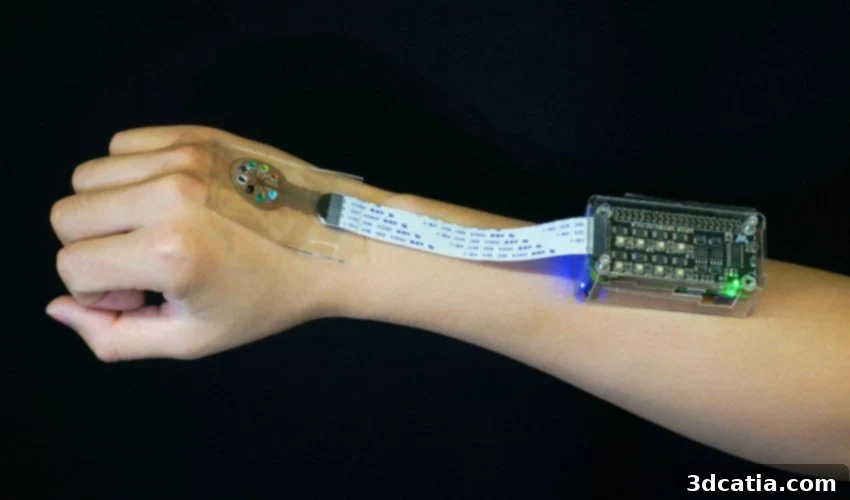
Initial results from the tests have been promising, showcasing the potential of this 3D printed device (photo credits: University of Minnesota)
Recognizing the profound variability of Lupus and the critical role of environmental factors, the researchers intentionally harnessed 3D printing to create highly customized devices. This bespoke approach is essential for delivering personalized treatments, a cornerstone of modern medicine, particularly for conditions as heterogeneous as Lupus. A well-established characteristic of Lupus is its propensity to provoke light sensitivity, with symptoms often worsening significantly upon exposure to ultraviolet (UV) radiation, whether from natural sunlight or artificial light sources. Understanding this crucial link, the research team embarked on developing a device capable of precisely tracking and correlating an individual’s light exposure with the manifestation of their specific Lupus symptoms. Dr. David Pearson, a distinguished dermatologist at the University of Michigan Medical School and a co-author of this groundbreaking study, articulated the profound importance of this research. He commented, “I treat a lot of patients with lupus or related diseases, and clinically, it is challenging to predict when patients’ symptoms are going to flare. We know that ultraviolet light and, in some cases visible light, can cause flares of symptoms—both on their skin, as well as internally—but we don’t always know what combinations of light wavelengths are contributing to the symptoms.” This highlights a significant gap in current clinical practice, where generalized advice often replaces precise, patient-specific data, making the new 3D printed device a potential game-changer for proactive disease management.
3D Printing a Revolutionary Device to Help Lupus Sufferers
The comprehensive findings of this innovative project are meticulously detailed in a prominent research article published in *Advanced Sciences*, titled “3D Printed Skin-Interfaced UV-Visible Hybrid Photodetectors.” While the specific 3D printing technology employed for fabrication is not explicitly mentioned in the initial summary, the success of the device undoubtedly stems from the advanced capabilities inherent in additive manufacturing. Dr. Pearson’s visionary approach was significantly inspired by the burgeoning field of customized 3D printed wearable devices, a domain where his colleague, Michael McAlpine, from the U of M College of Science and Engineering, had already made considerable advancements. This synergistic collaboration led to McAlpine joining Pearson as a co-author on the paper, bringing together diverse expertise from both engineering and dermatology. Their research group embarked on developing a truly pioneering 3D printed device featuring a flexible UV-visible light detector. This highly sensitive detector was then seamlessly integrated with a custom-built portable console, creating a cohesive system capable of continuous, real-time monitoring of an individual’s light exposure. The brilliance of this design lies in its ability to not only measure light but also to correlate those measurements directly with physiological reactions and Lupus symptoms, providing invaluable data for both patients and clinicians. The device itself is ingeniously constructed from multiple layers of biocompatible materials, ensuring safe and comfortable contact with the skin. Its intricate design incorporates a flexible silicone base, along with precisely placed electrodes and specialized optical filters. These filters are crucial for differentiating between various light wavelengths, allowing for a detailed analysis of which specific parts of the light spectrum might be contributing to a patient’s flare-ups, thereby moving beyond generic light avoidance strategies.
Beyond the unparalleled ability to personalize the device to each patient’s unique anatomical contours and sensitivity profiles, embracing 3D printing yielded a multitude of other significant benefits for this medical breakthrough. One of the most striking advantages is the relatively rapid turnaround time compared to traditional manufacturing methods. This speed is crucial for iterative design processes in research and development, allowing engineers and doctors to quickly test, refine, and improve prototypes. Furthermore, 3D printing significantly reduces the cost associated with producing complex, custom geometries. Unlike conventional manufacturing, which often requires expensive molds and tooling, additive manufacturing can produce unique parts directly from digital designs, leading to substantial cost savings, particularly for low-volume, highly specialized medical devices. These combined factors—speed, cost-effectiveness, and customization—are fundamental to the researchers’ ambition for widespread adoption. They envision a future where these devices are easily accessible, providing quick and convenient diagnostic and monitoring tools for Lupus treatment in clinics and even homes globally. The potential for rapid fabrication means that personalized care could become a reality for many more patients, circumventing the logistical and financial barriers typically associated with highly specialized medical equipment. The research team has already achieved a significant milestone, having received crucial approval to initiate testing of the device on human subjects. With plans to begin enrolling participants in the study imminently, the scientific community eagerly anticipates the results, which could usher in a new era of precision medicine for autoimmune disorders.
Dr. Pearson’s concluding remarks eloquently capture the revolutionary potential of this 3D printed device, painting a vivid picture of the future of patient-centric healthcare. He states, “There is no other device like this right now with this potential for personalization and such easy fabrication. The dream would be to have one of these 3D printers right in my office. I could see a patient and assess what light wavelengths we want to evaluate. Then I could just print it off for the patient and give it to them. It could be 100 percent personalized to their needs. That’s where the future of medicine is going.” This vision underscores a profound shift from a one-size-fits-all approach to medicine to an era of hyper-personalized care. The ability to fabricate a custom device on demand, tailored precisely to an individual patient’s unique skin geometry and specific light sensitivity, represents an unprecedented leap in managing chronic conditions like Lupus. Imagine a scenario where a dermatologist can diagnose specific light triggers in real-time, then immediately print a wearable sensor that accurately monitors and alerts the patient to those precise light exposures. This not only empowers patients with actionable data but also allows for highly targeted interventions, potentially preventing painful and debilitating flare-ups before they occur. This level of immediate, individualized customization, made possible by advancements in 3D printing and integrated biosensor technology, truly embodies the trajectory of modern medicine towards more effective, predictive, and patient-centered solutions. It highlights how technological innovation can directly translate into tangible improvements in patient quality of life and clinical outcomes, setting a new standard for medical device development.
What are your thoughts on the groundbreaking use of 3D printing to create a device that promises to significantly improve Lupus treatment and personalized care? We invite you to share your perspectives and comments below, or engage with us on our LinkedIn, Facebook, and Twitter pages! Don’t miss out on the latest advancements and news in additive manufacturing—be sure to sign up for our free weekly Newsletter here, delivering the most important 3D printing news directly to your inbox! You can also find all our insightful videos and interviews on our dedicated YouTube channel, offering a visual dive into the world of 3D printing innovation.
*Cover Photo Credits: ISM / Medical Images