
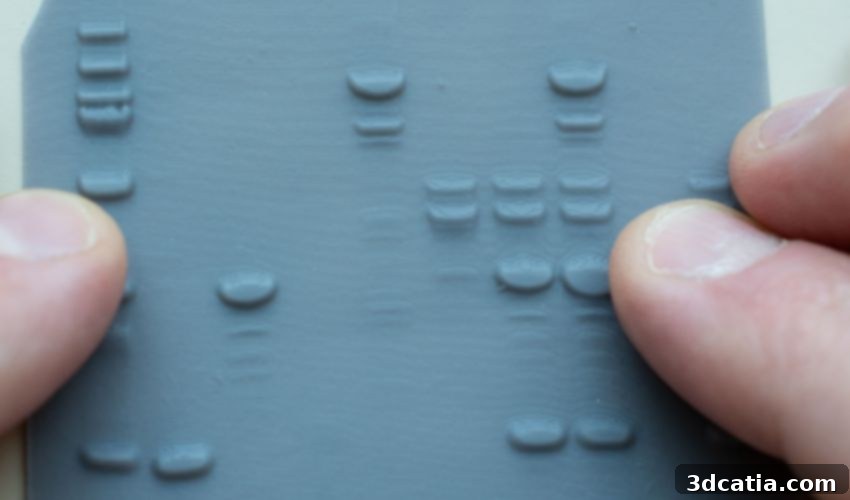
Empowering Blind Scientists: How 3D Printing and Tactile Lithophanes Revolutionize Scientific Data Accessibility
Accessibility in academia has long been a critical, yet often unaddressed, challenge for individuals with disabilities. While the fundamental right to equal opportunities in education and professional life is widely recognized, the implementation of adequate accommodations often falls short. This systemic oversight can create significant barriers, particularly for those with visual impairments, who are frequently excluded from fields like science that heavily rely on visual data interpretation. However, a groundbreaking study from Baylor University is poised to change this narrative, demonstrating how the innovative combination of 3D printing and an ancient art form can unlock scientific data for blind scientists, paving the way for a truly inclusive future in chemistry and beyond.
The research, aptly titled “Data for all: Tactile graphics that light up with picture-perfect resolution,” was published in the prestigious journal Science Advances. It details how Baylor researchers successfully leveraged 3D printing technology to transform conventional two-dimensional scientific images and data into tactile, three-dimensional lithophanes. This ingenious approach makes complex datasets not only perceivable but also profoundly interpretable by touch, thereby dismantling long-standing barriers that have historically prevented individuals with blindness from fully participating in and pursuing chemistry education and research.
Understanding Lithophanes: From Ancient Art to Modern Science
To truly appreciate the innovation of the Baylor study, it’s essential to understand the medium they employed: lithophanes. Lithographs, the two-dimensional precursors to lithophanes, originated in China as early as the sixth century, evolving into intricate artistic mediums. Lithophanes themselves rose to prominence in Europe during the 19th century as a captivating art form. At their core, lithophanes are thin, translucent engravings crafted from materials like porcelain, wax, or in this modern context, photopolymer resin. What makes them so unique is their optical property: they appear opaque and unremarkable in ambient light, but when illuminated from behind by a light source, they reveal a luminous, detailed image. This phenomenon occurs because the varying thicknesses of the translucent material scatter light differently; thinner regions allow more light to pass through, appearing brighter, while thicker regions absorb more light, rendering them darker. The interplay of light and shadow, dictated by the material’s topography, creates a stunning, picture-perfect resolution.
While lithophanes have a rich history in decorative arts, their application in scientific data visualization is entirely novel. The Baylor study marks the very first time this ancient artistic medium has been adapted and integrated into scientific methodology. By combining the inherent tactile nature of a lithophane’s varying thicknesses with the precision of modern 3D printing, researchers have created graphics that allow individuals, regardless of their visual acuity, to universally visualize and interpret the exact same piece of data. This fusion of art, history, and cutting-edge technology presents a powerful solution for scientific inclusivity.
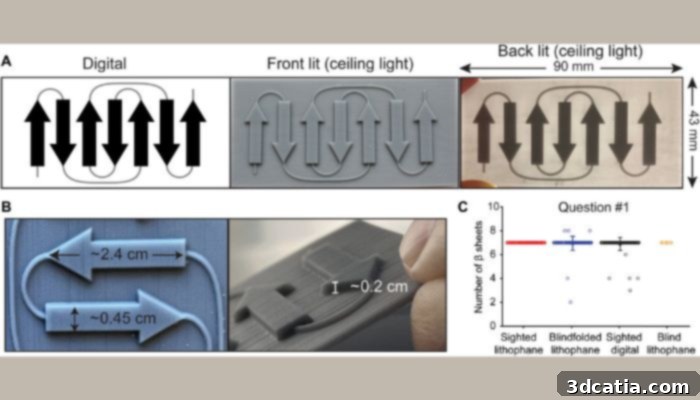
A representation of the steps going from the digital representation of the data all through to the printed lithograph and then the results from all participants (photo credits: Baylor University)
Dr. Bryan Shaw, a distinguished professor of chemistry and biochemistry and a corresponding author on the study, eloquently articulates the profound significance of this interdisciplinary breakthrough. He remarks, “This research is an example of art making science more accessible and inclusive. Art is rescuing science from itself. The data and imagery of science – for example, the stunning images coming out from the new Webb telescope – are inaccessible to people who are blind. We show, however, that thin translucent tactile graphics, called lithophanes, can make all of this imagery accessible to everyone regardless of eyesight. As we like to say, ‘data for all.’” This powerful statement underscores the transformative potential of blending creative disciplines with scientific rigor to foster an environment where knowledge truly knows no visual bounds.
Unveiling the Success: How Blind and Sighted Participants Interpreted Tactile Data
Remarkable Accuracy and the Power of Tactile Interpretation
The true test of the lithophanes’ efficacy came through rigorous testing involving both blind and sighted participants. The study aimed to assess the accuracy of data interpretation, either through touch (tactile interpretation) or eyesight (visual interpretation of back-lit lithophanes). The results were not just promising; they were truly groundbreaking, challenging conventional assumptions about how scientific data must be perceived. The overall accuracy across all participants, combining both methods, hovered around an impressive 79%. However, the accuracy rates soared even higher when focusing specifically on the blind participants, highlighting their exceptional ability to interpret complex data through touch alone.
For blind participants, the average test accuracy for interpreting the five different lithophanes tactually reached an astonishing 96.7%. This figure is not only remarkable on its own but also stands favorably against the 92.2% accuracy achieved by sighted participants when visually interpreting the back-lit lithophanes. Furthermore, when sighted participants were blindfolded to simulate a tactile-only experience, their interpretation accuracy was 79.8%. While this was slightly lower than that of the blind participants, it still represents a significant success, indicating that the lithophane design is inherently effective for tactile exploration, even for those not accustomed to it. This compelling data demonstrates unequivocally that blind individuals can achieve a level of data comprehension that is not merely comparable to, but in many cases, superior to visual interpretation when equipped with the right tools.
3D Printing: The Key to Precision and Cost-Effectiveness
The success of these tactile lithophanes is inextricably linked to the advanced capabilities of modern 3D printing technology. Specifically, the researchers utilized a small commercial Form 3B+ printer from Formlabs. This choice of resin 3D printing (Stereolithography or SLA) was crucial because it offers unparalleled precision and detail, which are absolutely essential for creating tactile graphics that accurately represent complex scientific data. Unlike other 3D printing methods, resin-based additive manufacturing allows for the creation of extremely fine features and smooth surface finishes, which are critical for nuanced tactile perception.
Each lithophane in the study was meticulously printed at an impressive resolution of 100 μm (micrometers) using a gray photopolymer resin. This high resolution ensured that even the most intricate variations in data were accurately translated into distinct tactile contours, providing blind participants with a truly faithful and interpretable representation of the scientific information. The choice of 3D printing also brings a significant advantage in terms of cost-effectiveness and replicability. The Formlabs printer used in the study costs under $5000, making this an accessible and relatively easy-to-replicate project for other universities, research institutions, and even schools. This affordability is a critical factor in scaling this innovation and ensuring its widespread adoption, making accessible science a tangible reality rather than an aspirational goal.
Paving the Way for a Truly Inclusive STEM Future
The implications of the Baylor study extend far beyond the laboratory, offering a beacon of hope for a more inclusive future in science, technology, engineering, and mathematics (STEM). Historically, the visually driven nature of STEM fields has posed significant, often insurmountable, challenges for individuals with vision impairments. Textbooks, lab experiments, data visualizations, and professional presentations are predominantly designed for sighted individuals, leading to systemic exclusion and limited career opportunities for blind scientists.
This breakthrough with 3D-printed tactile lithophanes directly addresses this core issue. Imagine chemistry students with vision impairments being able to “feel” the nuances of molecular structures, protein folding, or reaction kinetics through tactile representations that are as accurate and informative as their visual counterparts. Consider researchers who can independently analyze complex spectroscopic data or microscopic images, gaining insights previously only accessible through sight. This technology has the potential to transform STEM education, making curricula truly accessible and engaging for blind students from an early age, fostering their interest and talent in scientific disciplines.
Moreover, the scalability and affordability of this approach mean that it is not a niche solution but a practical, implementable one. Universities and research institutions can relatively easily acquire the necessary 3D printing equipment and integrate this methodology into their existing frameworks. This could lead to a cascade of innovations, where scientific data across various disciplines—from astronomy (as Dr. Shaw mentioned with Webb telescope imagery) to biology, physics, and geology—can be translated into tactile formats, broadening the participation and contributions of visually impaired individuals in critical scientific discourse and discovery.
Dashnaw, a contributing researcher to the study, encapsulates the profound impact of this work with inspiring clarity: “Most of the research I do on a daily basis won’t have a significant impact on the scientific community. However, the lithophane project allows for real change in real time. We are making STEM more accessible to people with vision impairment and calling attention to their systemic exclusion.” This sentiment powerfully underscores the study’s dual achievement: providing an immediate, practical solution for accessibility and shining a critical light on the historical biases that have marginalized an entire demographic from scientific pursuits. This is not just an academic exercise; it is a catalyst for genuine societal transformation.
The full study is available for download HERE, offering deeper insights into the methodology and findings. This research stands as a testament to human ingenuity and the power of technology when applied with a purpose: to build a more equitable and inclusive world for all. By embracing such innovations, we move closer to a future where every individual, regardless of their physical abilities, has the opportunity to explore, understand, and contribute to the vast and wondrous realm of scientific knowledge.
What are your thoughts on this incredible use of 3D printing and lithophanes to create tactile graphics, empowering blind scientists to interpret complex data? We invite you to share your perspective in the comments section below or engage with us on our LinkedIn, Facebook, and Twitter pages! Don’t forget to sign up for our free weekly Newsletter here to receive the latest 3D printing news directly in your inbox. You can also find all our videos and further content on our YouTube channel.
*Cover Photo Credits: Baylor University