
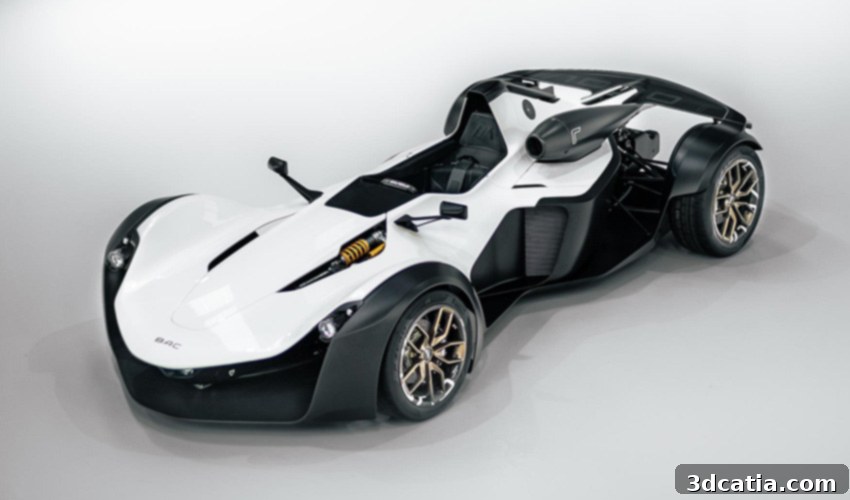
BAC Mono R: Driving Supercar Innovation with Advanced 3D Printing Technology
In the dynamic and highly competitive automotive industry, additive manufacturing, commonly known as 3D printing, has profoundly transformed traditional development and production processes. Initially embraced primarily for rapid prototyping and the creation of specialized tooling applications, its role has significantly expanded. Car manufacturers routinely leverage 3D printing to produce high-fidelity prototypes, allowing for meticulous verification of form, fit, and functionality long before committing to expensive production molds. Beyond prototyping, the technology facilitates the creation of cost-effective manufacturing aids, such as custom grips, jigs, and fixtures, which are indispensable during the intricate assembly phases of vehicle production. However, the true game-changer has been its accelerating adoption in the direct production of series and highly customised end-use parts. This trend is particularly pronounced within the elite segments of motorsports and luxury vehicles, where the demands for performance, lightweighting, and bespoke components are paramount. Additive manufacturing empowers engineers to design and produce complex, specific vehicle components that are not only tailor-made but also incredibly lightweight – a critical advantage where even marginal improvements in vehicle performance can justify the investment. Consequently, a rapidly increasing number of leading automotive players are strategically investing in diverse 3D printing technologies, eager to harness their multifaceted benefits across the entire product lifecycle.
Leading this charge in the UK is Briggs Automotive Company (BAC), the renowned British manufacturer celebrated for its iconic single-seater supercars, the BAC Mono and BAC Mono R. BAC has formally announced its deepened commitment to and continued integration of 3D printing into its advanced manufacturing processes. To achieve this seamless integration, the company has forged a strategic partnership with 3DGBIRE, a leading professional 3D printing expert based in the UK, and is leveraging the cutting-edge capabilities of Ultimaker 3D printers. Founded in 2009, BAC has consistently pushed the boundaries of automotive engineering, with its Mono and Mono R supercars renowned globally for their unparalleled performance and distinctive, sculptural aesthetics. These ultra-luxury, high-performance vehicles are conceptualized not merely as products but as canvases for unparalleled customer personalization. This bespoke approach makes additive manufacturing an absolutely perfect fit, enabling BAC to deliver unique, custom-engineered solutions that meet the exacting specifications and desires of their discerning clientele, while simultaneously enhancing vehicle dynamics and efficiency.
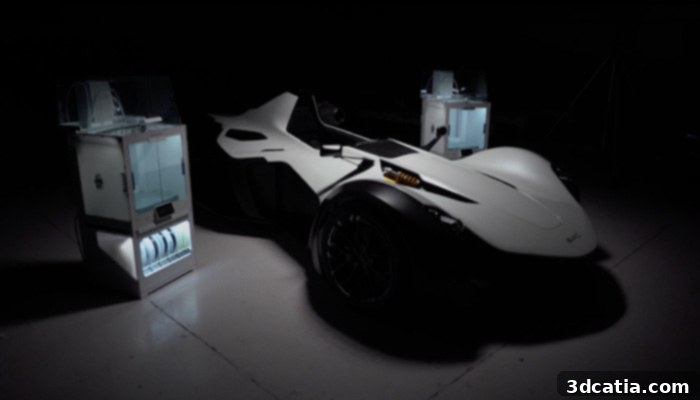
BAC, 3DGBIRE and Ultimaker made 40 3D printed parts for the Mono R supercar
The collaborative efforts of BAC, 3DGBIRE, and Ultimaker represent a significant investment in the future of supercar manufacturing. Their joint objective is to create an array of higher-performance, ultra-lightweight, and more technologically advanced parts specifically for the groundbreaking Mono R supercar. A primary goal behind this strategic move was to drastically reduce the notoriously long design-to-manufacture timeframes associated with complex geometrical components, while simultaneously bringing critical production capabilities in-house. This not only streamlines BAC’s operational efficiency but also enhances its control over quality and innovation. Daniel Abram, General Manager at 3DGBIRE, articulated the profound impact of this adoption in more detail: “The introduction of 3D printing into the car production process has proven to be beneficial at numerous stages. From crucial R&D and rapid prototyping, to the creation of essential manufacturing aids, and ultimately, to the direct production of high-performance end-use parts, 3D printing is unequivocally saving businesses like BAC significant capital and dramatically slashing lead times. This transformative technology empowers companies to innovate faster, react quicker to design changes, and achieve production efficiencies that were previously unattainable through conventional manufacturing methods.” This holistic integration underscores the versatility and value proposition of additive manufacturing across the entire product development and manufacturing pipeline for high-performance automotive applications.
A fundamental and critical step in the successful integration and widespread adoption of any advanced technology within a manufacturing environment is the judicious investment in the right system. For BAC, given the expansive variety of parts they intended to produce – ranging from initial conceptual prototypes to durable, high-performance end-use components destined for a supercar – the logical choice was to adopt a highly versatile 3D printing technology. After careful consideration, BAC and 3DGBIRE announced their selection of the Ultimaker S5 FFF 3D printers. This particular choice was driven by the S5’s reputation for reliability, precision, and most importantly, its open material system. Material selection emerged as one of the paramount considerations for BAC, as supercar components demand specific mechanical, thermal, and aesthetic properties. Ultimaker’s Open Source Material Alliance perfectly aligned with BAC’s stringent requirements. This extensive alliance, which proudly boasts a network of over 80 contributors worldwide, is dedicated to expanding the Ultimaker platform with an incredibly broad spectrum of industrial-grade 3D printing materials. This open approach provides BAC with unparalleled flexibility, allowing them to experiment with and utilize a diverse range of filaments optimized for strength, heat resistance, lightweighting, and specific surface finishes, ensuring each 3D printed part meets the rigorous demands of a high-performance vehicle like the Mono R.
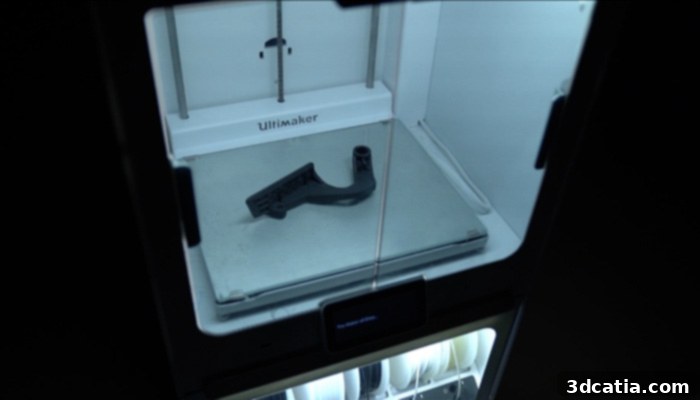
Ultimaker’s S5 FFF 3D printer
3DGBIRE, acting as a pivotal partner, not only supplies advanced 3D printers but also provides invaluable support, training, and expertise within the burgeoning 3D printing market. Their deep understanding of additive manufacturing systems played a crucial role in advising BAC on the optimal manufacturing system for creating bespoke vehicle parts. Adam Mughal, Lead 3D Designer at Briggs Automotive Company, enthusiastically shared his experience: “It’s been absolutely fantastic. The ability to create a design and have a physical, test-ready part in a matter of hours is truly game-changing for BAC. This unprecedented speed allows us to iterate designs rapidly, test new concepts with incredible agility, and accelerate our development cycles like never before. We are already integrating this technology across all facets of our production, from initial R&D and iterative prototyping to the creation of essential manufacturing aids and, crucially, the direct production of high-quality end-use parts. The impact on cost savings for particular components has also been monumental; for instance, the conventional cost price of our wing mirrors used to be an estimated £60 per unit. Now, with 3D printing, we can produce them efficiently in two parts for a total cost of just £10. This dramatic reduction in cost, coupled with enhanced design freedom and manufacturing speed, highlights how 3D printing has genuinely been a revelation for us at BAC, redefining what’s possible in supercar manufacturing.” The ability to produce such critical components in-house, quickly and affordably, provides BAC with a significant competitive edge in the ultra-luxury automotive market.
In a testament to the technology’s effectiveness, BAC proudly revealed that, for its Mono R vehicle alone, a total of 40 distinct parts have been successfully 3D printed. These include, but are not limited to, the intricate front and rear light surrounds, ergonomically designed mirror arms and their aerodynamic mirror housings, precision-engineered front hatch hinges, the robust front hatch latch mechanism, and various complex engine inlet components. Each of these parts benefits immensely from the inherent advantages of additive manufacturing, such as design optimization for lightweighting, the creation of internal lattice structures for strength, and the ability to produce highly complex geometries that would be cost-prohibitive or impossible with traditional methods. The collective benefits of integrating 3D printing into their workflow are undeniable: reduced weight contributes directly to the Mono R’s blistering performance and agile handling, while custom aesthetics enhance the vehicle’s unique appeal. Furthermore, the speed of iteration allows for continuous improvement and rapid response to design challenges. As this innovative partnership between BAC, 3DGBIRE, and Ultimaker continues to evolve, we eagerly anticipate the new capabilities and revolutionary advancements that additive manufacturing will undoubtedly offer to the broader automotive industry. Its potential to redefine vehicle design, performance, and personalization is only just beginning to unfold. You can find more information about 3D printing in automotive applications HERE.
What are your thoughts on the groundbreaking BAC Mono R and its strategic embrace of advanced 3D printing technologies? We invite you to share your insights and opinions by leaving a comment below, or join the conversation on our vibrant Facebook and Twitter pages! For all the latest news, innovations, and developments in the exciting world of 3D printing, don’t forget to sign up for our complimentary weekly Newsletter, delivering cutting-edge information directly to your inbox!