
3D-Printed Surgical Table: Revolutionizing Healthcare with Affordable, Open-Source Medical Equipment
In a groundbreaking advancement for medical technology, researchers from North American University, a collaborative effort between the University of Western Ontario (Western) and Michigan Technological University (Michigan Tech), have successfully developed a fully functional 3D-printed surgical table. This innovative project leveraged open-source hardware principles, resulting in a robust medical application produced at an astonishingly low cost – a mere fraction of what traditional surgical tables command. This achievement not only highlights the transformative power of additive manufacturing but also paves the way for democratizing access to essential healthcare equipment globally, particularly in resource-limited regions.
The exorbitant cost of medical equipment is a well-documented challenge facing healthcare systems worldwide. From advanced diagnostic tools to basic surgical instruments, prices often reach figures that are prohibitive for many institutions, especially in developing nations. The surgical table market in North America alone exceeded an impressive $456 million in 2021, and projections indicate continued significant growth in the coming years. This hefty market value is hardly surprising when considering that a single, conventionally manufactured surgical table can cost upwards of $250,000. Such steep expenses directly impact patient care, as healthcare providers in less affluent countries frequently struggle to acquire the necessary equipment, leading to inadequate treatment and avoidable health disparities.
Recognizing this critical need for more affordable and accessible medical solutions, the research teams from Western and Michigan Tech turned to additive manufacturing, more commonly known as 3D printing. This technology has, in recent years, proven its immense potential across numerous industries as a powerful alternative to traditional manufacturing methods. Its benefits are multifold: enabling faster production cycles, drastically reducing manufacturing costs, and promoting more sustainable practices through optimized material use and on-demand fabrication. For the medical sector, 3D printing offers unparalleled opportunities for customization, rapid prototyping of devices, and the creation of complex geometries that are difficult or impossible to achieve with conventional techniques. By harnessing these capabilities, the researchers aimed to design a surgical table that would be both high-quality and economically viable, thereby addressing a significant barrier to equitable healthcare.
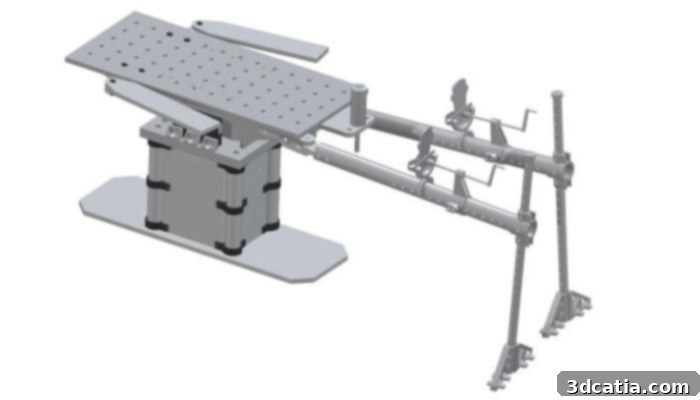
Model of the 3D-printed surgical table (photo credits: Western University)
Innovating the Surgical Fracture Table Through 3D Printing
The success of this project hinged on strategic decision-making regarding the manufacturing process. After extensive deliberation, the research team opted to utilize an open-source desktop 3D printer for the fabrication of the necessary components. This choice was deliberate, reflecting the project’s core philosophy of affordability and accessibility. Using an open-source printer not only kept initial equipment costs minimal but also ensures that the manufacturing process can be replicated and adopted by virtually anyone with access to similar hardware, significantly lowering the barrier to entry for producing critical medical devices. The entire printing process, from component fabrication to final assembly, was completed in just over a week, demonstrating the efficiency and speed that additive manufacturing brings to device development.
The culmination of this effort was a fully functional surgical fracture table, produced at an astonishingly low cost of approximately $4,000. When juxtaposed with the standard market price of up to $250,000 for a commercial equivalent, this represents an astounding 98.5% reduction in cost. This dramatic price difference is not merely a number; it signifies a paradigm shift in the potential for medical equipment procurement. According to Joshua Pearce, the John M. Thompson Chair in Information Technology and Innovation at Western, a key factor in achieving this affordability was the selection of materials that are not only robust and suitable for medical applications but also widely available worldwide. This global accessibility of materials is crucial for enabling decentralized manufacturing, empowering local communities and healthcare providers to produce essential equipment on-site, reducing reliance on complex and expensive international supply chains.
The design of the 3D-printed surgical fracture table incorporates a range of features crucial for versatile and effective surgical procedures. The table’s height can be precisely adjusted from 35.5 inches to 46 inches, accommodating various patient sizes and surgical requirements. Its tilt mechanism offers a range of +/-15 degrees, allowing surgeons to position patients optimally for different operations. Furthermore, the leg height can be independently altered from 12 inches to 46 inches, providing flexibility for specific orthopedic and trauma cases. Both the arm supports and foot holder boast an impressive 180-degree range of motion, ensuring patient comfort and surgical access. The foot traction system provides a 21-inch range, vital for fracture reduction and limb positioning, while the legs can be adjusted from 55 to 120 degrees, accommodating a wide spectrum of surgical approaches.
This extensive range of adjustability makes the 3D-printed table suitable for a broad array of orthopedic procedures, from complex fracture repairs to joint replacements. Beyond specialized orthopedic use, its robust and adaptable design makes it equally ideal for general surgical procedures, providing a stable and configurable platform for various abdominal, thoracic, and vascular operations. Moreover, the table’s versatility extends to gynecological procedures and childbirth, where precise positioning and patient comfort are paramount. For developing countries, where budgets are constrained and the need for adaptable equipment is high, this multi-purpose 3D-printed surgical table offers an unparalleled and affordable alternative to highly specialized and often overpriced conventional tables, allowing healthcare facilities to perform a wider range of critical procedures with limited resources.
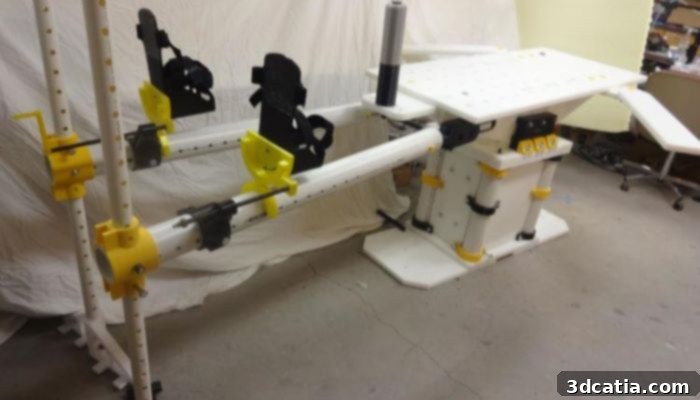
The 3D-printed table when finished (photo credits: Western University)
Joshua Pearce further elaborated on the broader vision behind this initiative, stating, “Medical technology is absurdly expensive. One way we can help reduce costs is to enable all manufacturers to build these, sell them directly, and to integrate some of the innovations, like the use of the radiolucent 3D-printed parts we made into their own designs.” This statement underscores a philosophy of open innovation and decentralization. By making the design open-source, the researchers aim to democratize access to the blueprint, empowering manufacturers worldwide – from large companies to small workshops – to produce these tables. This fosters competition, drives down prices, and accelerates innovation as different entities can contribute improvements. Pearce also highlighted the integration of innovations, such as the use of radiolucent 3D-printed parts. Radiolucent materials allow X-rays to pass through unimpeded, which is critical for intraoperative imaging without needing to move the patient or invest in specialized, often cumbersome and expensive, imaging-compatible tables. This feature alone significantly enhances the utility and safety of the table in a surgical setting.
Pearce continued, “This is in no way the final fracture table. I’m sure any decent engineer could look at it and make it a little bit better and that’s exactly what it’s meant to do – to be a starting point for other people to build on.” This embodies the spirit of open-source development: continuous improvement through community collaboration. The project serves not as a finished product to be consumed, but as a foundational design that invites further innovation, adaptation, and enhancement by engineers and medical professionals globally. This iterative approach ensures that the surgical table can evolve to meet diverse clinical needs and technological advancements over time, maximizing its long-term impact.
The genesis of this impactful project can be traced back to Western’s Frugal Biomedical Innovation Team. This dedicated team operates with a clear and compelling mission: to design, develop, test, and deploy biomedical devices specifically for communities where the need is most acute. Their primary focus is to provide sustainable and cost-effective solutions to regions grappling with underdeveloped medical infrastructure. This proactive approach to “frugal innovation” is about creating high-impact solutions with limited resources, a philosophy perfectly exemplified by the 3D-printed surgical table. By focusing on practical, affordable, and accessible technologies, the team hopes to significantly bridge the healthcare gap, ensuring that geographical or economic barriers do not prevent individuals from receiving the essential medical care they deserve. You can read more about the team and their inspiring work HERE.
This development marks a significant milestone in the convergence of additive manufacturing and global healthcare. The 3D-printed surgical table not only offers an immediate, tangible solution to the problem of expensive medical equipment but also champions an open-source model that promises to foster widespread innovation and accessibility in medical device development for years to come. It serves as a powerful testament to how smart design, collaborative research, and advanced manufacturing techniques can collectively address some of the most pressing challenges in global health, ultimately leading to better outcomes for patients worldwide.
What are your thoughts on this revolutionary 3D-printed surgical fracture table and its potential to transform healthcare? Let us know in a comment below or on our LinkedIn, Facebook, and Twitter pages! Don’t forget to sign up for our free weekly Newsletter here, the latest 3D printing news straight to your inbox! You can also find all our videos on our YouTube channel.
*Cover Photo Credits: Master Sgt. Carlotta Holley