
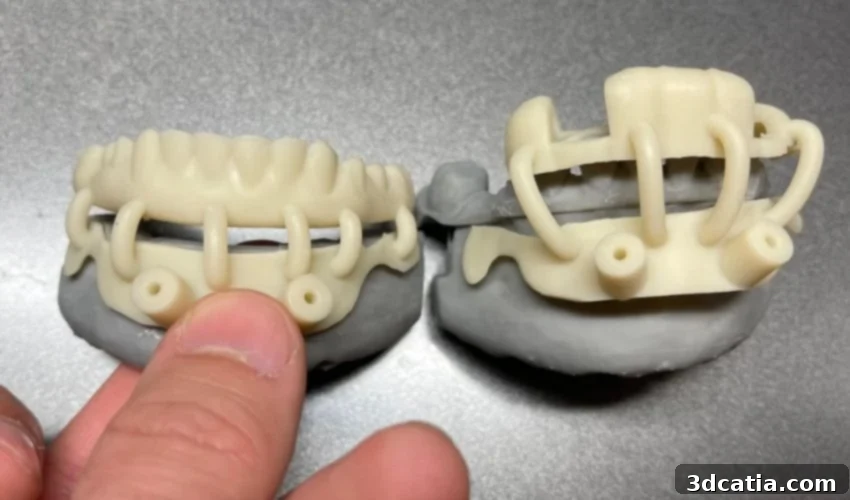
Revolutionizing Naval Healthcare: 3D Printing Transforms Emergency Dental Care for U.S. Navy Sailors
The landscape of military medical care is continually evolving, with advanced technologies playing a crucial role in enhancing the well-being and readiness of service members. A significant milestone was recently achieved in the United States Navy, demonstrating the transformative power of 3D printing. Two dedicated Sailors received emergency dental prosthetics, a procedure that has officially made military medical history. This groundbreaking application marks the first time such an advanced dental intervention, utilizing additive manufacturing, was successfully performed on Navy personnel during an active career assignment. The successful integration of 3D printing not only provided immediate relief for the affected sailors but also solidified its critical role in future naval medical operations, opening vast possibilities for broader implementation.
Dental emergencies are inherently disruptive, often arising at the most inconvenient times and locations. For individuals in active military service, particularly those deployed at sea, a severe dental issue can sideline them from critical duties, impacting both personal comfort and operational readiness. This exact scenario recently unfolded for two U.S. Navy Sailors. While on duty aboard the colossal USS Nimitz (CVN 68) and USS Theodore Roosevelt (CVN 71) aircraft carriers, they experienced dental problems that necessitated urgent and effective intervention. Traditionally, such severe issues might require extensive off-ship medical leave, a complex logistical challenge for the Navy. However, thanks to the pioneering application of additive manufacturing technologies, U.S. Navy dentists were able to swiftly and successfully address the Sailors’ failing teeth. They expertly removed the problematic structures and, with remarkable efficiency, implanted new 3D printed prosthetics, allowing both sailors to return to their assignments in a mere two weeks. This rapid recovery underscores the immense value of digital dentistry in maintaining a mission-ready force.
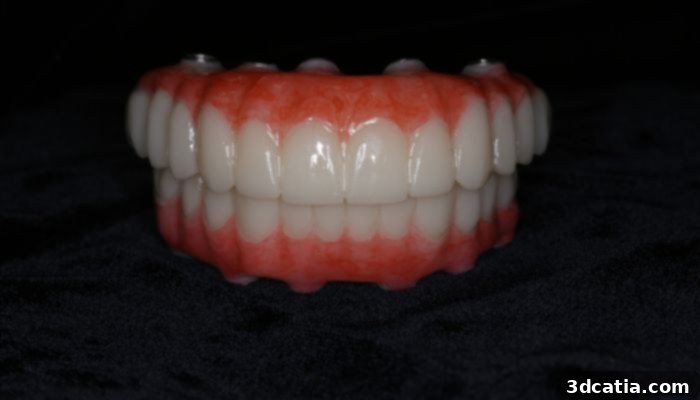
A model of 3D-printed teeth, similar to the advanced prosthetics implanted in the two Navy Sailors, showcasing the precision of digital dentistry.
The Imperative for Advanced Naval Dental Care
Ensuring the comprehensive health of its personnel is paramount for any military force, and dental health is a critical component of overall readiness. For the U.S. Navy, with thousands of sailors deployed on ships for extended periods, providing effective and timely dental care presents unique challenges. Historically, severe dental issues at sea often necessitated costly and time-consuming medical evacuations or lengthy periods of convalescence, directly impacting a ship’s operational capabilities and crew morale. The traditional process of crafting dental prosthetics, which typically involves multiple appointments, impressions, and laboratory fabrication, is ill-suited for the dynamic environment of naval deployments. Therefore, the Navy has been continuously seeking innovative solutions to provide high-quality, expedited dental care directly to its sailors, minimizing downtime and maximizing combat readiness.
The ability to diagnose and treat complex dental problems quickly and efficiently on board a vessel, or at a nearby naval facility, is not merely a convenience; it’s a strategic necessity. A sailor incapacitated by dental pain or infection cannot perform their duties effectively, creating a gap in the crew and potentially compromising missions. The recent advancements in digital dentistry, particularly 3D printing and intraoral scanning, offer a compelling answer to these challenges. By integrating these technologies, the Navy can move towards a more self-sufficient and responsive dental care model, capable of delivering custom treatments with unprecedented speed and precision, thereby ensuring that its sailors remain healthy, confident, and ready for any mission.
A Landmark Achievement: The Two Sailors’ Story
The specific cases of these two U.S. Navy Sailors highlight the profound impact of these technological advancements. Imagine the distress of facing debilitating dental issues while far from home, aboard an aircraft carrier in the middle of an ocean. For these individuals, the possibility of a prolonged period of discomfort, dietary restrictions, and the psychological burden of losing teeth was a daunting prospect. Their immediate recourse was the highly skilled dental teams accompanying them on their respective carriers. Every American aircraft carrier, which typically carries a crew of approximately six thousand active-duty Sailors, is equipped with a dedicated medical department that includes around five dentists, ready to address a range of oral health concerns.
What set these cases apart was not just the presence of dental professionals, but the cutting-edge technology at their disposal. Eight of America’s eleven aircraft carriers are now outfitted with state-of-the-art digital dental equipment, including advanced intraoral scanners. These devices provide an unparalleled level of diagnostic accuracy and treatment planning capability directly to sailors, enabling high-quality medical care even in challenging maritime environments. The rapid turnaround, allowing the sailors to return to full duty within two weeks, stands in stark contrast to conventional methods which could take months, showcasing the exceptional efficiency and effectiveness afforded by this new approach.
Revolutionizing Restorative Dentistry with Additive Manufacturing
The Role of Onboard Digital Equipment
The journey from diagnosis to a fully restored smile began with sophisticated digital imaging. Following initial dental check-ups to assess the severity of the issues, the Navy dentists utilized 3D radiographs of both patients. These advanced X-rays provide a comprehensive view of the oral anatomy, including bone structure and nerve pathways, far superior to traditional 2D images. Crucially, these 3D radiographs were then combined with precise intraoral scans of the sailors’ teeth. Intraoral scanners are handheld devices that create highly accurate 3D digital models of the teeth and gums, eliminating the need for uncomfortable physical impressions. This combination of detailed imaging allowed the dental team to meticulously plan the upcoming surgeries and precisely identify the optimal positions for the dental implants. The availability of such sophisticated equipment on board, or readily accessible, signifies a profound leap in the quality and speed of naval dental care.
Precision Planning and Rapid Production
With the detailed digital data in hand, the next phase involved advanced computer-aided design (CAD). The resulting surgical guides and the actual dental prostheses were digitally designed with exceptional precision, ensuring a perfect fit and optimal functionality. These digital files, representing the culmination of cutting-edge diagnostics and design, were then swiftly transmitted to the San Diego Area Dental Laboratory. This specialized facility is equipped with industrial-grade 3D printers capable of fabricating high-quality dental prosthetics from biocompatible materials. The efficiency of this digital workflow meant that the printing process could commence almost immediately upon file transfer, drastically reducing lead times. In less than two weeks, the customized 3D printed prosthetics and surgical guides were fabricated and sent back to the naval medical facility, a turnaround time that would be unthinkable with traditional methods.
The actual surgical procedure for the two Navy patients was meticulously finalized at the Naval Hospital Bremerton, Washington. Here, skilled dentists employed the state-of-the-art “all-on-4” method. This innovative prosthodontics procedure involves the application of fixed prostheses by strategically placing four dental implants in the frontal jaw region. The “all-on-4” technique is renowned for its efficiency, stability, and ability to provide a full arch of teeth using fewer implants, which translates to a quicker recovery and robust long-term solution. The use of custom 3D printed surgical guides ensured the precise placement of these implants, minimizing invasiveness and maximizing the success rate. After a thorough two-week follow-up period to ensure proper healing and integration, both patients were cleared to return to their full duty assignments. This swift and successful recovery is a testament to the combined power of advanced surgical techniques and additive manufacturing.
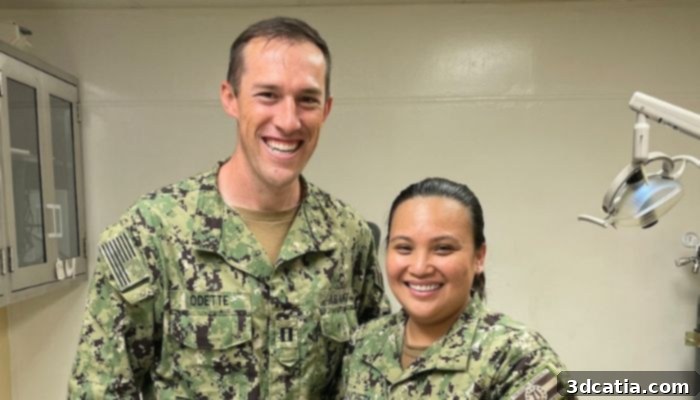
Navy Lt. Justin Odette (left), a key figure in the successful dental procedure, alongside Logistics Specialist 2nd Class Dianne Ancheta, one of the two grateful dental patients whose lives were transformed by 3D printing.
Tangible Benefits: Readiness, Morale, and Beyond
Keeping Sailors Mission-Ready
The benefits of integrating 3D printing into naval dental care extend far beyond individual patient outcomes. For the U.S. Navy, maintaining a high state of operational readiness is paramount. By significantly reducing the time required for complex dental procedures and recovery, 3D printing minimizes the need for sailors to be taken off active duty or repatriated for treatment. This directly translates to enhanced mission capability and efficiency across the fleet. Every sailor who can quickly return to their post contributes to the collective strength and effectiveness of their unit and ship. Furthermore, the ability to provide state-of-the-art care on or near deployment sites boosts logistical efficiency, reduces transportation costs, and frees up resources that would otherwise be allocated to managing complex medical evacuations.
A Brighter Future for Naval Healthcare
The successful deployment of 3D printing for dental prosthetics is just the tip of the iceberg for its potential applications in military medicine. This achievement paves the way for a broader adoption of additive manufacturing to create a wide array of customized medical devices, surgical instruments, and even battlefield prosthetics on demand. Imagine a scenario where a field medic could 3D print a customized splint or a life-saving surgical guide right where it’s needed, adapting to unpredictable circumstances with unprecedented agility. Such capabilities would revolutionize battlefield medicine, enhancing the survivability and recovery rates of injured service members. This ongoing integration of advanced manufacturing processes promises not only to improve the quality of care but also to significantly enhance the self-sufficiency and resilience of military medical operations worldwide.
The Human Impact: Restored Confidence and a New Smile
For Logistics Specialist 2nd Class Dianne Ancheta, one of the two patients, the outcome was nothing short of life-changing. Her candid testimony underscores the profound personal impact of this innovative dental solution. “I had many fears going through my mind on the possibility of anything failing and having to wear dentures,” Ancheta shared, articulating a common apprehension among patients facing significant tooth loss. Her relief and joy were palpable as she recounted her experience: “The surgery process was good, and I had zero pain in my mouth. I returned to work two weeks after the surgery and have been at work to include two underway periods. I have my confidence back for the first time in six years. I have my smile back.” This powerful statement transcends the technical achievement; it speaks to the restoration of an individual’s confidence, self-esteem, and quality of life, which are invaluable for any service member. Her swift return to duty, including two underway periods, directly illustrates how effectively this technology supports the Navy’s core mission.
Looking Ahead: The Expanding Horizon of 3D Printing in the Military
The successful use of 3D printing for emergency dental prosthetics within the U.S. Navy represents a pivotal moment in military healthcare. It demonstrates not only the immediate benefits of rapid, customized treatment for individual sailors but also foreshadows a future where additive manufacturing is an indispensable tool across various medical disciplines in the armed forces. From creating custom orthopedic implants to fabricating essential medical supplies and even tailoring personal protective equipment, the potential applications are vast and exciting. This initiative exemplifies how embracing technological innovation can lead to enhanced operational readiness, improved soldier welfare, and a more resilient and adaptable military medical system capable of meeting the evolving demands of modern warfare and global deployments. The U.S. Navy’s commitment to leveraging these advancements ensures its personnel receive the best possible care, wherever their duties may take them.
What are your thoughts on the groundbreaking use of 3D printing technologies to address critical dental issues in the Navy? Do you believe this pioneering approach will inspire similar innovations across other branches of military medicine or civilian healthcare? Let us know your perspective in a comment below or join the discussion on our LinkedIn, Facebook, and Twitter pages! Don’t forget to sign up for our free weekly Newsletter here to get the latest 3D printing news delivered straight to your inbox! You can also find all our compelling videos on our YouTube channel.
All Photo Credits: U.S. Navy