

The Future of Eyewear: How 3D Printing and Additive Manufacturing Are Revolutionizing the Industry
The global eyewear market, a behemoth worth over $100 billion annually, is on the cusp of a significant transformation, driven by the innovative capabilities of additive manufacturing, commonly known as 3D printing. A recent deep dive by the respected industry analysis firm, SmarTech Analysis, into this burgeoning sector highlights a future where bespoke designs and unparalleled personalization become the norm. Their comprehensive report, aptly titled “Markets for 3D-Printed Eyewear 2019-2028,” casts a spotlight on the accelerating adoption of 3D printing technologies within the eyewear industry, forecasting a remarkable revenue potential. According to SmarTech’s meticulous projections, the integration of additive manufacturing in eyewear is poised to generate an astounding $3.4 billion in revenues by the year 2028. This forecast underscores a pivotal shift, moving beyond traditional manufacturing methods towards a more agile, customizable, and efficient production paradigm, signaling a new era for optical fashion and functionality.
Key Drivers Fueling Growth in the 3D Printed Eyewear Market
The robust growth anticipated in the 3D printed eyewear market is not merely a technological whim but a direct response to evolving consumer demands and manufacturing advancements. At the forefront of these drivers are two powerful trends: mass customization and product personalization. Today’s consumers no longer settle for one-size-fits-all solutions; they actively seek products that resonate with their individual style, comfort preferences, and unique physical attributes. This demand for tailor-made items has already sent ripples through various consumer goods sectors, notably the footwear industry, where 3D printing has enabled everything from custom-fit insoles to uniquely designed sneaker components. The eyewear sector is following a similar trajectory, recognizing the immense potential for bespoke frame designs that cater to specific facial geometries, aesthetic preferences, and ergonomic requirements.
The conventional eyewear manufacturing process often involves a limited range of frame sizes and styles, requiring individuals to compromise on fit or aesthetics. 3D printing shatters these limitations, offering unprecedented design freedom and the ability to produce frames that are truly unique to each wearer. From intricate patterns to lightweight structures, the possibilities are virtually endless, allowing for frames that perfectly match the contours of a face, provide optimal comfort, and reflect a wearer’s personal brand. This shift is particularly impactful given the overall scale of the eyewear industry, which, as SmarTech’s data indicates, generates over $100 billion annually. Within this vast market, the trend towards tailor-made products is rapidly gaining momentum, as consumers increasingly expect and demand spectacles that offer both superior functionality and a distinct personal touch. This desire for personalized fit and style is a primary catalyst for the widespread adoption of additive manufacturing in this space, opening doors for both niche bespoke brands and large-scale manufacturers to innovate.
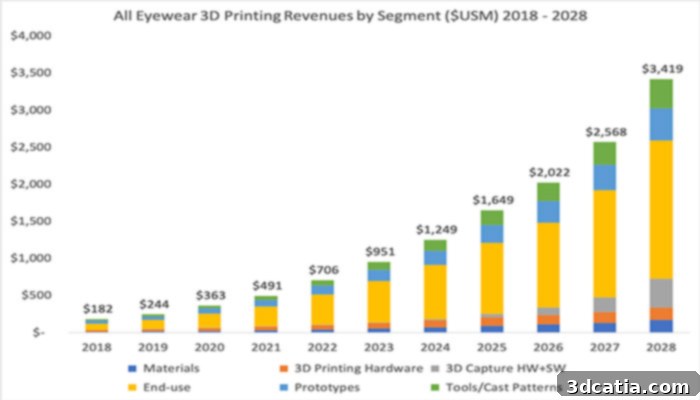
Beyond personalization, another critical growth segment is the rapid expansion of final parts production using 3D printing. While additive manufacturing has historically been associated primarily with prototyping and rapid iteration, its capabilities have evolved significantly, allowing for the direct production of high-quality, end-use components. In the context of eyewear, this means producing complete frames that are ready for assembly and retail. This segment is identified as the single most significant driver in eyewear additive manufacturing, projected to burgeon into a $1.9 billion opportunity. This represents a substantial portion of the overall $3.4 billion market forecast for 2028, highlighting the maturity and reliability of 3D printing for commercial-grade eyewear production. The ability to move directly from digital design to a finished product not only accelerates time to market but also reduces waste, minimizes tooling costs, and allows for agile adjustments in design and production volumes. This flexibility makes it an economically attractive alternative to traditional methods, enabling brands to respond quickly to market trends and minimize inventory risks, ultimately driving down costs and enhancing consumer choice.
The Advanced Technologies Powering 3D Printed Eyewear Innovation
The ascent of 3D printing in the eyewear industry is underpinned by a diverse array of 3D printing technologies, each offering unique advantages tailored to specific production needs, from rapid prototyping to high-volume final part manufacturing. For the highest level of prototyping, particularly when intricate details, visual fidelity, and multi-color capabilities are paramount, **material jetting** technologies are predominantly employed. These systems create models by jetting tiny droplets of liquid photopolymer onto a build platform and then curing them with UV light, allowing for incredibly smooth surface finishes, high resolution, and the ability to combine different material properties within a single print, ideal for concept models and detailed design validation.
However, for robust and functional final part production, **powder bed fusion** stands out as the workhorse technology. This category includes Selective Laser Sintering (SLS) and Multi Jet Fusion (MJF), which build parts layer by layer by selectively fusing powdered material (typically nylon) with a laser or thermal agent. Powder bed fusion is highly valued for its ability to produce strong, flexible, and durable frames with excellent mechanical properties, making it perfect for everyday wear. The technology also allows for nested parts within the build chamber, maximizing efficiency and minimizing material waste, which is crucial for scalable manufacturing and batch production of complex geometries.
**Vat photopolymerization**, encompassing technologies like Stereolithography (SLA) and Digital Light Processing (DLP), also plays a significant role, though often for niche applications. While capable of producing highly detailed and smooth parts, its primary use in eyewear often extends to creating patterns for lost wax casting processes, which can then be used to produce metal or other non-printable material frames with complex designs. It is also utilized for certain part production where specific aesthetic qualities, such as high transparency or incredibly smooth surfaces, are desired directly off the printer, although typically offering less durability and flexibility compared to powder-based methods for structural components.
Finally, **filament extrusion**, commonly known as Fused Deposition Modeling (FDM) or Fused Filament Fabrication (FFF), is primarily confined to basic desktop prototyping. Its accessibility and relatively low cost make it suitable for initial design iterations, conceptual models, and educational purposes. However, due to limitations in surface finish, anisotropic material properties, and structural integrity compared to other advanced AM methods, it is more rarely used for end-use internal parts or commercial eyewear products. It generally serves as an entry point for customization enthusiasts or for small-batch, non-critical components where high precision and aesthetics are not the primary concern.
The selection of materials is as crucial as the technology itself in determining the success and performance of 3D printed eyewear. **Nylon 12 (PA12)** has emerged as the primary material for the majority of polymer powder bed fusion applications in eyewear. Its exceptional balance of properties—including a high strength-to-weight ratio, excellent flexibility, superior impact resistance, and biocompatibility—makes it an ideal choice for durable, lightweight, and comfortable eyeglass frames. The inherent versatility of PA12 allows for the realization of complex geometries, intricate lattice structures, and thin-walled designs that are impossible or cost-prohibitive with traditional manufacturing, contributing significantly to both fashionable aesthetics and ergonomic comfort.
To elevate the aesthetic and tactile quality of 3D printed eyewear, manufacturers have invested heavily in developing specialized finishing processes. These crucial post-processing techniques are essential for transforming raw, often somewhat porous, 3D printed parts into premium consumer products. They aim to deliver a smoother, more refined surface finish, achieve more vibrant and consistent colors, and significantly reduce the material’s inherent porosity, which can affect both appearance and comfort. Techniques range from advanced chemical vapor smoothing and tumbling to sophisticated dyeing, painting, and coating procedures. These processes ensure that the final product not only meets but often surpasses the quality and aesthetic standards of traditionally manufactured frames, making 3D printed eyewear indistinguishable from, or even superior to, its conventionally made counterparts. These advancements in material science and post-processing are vital in bridging the gap between innovative manufacturing and consumer expectations for high-end optical products.
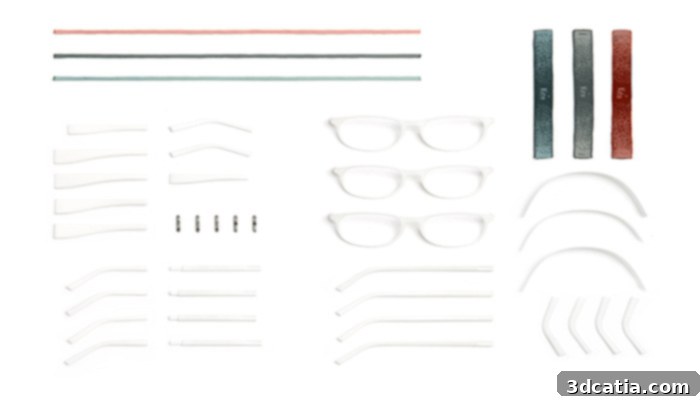
Kite offers eyewear that is 3D-printed to fit exact measurements of any face| Credits: Kite Eyewear
Despite the impressive growth trajectory, the report also acknowledges that the 3D printed eyewear segment is currently expected to account for only a relatively small fraction of the broader landscape of all 3D printed consumer products. This is largely due to the rapid expansion and higher visibility of other segments, such as the aforementioned footwear industry, which has seen substantial investment and marketing in 3D printed components like midsoles and uppers, and various design-centric products where aesthetic novelty is a primary selling point. Additionally, the eyewear market has its unique challenges, including strict regulatory requirements for medical devices (in the case of prescription eyewear), the need for high-precision optical alignment, and the deeply entrenched traditional manufacturing supply chains. However, this “small part” status should not diminish the significance of the projected $3.4 billion market. It rather underscores the enormous untapped potential and the ongoing journey of additive manufacturing to penetrate and revolutionize established consumer markets, hinting at an even larger future beyond the current forecast period.
The strategic advantages offered by 3D printing—namely, unparalleled design freedom, localized production capabilities, reduced material waste, and the ability to rapidly iterate and customize—position it as a powerful disruptor in the eyewear space. As technologies mature, materials become more diverse and affordable, and post-processing techniques continue to refine, 3D printed eyewear is set to carve out an increasingly significant niche. Brands that embrace this technology early are finding new ways to engage with consumers, offer superior products, and establish innovative business models that prioritize individuality and sustainability. The convergence of advanced scanning technologies, sophisticated design software, and state-of-the-art 3D printers is making truly personalized eyewear a commercial reality, moving beyond concept to accessible consumer product and redefining what’s possible in optical design and manufacturing.
The insights provided by SmarTech Analysis paint a clear picture: 3D printing is not just an experimental technology for the eyewear industry; it is a fundamental shift towards a future where fit, comfort, and style are inherently personal. This technological revolution promises not only to enhance the wearer experience but also to reshape the competitive landscape for manufacturers, designers, and retailers alike, fostering an era of unprecedented innovation in optical fashion and function. The coming years will undoubtedly see an accelerating adoption curve as the benefits become clearer and the technologies more integrated into mainstream production.
For more detailed information and insights, the full report can be accessed HERE.