
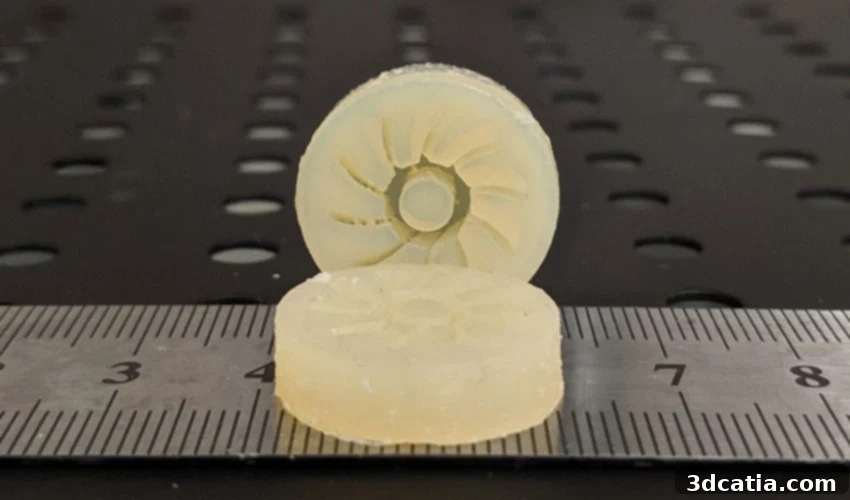
Revolutionizing Additive Manufacturing: The Breakthrough in 3D Printing with Latex
Latex, a remarkably versatile and inherently flexible material, has long been a staple across numerous industries. Derived from natural sources, it is characterized by its intricate composition of long polymer chains naturally dispersed as nanoparticles in water. Despite its widespread utility and familiarity, the integration of latex into the realm of additive manufacturing has remained a significant challenge. The unique chemical and mechanical properties required for successful 3D printing with this material have historically presented formidable barriers. However, a recent groundbreaking collaboration between a dedicated team of researchers from Virginia Tech University (VTU) and experts from Michelin North America has ushered in a new era for flexible material 3D printing. This innovative partnership has successfully developed a novel methodology for 3D printing with latex, opening vast possibilities for fabricating highly elastic and customizable components with unprecedented precision and performance.
The journey to achieving printable latex was fraught with scientific and engineering hurdles. Phil Scott, a fifth-year student working within the Long Research Group and a key member of the research team, dedicated considerable effort to synthesizing latex with the precise molecular weight and mechanical integrity necessary for additive manufacturing applications. His initial endeavors focused on utilizing liquid latex, quickly revealing the material’s inherent limitations: it was extremely brittle and proved exceptionally difficult to chemically modify without compromising its fundamental structure. This highlighted the delicate balance required to harness latex’s elasticity while ensuring its printability.
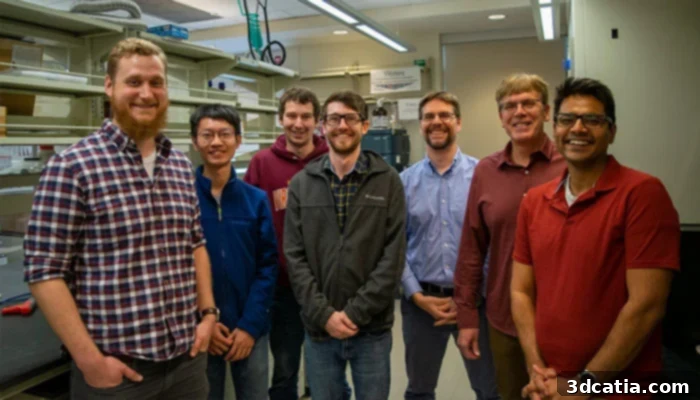
Dedicated chemists and engineers from the project’s research group. (Image credits: VTU)
The inherent instability of latex posed a significant challenge. Viswanath Meenakshisundaram, a PhD student in mechanical engineering actively contributing to the project, eloquently described this predicament: “Latex is in a Zen state. If you add something to it, it will completely lose its stability and break.” This observation underscored the difficulty in introducing chemical agents without causing the latex emulsion to coagulate or become unusable. To circumvent this critical issue, the innovative VTU team devised a ingenious solution. They employed water-soluble network precursors, commonly known as photoinitiators, to construct a tunable scaffold around the individual latex particles. This intricate scaffold system facilitated the controlled fusion of the latex particles, allowing for chemical modification without destabilizing the entire emulsion. This pioneering technique proved highly successful, leading to the creation of a specialized latex variant perfectly suited for stereolithography (SLA) – a popular additive manufacturing process that uses light to cure liquid resin into solid objects. This initial breakthrough was pivotal, transforming latex from an unprintable material into a viable resin for advanced 3D printing applications, thereby paving the way for more intricate and functional elastic structures.
Innovative Techniques for Advanced 3D Printing with Latex
Once the latex material was successfully chemically modified and rendered 3D-printable, the next hurdle involved developing a 3D printer specifically designed to handle its unique properties. Meenakshisundaram took on this challenge, meticulously developing a custom stereolithography (SLA) machine capable of light-curing the newly formulated latex resin. However, even with this purpose-built equipment, the fluid dynamics of the latex particles presented an unforeseen problem. During the UV light exposure phase, the microscopic latex particles exhibited a tendency to disperse outside the precisely projected UV light on the resin surface. This phenomenon led to significant inaccuracies in the printed parts, compromising the desired geometry and structural integrity. This issue demanded an even more sophisticated solution.
The team’s ingenuity shone through in their refinement of the printing process. To combat the resin dispersion, they integrated a high-resolution camera directly into the printer’s system. This camera was programmed to capture a real-time image of each vat of latex resin during the printing process. Leveraging a sophisticated, customized algorithm, the machine gained the remarkable ability to “see” and interpret the interaction of ultraviolet light with the resin surface. This real-time feedback loop enabled the printer to automatically and dynamically adjust printing parameters – such as UV light intensity, exposure time, or even the movement of the build platform – to precisely correct for any resin dispersion. This intelligent adjustment mechanism ensured that only the desired shape was cured, resulting in highly accurate and detailed latex components. This adaptive printing approach represents a significant leap forward in manufacturing challenging materials like latex, demonstrating how smart feedback systems can overcome inherent material limitations in additive manufacturing.
A crucial element in achieving the desired mechanical properties of the 3D-printed latex objects was the clever use of the scaffold. Meenakshisundaram further elaborated on this two-stage process: “The scaffolding gives it shape. Once you put it in the oven, the water will evaporate and the tightly wound polymer chains can relax, spread out or flow and interpenetrate the net.” This explanation illuminates the genius behind the interpenetrating polymer network (IPN) structure. Initially, the photoinitiator-driven scaffold provides the necessary structural integrity for the green (uncured) part. After the initial light curing, a post-processing step involving heat treatment in an oven plays a critical role. As the water within the latex emulsion evaporates, the previously constrained polymer chains gain the freedom to relax and move. They then spread out and interpenetrate the existing scaffold network, effectively creating a robust, interwoven structure. Meenakshisundaram vividly described this phenomenon as “catching fish in a net,” perfectly illustrating how the polymer chains become intimately entangled within the network, leading to enhanced mechanical strength, resilience, and elasticity. This sophisticated interplay between the initial scaffold and the final IPN formation is key to unlocking the superior performance of the 3D-printed latex.
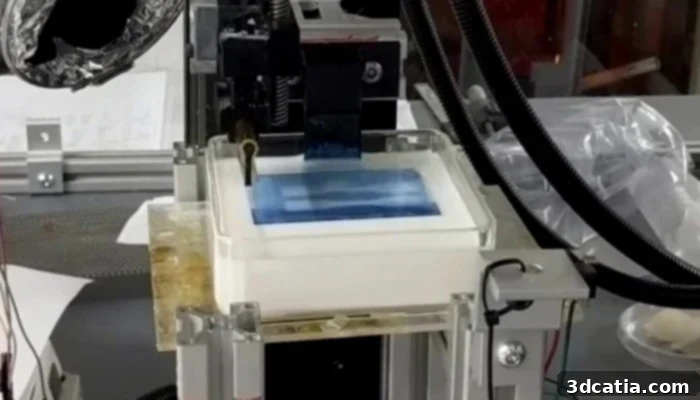
Advanced stereolithography technique for 3D printing with highly elastic latex materials. (Image credits: VTU)
To rigorously test the functionality and performance of their newly developed process, the VTU team embarked on 3D printing a series of complex objects using their light-cured latex material. The results were truly impressive. The samples exhibited exceptional detail and demonstrated a substantial improvement in strength compared to existing latex materials or other commercially available elastomers. Specifically, these 3D-printed latex objects displayed remarkable elongations in excess of 500%, signifying their extraordinary flexibility and ability to stretch without breaking. Furthermore, they achieved an average breaking strength of 9.7 MPa, which is a testament to their robust structural integrity. These figures not only validate the efficacy of the new technique but also position this advanced latex material as a top-tier elastomer for demanding applications. The ability to print such resilient and highly elastic parts with precision marks a significant milestone in additive manufacturing.
The broader implications of this research are profound, as highlighted by the other researchers involved in the project. They emphasized that this innovative technique for 3D printing with latex is not merely an isolated advancement but rather a gateway to fabricating components from an unprecedented range of advanced materials. “This work expands the opportunities for printing elastomers with complex characteristics that exhibit extensibilities greater than 500%, almost 200% above the leading commercial elastomers,” concluded the VTU researchers. This means that industries can now envision designing and producing intricate, highly elastic parts that were previously impossible to manufacture with traditional methods or existing 3D printing technologies. Potential applications span across various sectors, from creating flexible sensors and soft robotics components to developing advanced medical devices, custom wearables, and high-performance automotive parts. The collaboration with Michelin North America underscores the industrial relevance and potential for real-world impact of this academic breakthrough. This development promises to accelerate innovation in fields requiring highly deformable yet durable materials, truly pushing the boundaries of what is achievable with additive manufacturing.
For those interested in delving deeper into the specifics of this groundbreaking research and its potential applications, more comprehensive information about the project can be accessed directly on the official Virginia Tech University website HERE. This research not only showcases the power of interdisciplinary collaboration but also sets a new benchmark for material science in the context of additive manufacturing.
What are your thoughts on this revolutionary new technique for 3D printing with latex? Do you foresee specific industries or applications that could benefit most from this advancement in flexible material additive manufacturing? We invite you to share your insights and comments below, or join the conversation on our official Facebook and Twitter pages! Don’t miss out on the latest innovations and news in the world of 3D printing; sign up for our free weekly Newsletter to receive all the cutting-edge updates directly in your inbox.