
Revolutionizing Water Purification: How 3D Printing is Tackling Global Pollution
In an era defined by rapid technological advancements, 3D printing, also known as additive manufacturing, has emerged as a groundbreaking force, enabling the creation of intricate, custom-designed objects with unprecedented ease and speed. Its transformative potential extends far beyond industrial prototyping and consumer goods, increasingly offering innovative solutions to some of humanity’s most pressing challenges. Among these, the critical issue of global water pollution stands out. Recognizing this immense potential, an pioneering research team, comprising experts from the University of Tasmania and the University of the Balearic Islands, has ingeniously harnessed 3D printing technology to develop advanced systems for purifying contaminated water. This ambitious project, spearheaded by researchers Andreu Figuerola, Fernando Maya, and Gemma Isabel Turnes, received vital funding through the Spanish State Research Agency (AEI) and the European Regional Development Funds (ERDF). Their work underscores a growing trend where additive manufacturing methods are becoming indispensable tools in the global battle against environmental pollution, inspiring numerous organizations to integrate this versatile technology into their sustainability initiatives.
The Global Challenge of Water Pollution and the Urgent Need for Innovative Solutions
The degradation of our natural environments through pollution is an unfortunate and increasingly common narrative. News reports frequently highlight environmental disasters that devastate ecosystems and threaten vital natural resources. A stark example occurred recently in Spain, where the Mar Menor, a significant coastal saltwater lagoon, suffered an ecological catastrophe. This event led to the widespread destruction of thousands of marine organisms, directly attributable to the severe effects of anthropogenic pollution. Such incidents are not isolated; they are symptoms of a broader global water crisis, where countless natural ecosystems worldwide face irreversible damage. Water, being an absolutely indispensable resource for all human and ecological life, demands unparalleled attention, protection, and innovative treatment solutions. The question then arises: how did this dedicated team of researchers successfully integrate the advanced capabilities of additive manufacturing into the complex and crucial process of water purification?
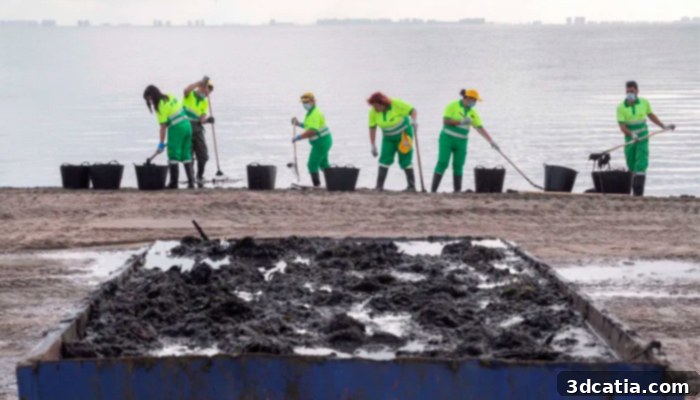
Image credits: Marcial Guillén/EFE
Pioneering Research: 3D Printing for Advanced Water Treatment
Traditional water treatment methodologies typically involve multiple stages, each meticulously tailored to the origin and specific contaminants present in the water (e.g., fluvial, industrial, or residual). These methods, while effective, often face limitations in terms of design flexibility, material efficiency, and scalability for complex contaminant profiles. The research team recognized these inherent challenges and leveraged the unique strengths of 3D printing to overcome them. Their innovative approach centered on manufacturing specialized devices designed to purify aqueous solutions, specifically targeting various industrial dyes, which are notoriously difficult to remove using conventional methods. By creating these devices with 3D printing, they could achieve unparalleled precision and complexity in design, laying the groundwork for a more effective water treatment system.
The Ingenious Methodology: Combining Additive Manufacturing with Adsorbent Materials
The core of their innovation lies in developing a support piece: a modular device featuring a network of interconnected channels. This intricate design serves a crucial purpose – it significantly increases the internal surface area within the module, thereby maximizing the amount of adsorbent material that can be effectively incorporated. Adsorbent materials are vital for water purification because of their ability to capture and retain contaminants on their surface. These materials possess a distinct advantage: they can be chemically modified to selectively target and remove specific pollutants or even a combination of different contaminants from water. However, the inherent challenge lies in their integration with 3D printed parts, as parts produced directly through additive manufacturing typically do not possess adsorbent properties themselves.
This technical hurdle required an ingenious solution. The project sought to combine the structural benefits of 3D printing with the chemical efficacy of adsorbent materials in a synergistic manner. The researchers devised a novel strategy to incorporate the adsorbent substances onto the surface of the 3D printed device. This critical step was performed right at the conclusion of the manufacturing process, specifically when the printed part was still in a malleable, soft, and slightly sticky state. This precise timing proved to be the key. Through simple contact, they were able to deposit a specially synthesized adsorbent carbon directly onto the device’s surface. This method allowed the adsorbent material to adhere effectively, creating a hybrid device that benefits from both the structural integrity and complex geometry of 3D printing, and the contaminant-removing capabilities of the adsorbent. To rigorously verify the effectiveness of their newly developed device, the team conducted a comprehensive series of laboratory tests using various aqueous solutions, each prepared with different industrial dyes, simulating real-world industrial wastewater conditions.
Designing for Efficiency: The Role of Complex Geometries in Water Treatment
One of the most significant advantages of 3D printing is its capacity to produce objects with highly complex geometries that are otherwise impossible or prohibitively expensive to create using traditional manufacturing techniques. In the context of water purification, this capability is revolutionary. The researchers deliberately designed their module with an intricate network of interconnected channels, rather than a simple, solid structure. This complex internal architecture is not merely aesthetic; it is fundamentally functional. By maximizing the internal surface area, the device can house a substantially larger quantity of the adsorbent material. A greater surface area means more active sites available for contaminant adsorption, which directly translates to enhanced purification efficiency and capacity. This strategic use of advanced design, enabled by additive manufacturing, allows the device to process more polluted water or handle higher concentrations of contaminants than simpler designs, making the purification process faster and more effective.
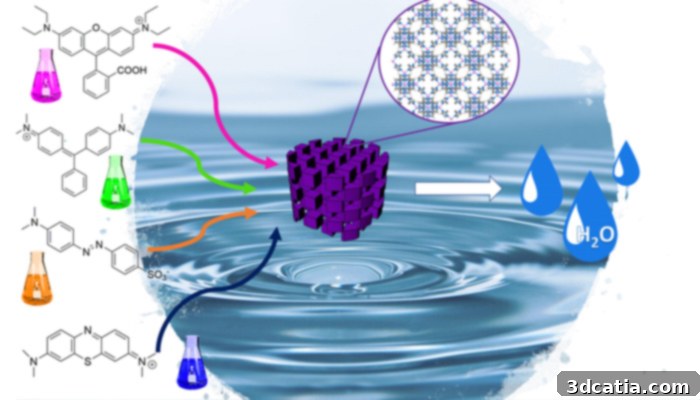
The 3D printed device integrates adsorbent materials to remove contaminants efficiently.
Validating the Solution: Promising Results and Reusability
The experimental results were remarkably promising, demonstrating the high efficacy of the 3D printed devices. In initial tests, the team observed a total loss of color in the contaminated solutions in less than 24 hours. This rapid discoloration was a direct result of the efficient adsorption of the industrial dyes by the adsorbent-coated 3D printed device. This immediate success highlighted the viability of their innovative approach. To further enhance and validate the system’s performance, another series of tests was conducted. In this phase, a synthetic membrane was introduced to facilitate the connection between multiple 3D printed parts and the adsorbent material, effectively creating a more integrated and potentially scalable system. The results from this advanced setup were even more satisfactory. The discoloration process was significantly accelerated, taking less than half an hour for complete dye removal. More importantly, these enhanced devices demonstrated remarkable reusability; the purification process could be repeated multiple times without a significant loss in efficiency. This crucial finding confirmed that the device could be constantly reused, a vital factor for long-term sustainability and cost-effectiveness in large-scale water treatment applications. In essence, the research team successfully developed two distinct processes for incorporating adsorbent materials into 3D printed structures, endowing these structures with pollutant-removing qualities they inherently lacked. The overall conclusion was unequivocal: the innovative 3D printed devices are highly effective in removing pollutants, signifying their immense potential to contribute on a large scale to the purification of contaminated waters, offering a sustainable, long-term solution for global water quality improvement.
The Future of Sustainable Water Purification Through 3D Printing
The findings from this research represent a significant leap forward in the field of environmental engineering and sustainable technology. The ability to customize complex structures via 3D printing and imbue them with potent adsorbent properties opens up a myriad of possibilities for addressing diverse water pollution challenges. Imagine bespoke purification modules designed for specific industrial effluents, or portable units for disaster relief zones where clean water is critically scarce. The reusability of these devices not only reduces operational costs but also minimizes waste, aligning perfectly with circular economy principles. Furthermore, the modular nature of the 3D printed components suggests that these systems could be easily scaled up for larger municipal or industrial applications, or scaled down for household use, offering unprecedented flexibility. Future research could focus on exploring a wider range of adsorbent materials, tailoring them for different types of pollutants such as heavy metals, pharmaceuticals, or microplastics. Optimizing the 3D printing process itself, perhaps through direct integration of adsorbent polymers, could lead to even more streamlined manufacturing and improved performance. This project serves as a compelling testament to how interdisciplinary collaboration and advanced manufacturing technologies can pave the way for a cleaner, healthier planet.
Conclusion
The groundbreaking work from the universities of Tasmania and the Balearic Islands clearly demonstrates the transformative power of additive manufacturing in tackling one of the most critical environmental challenges of our time: water pollution. By ingeniously combining the design flexibility of 3D printing with the chemical efficacy of adsorbent materials, the research team has developed an innovative, efficient, and reusable solution for purifying contaminated water, particularly targeting industrial dyes. From the rapid discoloration observed in laboratory tests to the remarkable reusability of the devices, the results unequivocally highlight the potential of this technology. This success story not only offers hope for cleaner water globally but also sets a new precedent for how advanced manufacturing can drive sustainable solutions, proving that innovation can indeed clean up our world, one drop at a time.
What are your thoughts on the use of additive manufacturing for advanced water treatment? We’d love to hear your perspective! Share your comments below or engage with us on our Facebook and Twitter pages! Don’t miss out on the latest advancements in 3D printing – sign up for our free weekly Newsletter, delivered straight to your inbox!