

Revolutionizing Sustainable Chemistry: How 3D Printing Single-Atom Catalysts Are Combating Climate Change
The global challenge of climate change demands innovative and sustainable solutions across all sectors, especially in industrial chemistry. Chemical reactions, which form the backbone of countless manufacturing processes, are often energy-intensive and can generate significant waste. Addressing these inefficiencies is paramount to achieving a greener future. A groundbreaking research initiative led by Professor Shizhang Qiao, an Australian Laureate Fellow at the University of Adelaide, is poised to redefine our approach to sustainable chemistry. His team has successfully developed a novel method to 3D print single-atom metal catalysts, a breakthrough that could fundamentally change how we tackle environmental issues and drive the development of highly efficient, cost-effective chemical processes for the benefit of society.
Understanding Catalysts: Speeding Up Reactions, Minimizing Waste
At their core, catalysts are substances that accelerate chemical reactions without being consumed in the process. They achieve this by lowering the activation energy – the minimum energy required for a reaction to begin. This capability makes them indispensable in a vast array of industrial applications, from producing fuels and pharmaceuticals to manufacturing plastics and fertilizers. The efficiency of a catalyst is profoundly influenced by its surface area; a larger surface area translates to more “active sites,” which are the specific locations where reactant molecules bond and undergo transformation. Therefore, maximizing the number of active sites is crucial for creating highly effective catalysts.
Traditional catalysts often involve nanoparticles or bulk materials, where only a fraction of the atoms are exposed on the surface and actively participate in the reaction. This leads to inefficient use of expensive catalyst materials and can generate undesirable byproducts. The quest for ultimate catalytic efficiency has driven researchers towards single-atom catalysts (SACs). As their name suggests, SACs consist of individual metal atoms precisely dispersed and anchored on a support material. This unique structure ensures that every single metal atom is an active site, offering the highest possible surface area and thus maximizing atom utilization and catalytic efficiency. Their exceptional performance potential for various reactions, including energy conversion, environmental remediation, and fine chemical synthesis, has made SACs a hot topic in materials science and chemistry.
Despite their immense promise, the practical implementation of SACs has been hampered by significant challenges. Conventional synthesis methods are often complex, costly, and difficult to scale up for industrial applications. They frequently involve harsh chemicals, multi-step processes, and lack the precision needed to consistently produce catalysts with uniform atomic dispersion and stable performance. These limitations have historically restricted SACs largely to laboratory research, preventing their widespread adoption in tackling pressing industrial and environmental problems. This is precisely where the innovative approach of 3D printing emerges as a game-changer.

The method involved extruding the catalyst from a 3D printer; each individual atom then formed the center of four coordination atoms within a carbon structure. (Photo credits: A General Approach to 3D-printed Single-Atom Catalysts)
The Breakthrough: Precision 3D Printing of Single-Atom Catalysts
Professor Qiao’s team at the University of Adelaide has pioneered a revolutionary method utilizing 3D printing technology to overcome the traditional hurdles of SAC production. This innovative approach allows for the cost-effective and precise fabrication of catalysts with custom geometric designs, ranging in size from microscopic millimeters to large industrial meters. The ability to tailor the physical architecture of the catalyst on demand is a significant advantage, enabling optimization for specific reaction environments and maximizing contact with reactants.
The core of their experimental method involved the extrusion of a catalyst precursor material from a sophisticated 3D printer. This process was meticulously controlled to ensure that individual atoms of the metal catalyst were precisely deposited and anchored. Crucially, each single atom subsequently formed the center of four coordination atoms, creating a stable and highly active structure within a carbon lattice. This level of atomic precision, achieved through additive manufacturing, is what truly differentiates their technique. It provides an unprecedented degree of control over the catalyst’s morphology and active site environment, ensuring uniform distribution and preventing the agglomeration of single atoms into less efficient clusters.
Validating Performance at the Australian Synchrotron
To rigorously characterize and confirm the unique properties of their 3D printed catalysts, Professor Qiao’s team sent their samples to the Australian Synchrotron. Located near Melbourne, the Synchrotron is a world-class research institute that leverages accelerator technology to generate exceptionally powerful beams of light. These intense X-ray beams are invaluable for probing the atomic and electronic structure of materials, offering insights that are impossible to obtain with conventional laboratory equipment.
At the Synchrotron, materials characterization was performed using the X-ray Absorption Spectroscopy (XAS) beamline. XAS is a powerful technique that allows scientists to determine the local atomic and electronic structure of an absorbing atom within a material, providing critical information about its coordination environment, oxidation state, and bond lengths. The detailed analysis conducted at the Synchrotron confirmed the successful formation and stability of the single-atom catalysts. More importantly, the findings revealed that these 3D printed catalysts possessed unique structural and electronic properties that translated into extraordinarily efficient reactions. They exhibited high catalytic activity, meaning they could significantly speed up chemical processes, and achieved a remarkable 100% atom economy. This signifies that virtually every atom of the reactant material is converted into the desired product, minimizing waste and maximizing resource utilization – a holy grail for sustainable chemical manufacturing.
A New Era for Climate Change Mitigation and Sustainable Chemicals
The implications of this research are profound and far-reaching, offering significant promise for addressing the urgent challenges of climate change. By enabling the cost-effective and scalable production of highly efficient single-atom catalysts, this 3D printing method opens new avenues for developing cleaner, more sustainable chemical processes. Professor Qiao highlighted the immense potential, stating, “This novel combination has the potential to advance Australia’s status as a global leader in tackling the effects of climate change and help us take the lead in new techniques to make chemicals that benefit society.”
The ability to perform chemical reactions with 100% atom economy means industrial processes can become dramatically more efficient, consuming less raw material, requiring less energy, and generating minimal byproducts. This translates directly into reduced carbon footprints, lower operational costs, and a significant step towards a circular economy. Imagine industries where the synthesis of essential chemicals, from pharmaceuticals to advanced materials, can be achieved with unprecedented efficiency and minimal environmental impact. This research lays a crucial foundation for such a future, offering tools to develop innovative solutions for carbon capture, conversion of greenhouse gases into useful products, and the production of sustainable fuels.
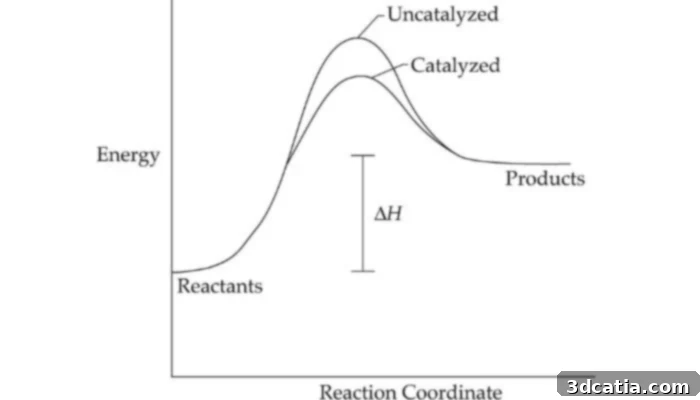
Catalysts speed up reactions by lowering the activation energy: the energy required for a reaction to begin. (Licensed under Attribution-ShareAlike 3.0 Unported (CC BY-SA 3.0))
The Broader Impact of 3D Printing in Chemistry
This groundbreaking work on 3D printed single-atom catalysts is part of a larger trend where additive manufacturing is increasingly recognized as a transformative technology within chemistry and materials science. Researchers worldwide are exploring how 3D printing can revolutionize chemical processes, enhance material properties, and accelerate scientific discovery. For instance, similar experiments are exploring the use of multi-material DLP (Digital Light Processing) to create complex plastic-metal composites in significantly shorter timeframes, improving efficiency in manufacturing and design. Another notable collaboration, involving researchers from Leeds and Karlsruhe, is investigating the application of additive manufacturing in the fabrication of advanced plastics and polymers, paving the way for new materials with tailored functionalities.
While many of these processes, including the 3D printed catalysts, are still in their testing and optimization phases, the rapid advancements in additive manufacturing indicate a future where 3D printing will be a common, indispensable technology in various chemical and industrial settings. Its ability to create intricate designs, precisely control material deposition, and enable rapid prototyping makes it an ideal tool for developing next-generation catalysts, reactors, and material systems. The full paper detailing this remarkable 3D printed catalyst experiment was published in the prestigious journal Nature Synthesis on January 2nd, 2023, and can be accessed HERE (access required), marking a significant milestone in sustainable chemistry.
What are your thoughts on this innovative experiment to develop 3D printed single-atom catalysts and its potential to tackle climate change? We invite you to share your insights in a comment below or engage with us on our LinkedIn, Facebook, and Twitter pages! Don’t forget to sign up for our free weekly Newsletter here to get the latest 3D printing news delivered straight to your inbox! You can also find all our compelling videos on our YouTube channel, showcasing the dynamic world of additive manufacturing.
*Cover photo credits: A General Approach to 3D-printed Single-Atom Catalysts in Nature Direct.