
Unlocking Sustainable Futures: Insights from Sculpteo’s State of 3D Printing 2022 Report
In a rapidly evolving industrial landscape, the convergence of technological innovation and environmental responsibility has never been more critical. Specialist in additive manufacturing and digital production, Sculpteo, has once again provided invaluable insights into this dynamic sector with the release of its 8th edition of “The State of 3D Printing: 2022” report. Building on the foundation of its seven predecessors, this annual international study serves as a crucial barometer for the additive manufacturing industry, offering a comprehensive overview of emerging trends, strategic opportunities, and evolving challenges. This year, the report prominently highlights a significant shift in focus towards sustainability, positioning 3D printing as a pivotal technology in the quest for more environmentally conscious industrial practices. For the majority of respondents – a diverse group primarily comprising executives, engineers, and designers – 3D printing is not just a manufacturing method but a powerful tool actively enhancing the environmental footprint of their operations.
The findings within the report emphatically underscore additive manufacturing’s potential to drive sustainability initiatives. A compelling 41% of manufacturers surveyed believe that adopting additive manufacturing significantly aids their companies in achieving ambitious sustainability goals. This conviction is further reinforced by another critical statistic: 61% of manufacturers agree that 3D printing technology enables them to produce precisely the right amount of material for the specific need, minimizing waste and optimizing resource allocation. This meticulous approach to material usage stands in stark contrast to traditional manufacturing techniques, which often necessitate an abundance of resources and generate considerable material scrap. The inherent advantage of 3D printing lies in its ability to facilitate a more sustainable policy by ensuring that manufacturers procure and utilize only the exact quantity of material required for product fabrication, thereby drastically reducing waste and promoting efficient resource management from conception to completion.
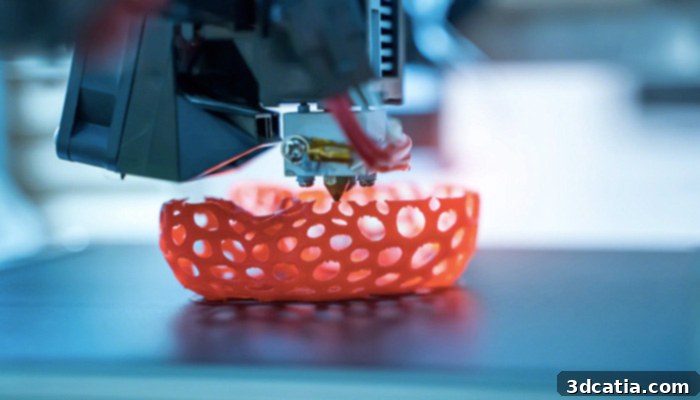
3D printing allows for better resource management (photo credits: Mecalux)
The State of 3D Printing 2022: Is It a Promising Sustainable Technology for the Future?
Beyond its immediate environmental benefits, Sculpteo’s study paints a picture of additive manufacturing as a profoundly promising design and production methodology with a bright future. The industry’s optimism is palpable, with an impressive 84% of respondents expressing confidence in the technology’s long-term potential. Delving deeper, 58% of manufacturers anticipate that 3D printing will play a non-negligible, indeed pivotal, role across various sectors, impacting not only the corporate manufacturing world but also personal life and consumer applications. These statistics are a direct reflection of the sentiments shared by industry leaders, including Alexandre d’Orsetti, CEO of Sculpteo. D’Orsetti articulates this optimistic outlook, stating, “I can say that the future of 3D printing is promising and I am proud to be able to contribute to the future of this technology.” This reflects a collective belief in 3D printing’s capacity to transform industries, foster innovation, and offer solutions to contemporary manufacturing challenges.
The widespread adoption of 3D printing as a tool for reducing the environmental impact of manufacturing operations is intrinsically linked to its inherent reliability and efficiency. According to 61% of those surveyed, on-demand manufacturing stands out as a primary reliability and sustainability advantage offered by 3D printing. This approach minimizes the need for extensive inventories, reduces transportation emissions, and virtually eliminates obsolescence-related waste. Furthermore, a significant 59% of manufacturers are actively seeking and demanding more sustainable materials for their additive manufacturing processes. This growing demand highlights a crucial market trend: the increasing covetousness for bio-sourced, recycled, and otherwise environmentally friendly products within the additive manufacturing sphere. In essence, the report identifies three critical aspects of reliability and sustainability that the 3D printing industry must continue to improve upon:
- Expanding Recycling Options: Developing more robust and accessible recycling infrastructure for printed objects at the end of their lifecycle.
- Accelerating Sustainable Material Development: Investing further in research and development to create and commercialize a wider array of sustainable and high-performance materials.
- Enhancing Powder Reuse: Achieving greater progression in powder reuse technologies, particularly with advanced methods like Selective Laser Sintering (SLS), to reduce material waste and optimize costs.
These areas represent key avenues for innovation that will further solidify 3D printing’s role as a leader in sustainable manufacturing practices. The ability to print only what is needed, when it is needed, coupled with advancements in material science and waste reduction, positions additive manufacturing as a cornerstone of future eco-conscious industries.
Addressing the Limitations of 3D Printing for Broader Adoption
Despite the myriad of benefits that 3D printing offers to various industries, the technology, like any other, still confronts certain drawbacks that hinder its universal adoption, particularly concerning cost. The Sculpteo study reveals that a notable third of the companies surveyed, precisely 33% of respondents, perceive budget as the primary limiting factor preventing them from fully embracing additive manufacturing. While this figure represents a significant portion, it is equally important to acknowledge that the majority of companies do not view cost as an insurmountable barrier. Nevertheless, this statistic underscores a critical point: 3D printing has not yet achieved widespread accessibility for all businesses, especially smaller enterprises or those with tighter capital expenditure budgets. The initial investment in equipment, material costs, and the need for specialized training can pose substantial hurdles for some.
Furthermore, the pursuit of a more sustainable policy inherently demands superior material management throughout the product lifecycle. While 3D printing excels in reducing initial material waste, the end-of-life management of printed parts remains an area ripe for innovation. The study highlights this by revealing that a significant 63% of manufacturers are actively seeking viable options to recycle 3D printed components. As previously discussed, enhancing resource management, particularly in the post-production phase, continues to be a crucial area for improvement within the additive manufacturing industry. This includes developing effective methods for sorting, processing, and repurposing various types of 3D printing materials. Addressing these limitations – primarily cost and comprehensive recycling solutions – will be instrumental in unlocking the full potential of 3D printing and accelerating its integration into mainstream manufacturing processes. Companies are increasingly investing in research for closed-loop systems, where discarded 3D prints can be re-processed into new filament or powder, thereby creating a truly circular economy. This not only minimizes waste but also reduces the reliance on virgin materials, aligning perfectly with the overarching goals of sustainability.
The Path Forward: Driving Innovation and Sustainability
The 2022 “State of 3D Printing” report from Sculpteo clearly articulates that additive manufacturing is at a pivotal juncture. It’s a technology brimming with potential, especially in its capacity to foster more sustainable industrial practices. From reducing material waste through precise production to enabling on-demand manufacturing that slashes inventory and transportation costs, 3D printing offers tangible environmental benefits. The widespread optimism among industry professionals regarding its future role in both industrial and personal applications further solidifies its trajectory as a transformative force. While challenges such as initial investment costs and the need for more robust recycling solutions persist, the industry is actively engaged in overcoming these hurdles. The demand for bio-sourced and recyclable materials is driving innovation in material science, and advancements in powder reuse techniques are making processes like SLS even more efficient. As these challenges are addressed, 3D printing is poised to become an even more accessible and indispensable technology for businesses striving towards a more efficient, resilient, and environmentally responsible future.
For those keen to delve deeper into these comprehensive findings and explore the nuances of the 3D printing industry’s current state and future outlook, the full report is readily available for download HERE. Engaging with such detailed analyses is crucial for businesses and individuals alike to stay ahead in this rapidly evolving sector and strategize effectively for future growth.
What are your thoughts on the insights presented in the 8th edition of The State of 3D Printing: 2022 Report? We invite you to share your perspectives and comments below or connect with us on ourLinkedIn,Facebook, andTwitter pages! Don’t miss out on the latest advancements and breaking news in the additive manufacturing world – be sure to sign up for our free weeklyNewsletter hereto get the freshest 3D printing news delivered straight to your inbox! Additionally, you can find a wealth of informative videos and discussions on our dedicatedYouTube channel. Your engagement helps foster a vibrant community dedicated to exploring the limitless possibilities of 3D printing.