
LASED: Auburn University’s Breakthrough in Microgravity 3D Printing and On-Demand Space Manufacturing
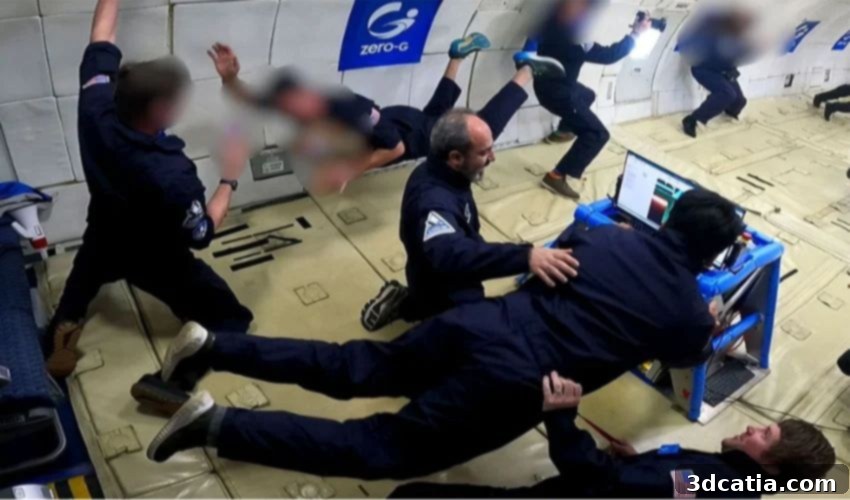
The ambitious vision of 3D printing in space is rapidly transitioning from a theoretical concept to an tangible reality. Crafting three-dimensional components within the challenging confines of a microgravity environment, where the absence of gravitational forces poses unique engineering constraints and significant operational hurdles, has now been demonstrably proven. Numerous pioneering projects have successfully showcased the capability to fabricate a diverse array of essential components directly aboard spacecraft, bypassing the logistical complexities and costs associated with Earth-bound manufacturing and delivery. Among these groundbreaking innovations, the LASED (Laser Ablation and Sintering Enabling Deposition) machine stands out as a remarkable leap forward. This advanced, compact 3D printer is engineered not only to generate nanoparticles and precisely deposit materials through a specialized nozzle but also to perform highly effective powder sintering. What truly sets LASED apart, however, is its proven ability to execute these sophisticated processes in microgravity. So far, the LASED system has undergone rigorous and successful testing aboard a modified Boeing aircraft, which expertly executes parabolic arcs, providing crucial intervals of 23 to 25 seconds of microgravity—a critical window for validating its operational efficiency in simulated space conditions.
The Vision Behind LASED: Enabling Self-Sufficiency in Space
At the heart of the LASED project is Masoud Mahjouri-Samani, a distinguished professor in the Department of Electrical and and Computer Engineering at Auburn University. Professor Mahjouri-Samani articulates the machine’s capabilities with a clear vision: “It’s a fully functional machine. Everything is integrated. You can program it to complete complex tasks in 20 seconds. In space, without that time constraint, it can do even more.” This statement underscores the machine’s robust design and its immense potential when deployed in continuous microgravity. From a practical standpoint, the LASED printer is engineered for the extreme efficiency demanded by space applications. Measuring a mere 60 cm in length and consuming less than 500 watts of power, its ultra-compact footprint and minimal energy requirements make it exceptionally practical for installation and operation aboard a spaceship. In an environment where every cubic centimeter of space and every watt of power is meticulously accounted for, LASED’s design represents a significant advantage for long-duration missions and habitat sustainability.
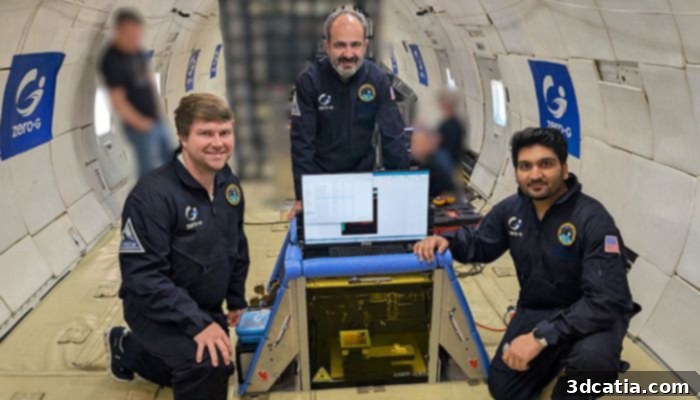
From left to right: Colton Bevel, Masoud Mahjouri-Samani and Aarsh Patel, in front of the LASED 3D printer.
The primary objective driving the development of LASED was to pioneer a sophisticated solution capable of 3D printing parts directly in microgravity conditions. This capability is paramount for circumventing the notoriously long, complex, and prohibitively costly supply chains that currently govern space missions. The ability to have an advanced 3D printer readily available in space grants astronauts an unparalleled degree of autonomy and operational flexibility. This is particularly critical for situations requiring the fabrication of highly specialized or flexible electronic components—items that are often mission-critical and difficult to stock in sufficient quantities. It is precisely this type of on-demand manufacturing for sensitive and advanced electronic parts that Masoud Mahjouri-Samani’s dedicated team at Auburn University has meticulously focused on, understanding the transformative impact it can have on future space exploration and sustained human presence beyond Earth.
Rigorous Testing in Zero-G Conditions: Proving LASED’s Reliability
To rigorously evaluate the performance and reliability of their innovative LASED machine, Professor Mahjouri-Samani and his team embarked on a series of critical parabolic flights. These tests were conducted within a specially modified Boeing 727, a unique flying laboratory designed to simulate periods of microgravity. The results gleaned from these intensive tests were not merely positive; they were genuinely impressive and groundbreaking, setting a new benchmark for in-space additive manufacturing. Professor Mahjouri-Samani proudly noted a stark contrast between LASED’s performance and that of other systems: “Other systems sometimes need multiple flights to even get one usable print. Ours worked perfectly on parabola one. Once the programmed tests were completed, we had time to print more. We built in a margin for error, but we didn’t need it. We had time left, so we printed extra.” This extraordinary success on the very first attempt underscores LASED’s robust design, advanced automation, and inherent reliability under highly challenging conditions. The professor emphatically confirmed the core achievement: “But the real question was: would it print in zero gravity? The answer is ‘yes.’ This printer is highly automated. You just hit ‘print’ and let it go.” This seamless operation signifies a major step toward fully automated in-space fabrication, reducing the need for extensive astronaut intervention and maximizing efficiency.
Following the successful parabolic flights, the Auburn University team undertook extensive post-flight analyses to corroborate the exceptional claims of LASED’s performance. They meticulously measured various critical physical properties of the 3D-printed parts, including their thickness, surface roughness, tensile strength, and other structural characteristics. These detailed comparisons and assessments confirmed that the parts fabricated in microgravity met the required specifications, demonstrating the machine’s precision and consistency. The success of these initial trials has not only validated LASED’s immediate capabilities but has also ignited further ambitious plans for its future development and application. The team is already looking ahead, with Masoud Mahjouri-Samani expressing a keen interest in pushing the boundaries of what LASED can achieve. His next significant goal is to print semiconductors—components vital for advanced electronics—again leveraging the unique environment of a parabolic flight for testing. This next phase of research promises to unlock even greater potential for on-demand manufacturing of critical high-tech components in space.
Paving the Way for In-Space Manufacturing and Beyond
Next year, we’re going to try printing semiconductors. We might also integrate other ideas to better simulate the space environment. If the printer works this well in 0G, maybe we should consider sending one to space. It’s stable, precise, and efficient — exactly what you want in orbit or beyond. This was one small step for our printer, one giant leap for space-based fabrication.
Professor Mahjouri-Samani’s forward-looking statement encapsulates the profound potential of the LASED machine and the future of additive manufacturing in space. The plan to print semiconductors during upcoming parabolic flights is a critical step towards enabling highly advanced electronic systems to be produced directly in orbit, offering unprecedented capabilities for spacecraft, lunar bases, and future Martian missions. This would allow for the customization and repair of complex sensors, communication devices, and computing hardware without relying on costly and time-consuming resupply missions from Earth. Furthermore, the intention to integrate additional concepts for even more accurate simulation of the space environment underscores the team’s commitment to robust testing and refinement, ensuring LASED’s readiness for eventual deployment. The consistent stability, precision, and efficiency demonstrated by LASED are precisely the characteristics required for reliable operation in the harsh and unforgiving conditions of orbital mechanics or deep space exploration. This technology promises to transform space logistics, enabling true self-sufficiency for astronauts and pioneering the age of in-space resource utilization and manufacturing. The analogy to “one small step for our printer, one giant leap for space-based fabrication” is apt, as LASED represents a monumental stride towards a future where humanity’s reach in space is limited only by imagination, not by Earth-based supply lines.
The implications of LASED’s success extend far beyond merely printing replacement parts. It heralds a new era of proactive space exploration, allowing for the rapid iteration of designs, the creation of mission-specific tools, and the development of customized habitats and infrastructure directly in extraterrestrial environments. This capability drastically reduces the logistical burden and costs associated with launching everything from Earth, making long-duration missions to the Moon, Mars, and beyond significantly more feasible and sustainable. By enabling on-demand fabrication of everything from simple tools to complex electronic components, LASED embodies the promise of true in-situ manufacturing, empowering astronauts to be builders and innovators rather than merely maintainers. This transformative technology is a cornerstone for the next generation of space exploration, fostering resilience, adaptability, and an unprecedented level of independence from our home planet.
To delve deeper into these exciting developments and learn more about Auburn University’s groundbreaking work, you can click HERE. What are your thoughts on the LASED machine and its potential impact on space exploration and manufacturing? Share your insights and comments below, or engage with us on our LinkedIn or Facebook pages! Additionally, ensure you don’t miss out on the latest advancements and news in the 3D printing industry by signing up for our free weekly Newsletter, delivered directly to your inbox. You can also explore our extensive library of videos on our YouTube channel for more engaging content. For further specialized news and articles within the aerospace and defense sectors of 3D printing, we invite you to visit our dedicated page HERE.
*All Photo Credits: Auburn University