
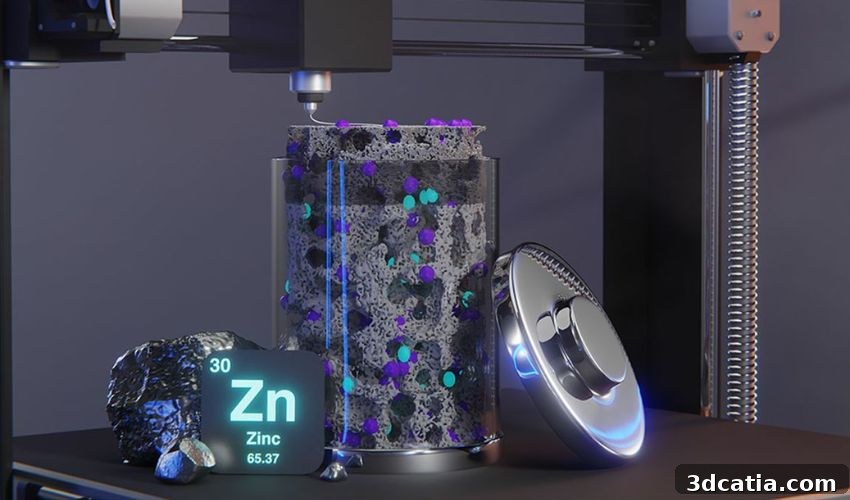
A UCLA-led team of researchers has developed a 3D-printed porous carbon electrode that significantly improves hybrid zinc-ion battery performance. The new electrode enables the battery to store more than seven times the charge of comparable devices while maintaining about 82% of that capacity after 1,500 charge cycles. The study, published in the journal Small, was led by co-corresponding authors Maher El-Kady and Ric Kaner, with Sophia Uemura as first author.
A Honeycomb Electrode
The hybrid cell combines two complementary modes of energy storage. One electrode behaves similarly to a conventional battery electrode, while the other is a porous carbon electrode that functions like the electrode in a supercapacitor. Supercapacitors charge and discharge rapidly and endure many cycles, but they typically store less energy because charge is confined to electrode surfaces. By redesigning the carbon electrode’s internal architecture, the researchers were able to overcome that surface-area limitation.
The team 3D printed the carbon electrode with a honeycomb-like internal lattice using a UV-curable resin and a fine laser-based printing technique. After printing, the structure underwent heating and gasification to remove noncarbon components, leaving behind a conductive carbon scaffold full of interconnected cavities. That porous scaffold was then coated with vanadium oxide, a material known for its high energy-storage capacity. The resulting electrode has an immense internal surface area: a single gram, if spread flat, would cover an area comparable to many tennis courts.
“The method we used lets us build any 3D scaffold, layer by layer, and control its microstructure,” said Ric Kaner, a UCLA distinguished professor of chemistry and biochemistry and of materials science and engineering. “We can create billions of tiny pores, producing an enormous internal surface area. That means we can store a lot more charge than a conventional porous electrode.”
Choosing zinc as the charge carrier also brings supply-chain and sustainability advantages. Zinc is far more abundant than lithium, is easier to source, and can be recycled with less environmental impact. These attributes make zinc-based chemistries attractive candidates for large-scale energy storage applications where material availability and cost matter.
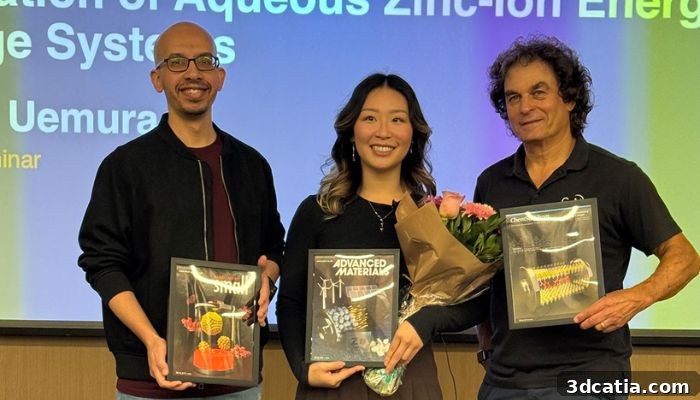
From left to right, co-corresponding author Maher El-Kady, first author Sophia Uemura and co-corresponding author Ric Kaner. (Photo credit: Julia Hu and Hai Co Tiet)
A Second Contribution: A Standardized 3D-Printed Test Cell
In addition to the advanced electrode, the researchers created a 3D-printed test cell designed to improve reproducibility in battery experiments. Typical laboratory tests often use open beaker setups, which suffer from electrolyte evaporation and variable electrode spacing, both of which can skew results over long-term cycling. The UCLA-printed test cell features a sealed top and fixed electrode spacing to reduce these sources of error.
Using the standardized printed cell, the team observed that carbon electrodes retained about 98% of their capacity after 1,500 cycles. By contrast, similar electrodes tested in conventional open-cell setups often fail in under 100 cycles due to evaporation and inconsistent contact. The printed test cell therefore represents a practical tooling advance that can produce more consistent, reliable data for battery research.
The researchers emphasize that the printed cell is intended as a research tool rather than a commercial product. Compared with expensive premade glass test cells, which can cost upwards of a thousand dollars, a 3D-printed option is accessible to many university and industry labs that already have additive-manufacturing capabilities. This accessibility could help standardize experimental methods across different groups and accelerate comparisons between technologies.
The project was a collaboration between UCLA and National Tsing Hua University in Taiwan, supported by a University of California Climate Action Seed Grant, Nanotech Energy Inc., and UCLA’s Dr. Myung Ki Hong Endowed Chair in Materials Innovation. The research demonstrates how combining advanced 3D printing with materials chemistry can yield electrodes and test fixtures that improve both device performance and experimental reliability.
Overall, the work highlights two main advances: a highly porous, 3D-printed carbon electrode that boosts energy storage when paired with vanadium oxide in a zinc-based hybrid cell, and a cost-effective, standardized 3D-printed test cell that improves the reproducibility of battery cycling experiments. Both contributions may help researchers explore alternative chemistries and accelerate progress toward scalable, sustainable energy storage solutions.
*Cover photo credit: Maher El-Kady / UCLA