
Wildfire Reforestation Revolution: 3D Printed Seed Capsules Offer Hope for Ecological Revival
The summer months of recent years have unequivocally highlighted the escalating impact of global warming across the planet. A particularly alarming symptom of this climate crisis has been the dramatic surge in wildfires, a direct and devastating consequence of prolonged heat waves and critically low rainfall. From the vast forests of the United States to the diverse landscapes of Europe, these infernos have ravaged natural habitats, displaced communities, and significantly contributed to global carbon dioxide emissions, precipitating an environmental emergency on an unprecedented scale.
In the United States alone, data from the National Interagency Fire Center reveals a staggering reality: as of September 13th, nearly 50,000 fires had consumed over 6.7 million acres, far exceeding the ten-year averages. This destructive pattern is not confined to North America. European nations, particularly France, Spain, and Greece, have experienced unprecedented wildfire seasons, leading to widespread ecological damage and an urgent call for innovative solutions. However, amidst this daunting challenge, a beacon of hope has emerged from the academic halls of the Polytechnic University of Valencia. A group of visionary industrial design students has conceptualized and developed DISPERSEED, an ingenious 3D printed edible seed capsule. Their ambitious goal is to revitalize fire-scorched lands, reintroducing floral diversity and fostering the return of thriving ecosystems to areas that have been tragically devastated by these catastrophic blazes.
Understanding the Ecological Challenge: Wildfires and Pyrophytic Species
While global attention often focuses on the massive wildfires in regions like California and the Western United States, it’s crucial to acknowledge that fires are also an extremely common and destructive phenomenon in other parts of the world, notably Spain, especially during the hot summer months. This inherent vulnerability has been severely exacerbated by the intensifying effects of climate change, leading to more frequent, larger, and more intense fire events. The ecological aftermath of these fires presents a complex problem: they often lead to the rapid proliferation of pyrophytic species. These are plant species that have evolved remarkable adaptations to tolerate, or even thrive after, fire.
Unfortunately, while resilient, an overpopulation of pyrophytic species can severely disrupt the delicate balance of ecosystems. They rapidly colonize the post-fire landscape, outcompeting and displacing native species that lack such fire adaptations. This dominance creates a monoculture, reducing overall biodiversity and leading to an ecosystem that is less resilient and often more prone to future fires, as many pyrophytes contain highly flammable oils or structures. Recognizing this critical imbalance, the students behind DISPERSEED embarked on their mission. Their innovative solution aims to enable the creation of healthier, more diverse, and crucially, more fire-resistant forests – ecosystems that are better equipped to withstand and recover from environmental disasters like wildfires, rather than being trapped in a cycle of repeated destruction and pyrophytic takeover.
DISPERSEED: An Innovation in Sustainable Reforestation
The journey to DISPERSEED involved extensive research, interdisciplinary collaboration, and invaluable input from industry experts. Through this rigorous process, the students developed a definitive concept: a biodegradable, spherical capsule produced using advanced 3D printing technology. A key innovation lies in the use of a 3D food printer, which allows the capsules to be both edible and entirely biodegradable. This choice of materials ensures that DISPERSEED leaves no harmful residue in the environment, aligning perfectly with its ecological mission.
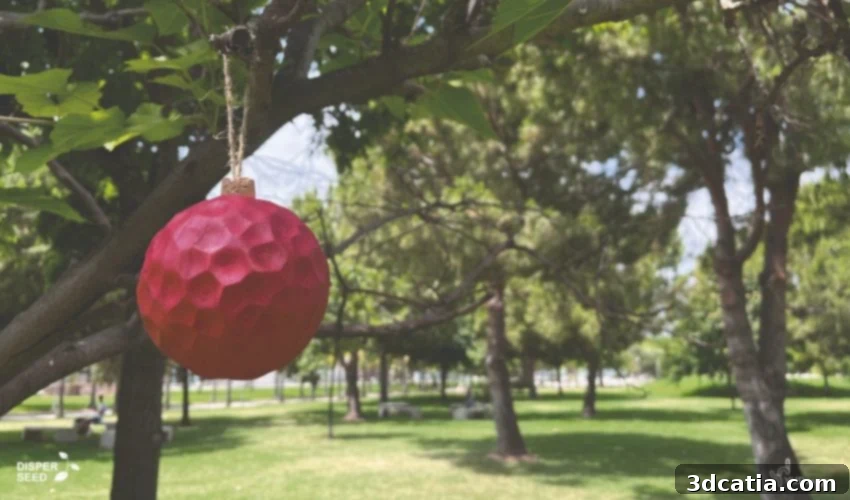
The physical design of the DISPERSEED capsule is thoughtfully engineered for maximum effectiveness. Its rounded, spherical shape is not merely aesthetic; it’s designed for ease of ingestion by target animal species. The striking reddish color, reminiscent of many fleshy fruits or berries, serves as a natural visual attractant for birds and other animals, encouraging them to consume the capsules. Each capsule is ingeniously composed of a carefully formulated mass that encapsulates various native seeds. The brilliance of this design is truly revealed once ingested by birds or other foraging animals. The passage through the animal’s digestive system, far from destroying the seeds, actually enhances their germination capacity – a natural process known as scarification, which breaks down the seed coat and prepares it for growth. These animals, acting as unwitting partners in reforestation, will travel considerable distances before naturally expelling the DISPERSEED, along with their feces, thereby distributing the seeds far and wide in a natural and highly effective manner.
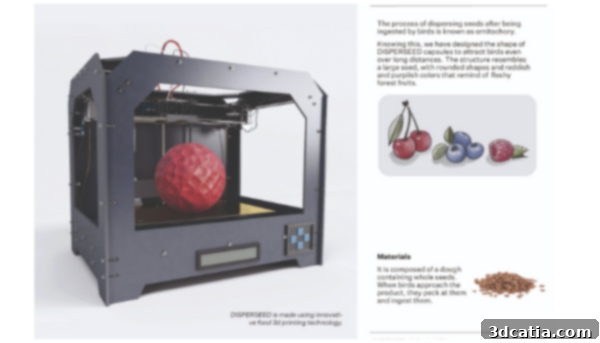
DISPERSEED has been made using a food 3D printer, highlighting its innovative and eco-friendly manufacturing process.
Catalyzing Environmental Recovery with DISPERSEED
The implementation strategy for DISPERSEED combines human effort with natural processes. As previously described, these reddish, fruit-like spheres will initially require human assistance for their distribution and strategic placement within the fire-damaged forests. This initial deployment is crucial for introducing the seed capsules into the target areas, making them accessible to local wildlife. Each sphere is thoughtfully designed with a string made from potato starch, ensuring it is completely biodegradable and leaves no environmental footprint. Once these seeds are introduced into the forest environment and begin their journey through the digestive tracts of various animals, a natural and highly efficient distribution system takes over. The animals, drawn by the capsule’s appearance and edibility, will carry the encapsulated seeds wherever they roam, effectively dispersing them across vast and often difficult-to-reach terrains.
The long-term impact of DISPERSEED on reforestation efforts is profound. By facilitating widespread, natural seed dispersal, DISPERSEED directly addresses the problem of pyrophytic species dominance after a fire. Instead of allowing these fire-adapted plants to form an ecological monopoly, DISPERSEED helps to reintroduce a diverse array of native plant species, fostering competition and promoting a healthier, more balanced forest ecosystem. This approach actively encourages the diversity of plant species, which in turn supports a wider range of animal life and strengthens the entire food web. Furthermore, diverse forests are inherently more resilient to future disturbances, including fires, as they contain a mix of species with varying flammability and regenerative capacities. By engaging with this innovative solution, we humans are brought closer to the active care and restoration of our natural environment, participating in a cycle of healing and growth.
Global Ambitions and Recognition for a Sustainable Future
The students’ vision for DISPERSEED extends far beyond the Mediterranean forests where the concept was born. They aspire for DISPERSEED to become a global tool in the fight against wildfire devastation, offering a scalable and sustainable solution for ecological restoration across diverse biomes. Imagine the potential for arid regions in Australia, fire-prone areas in the Amazon, or the resilient forests of North America to benefit from this ingenious approach. The adaptability of 3D printing allows for the customization of seed capsules to contain species native to any affected region, making DISPERSEED a versatile solution for a worldwide crisis.
The potential of DISPERSEED has not gone unnoticed. The project garnered significant recognition, earning the students a runner-up position for the prestigious James Dyson Award. This accolade is a testament to the innovative design, practical application, and profound environmental impact potential of their creation. Such recognition not only validates the students’ hard work and ingenuity but also amplifies the message of sustainable innovation in tackling some of the most pressing environmental challenges of our time. The James Dyson Award celebrates designs that solve problems, and DISPERSEED undeniably offers a creative and effective solution to the devastating consequences of wildfires, offering a path towards a more resilient and biodiverse future for our planet.
The development of DISPERSEED stands as a powerful example of how creative thinking, combined with technological advancements like 3D printing and a deep understanding of ecological principles, can pave the way for revolutionary solutions to global environmental issues. It instills hope that through human ingenuity and collaboration with natural processes, we can begin to heal the scars left by climate change and foster a more sustainable future for our planet’s precious ecosystems.
What are your thoughts on DISPERSEED? Do you believe this innovative approach will significantly contribute to rebuilding forests devastated by wildfires and fostering greater ecological resilience? We’d love to hear your perspective. Let us know in a comment below or join the conversation on our LinkedIn, Facebook, and Twitter pages! Don’t forget to sign up for our free weekly Newsletter here to receive the latest 3D printing news straight to your inbox! You can also find all our videos and more inspiring content on our YouTube channel.
*All Photo Credits: DISPERSEED