
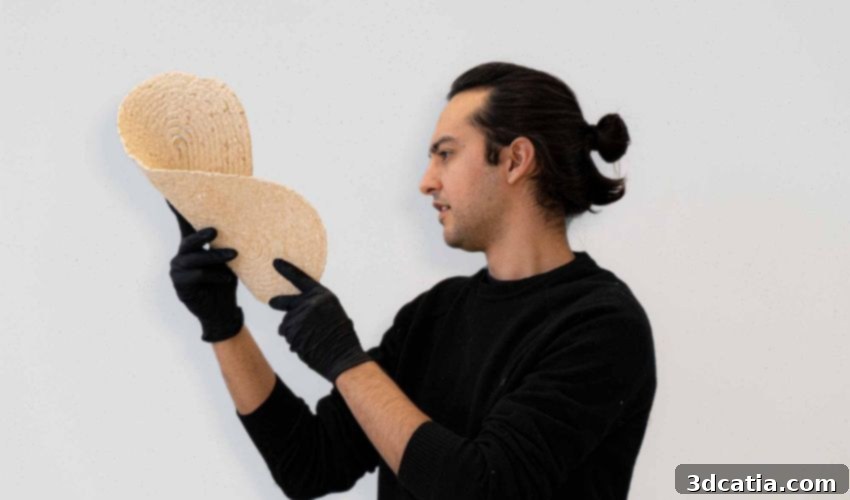
Revolutionizing Sustainable Construction: 3D Printed Sawdust Formworks Upcycle Waste for Eco-Friendly Building
As the construction industry seeks more sustainable practices, advanced manufacturing techniques, particularly 3D printing, are emerging as powerful tools for environmental innovation. The global push for greener building solutions has led to a surge in creative applications of additive manufacturing, aiming to reduce waste, conserve resources, and minimize carbon footprints. This shift is evident in concepts like upcycling, utilizing natural materials, and even employing wood as a 3D printable material. These initiatives have already demonstrated significant potential in making construction more environmentally responsible. Taking these efforts a step further, researchers at the University of Michigan have combined these three elements into a groundbreaking new project. A team known as BioMatters has developed an innovative solution that leverages 3D printed, upcycled sawdust as a sustainable and cost-effective alternative to traditional concrete formworks in the construction sector. This pioneering approach addresses the critical issue of sawdust waste while offering a viable, reusable, and responsible building material.
The Pervasive Problem of Sawdust Waste in Construction
Sawdust, a readily available byproduct of logging, lumber production, and woodworking, presents a paradox: it’s a ubiquitous resource that simultaneously poses a significant environmental and health hazard if not properly managed. Millions of tons of sawdust are generated annually worldwide, stemming from the vast scale of timber harvesting and processing. In the United States alone, an astonishing figure of over 3 million tons of sawdust finds its way into landfills each year. This disposal method is far from benign, contributing to a range of ecological problems. When sawdust decomposes in landfills, it releases harmful organic compounds, including fatty acids and lignin. These substances leach into the surrounding soil and groundwater, leading to water toxicity that can severely impact local ecosystems, harming smaller wildlife, microbial populations, and a broad spectrum of aquatic and terrestrial organisms.
Beyond its toxic potential, sawdust is also highly flammable, posing a substantial risk for wildfires, particularly in arid regions or during dry seasons. The traditional practice of burning sawdust, while reducing volume, exacerbates climate change by releasing considerable amounts of CO2 and other greenhouse gases into the atmosphere. Muhamad Dayyem Khan, a researcher with the BioMatters team and the Digital Architecture Research & Technology (DART) Laboratory, underscores the urgency of this issue: “When the sawdust decomposes, it is producing fatty acids, lignin, which causes toxicity in water. And once it starts contaminating water, it has its effects on smaller wildlife, microbes and a broad range of organisms. And with sawdust being extremely flammable, its potential contribution to wildfires is very high.” He further emphasizes the project’s core philosophy: “So rather than burning it up and generating more CO2 emissions, it is so much better that we make it into a material that is actually capable of being used again and again.” This perspective highlights the critical need to transform this problematic waste stream into a valuable, reusable resource.
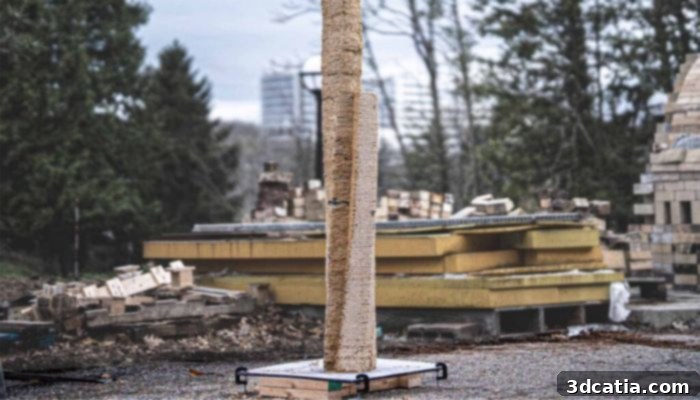
The 3D printed formwork could make use of waste lumber and sawdust left at construction sites, offering an innovative path to sustainable building (photo credits: Tharanesh Varadharajan, Zachary Keller, Muhammad Dayyem Khan)
Addressing the Challenges of Traditional Concrete Formworks
The BioMatters team’s innovative solution specifically targets formworks, which are essential molds used for casting concrete on construction sites. While seemingly straightforward, formworks represent a significant component of construction logistics, material consumption, and overall project costs. Currently, these temporary structures utilize a variety of materials, including timber, plastics, and metals. Each of these traditional options comes with its own set of environmental and economic drawbacks. Timber formworks, for instance, contribute to deforestation and often have limited reusability before degrading or being discarded. Plastic formworks, though sometimes reusable, contribute to plastic waste if not properly recycled, and their production is energy-intensive. Metal formworks are durable but also require substantial energy for manufacturing and can be costly to transport and maintain.
Economically, formworks can account for a staggering 30% to 40% of the total expenses associated with concrete construction. This high cost is driven by material acquisition, fabrication, labor for assembly and dismantling, and disposal. In environments where sawdust is already abundant—such as near sawmills or large construction sites—the potential to repurpose this byproduct into a high-performance formwork material offers a compelling alternative. The hope is that by transforming a readily available waste material into a vital construction component, the industry can significantly reduce its reliance on virgin resources, lower material costs, and drastically cut down on waste generation. This approach aligns perfectly with circular economy principles, where waste from one process becomes a valuable input for another.
The BioMatters Solution: 3D Printed Sawdust-Biopolymer Composites
The core of the BioMatters team’s innovation lies in its material science and manufacturing process. They have developed a composite material by mixing waste sawdust with specially selected biopolymers. These biopolymers act as binders, transforming the loose sawdust particles into a cohesive, extrudable paste suitable for 3D printing. Unlike raw sawdust, which is structurally weak and prone to decomposition, this engineered material possesses the necessary rheological properties for precise additive manufacturing, allowing for the creation of complex and custom formwork geometries. Crucially, the material is designed to be entirely biodegradable, ensuring that even at the end of its functional life, it returns to the environment without harmful residues. Furthermore, its inherent nature allows it to be easily reused or recycled, closing the loop on material consumption.
The 3D printing process offers unparalleled flexibility and customization. With their 3D printed sawdust formworks, the team can rapidly produce on-demand concrete casts tailored to specific architectural and structural requirements. This capability eliminates the need for mass-produced, standardized forms, reducing material waste from cutting and fitting. The precision of 3D printing also allows for the integration of intricate designs and features directly into the formwork, potentially simplifying the casting process and reducing post-processing work.
Synergistic Performance and a Circular Lifecycle
The true ingenuity of this system becomes apparent during the concrete casting and curing process. As the concrete mixture is poured into the hollow 3D printed sawdust formworks, the two materials work in a remarkable tandem. The sawdust form provides the external mold, dictating the shape of the concrete, while simultaneously stabilizing the concrete from the inside. This internal stabilization is critical in preventing deformation during the concrete’s hydration and curing, a process that can exert considerable internal pressure and heat. The engineered properties of the sawdust composite ensure it maintains its integrity throughout this critical phase, leading to accurately formed and structurally sound concrete elements.
Once the concrete has fully hardened and achieved its necessary strength, the sawdust formwork can be easily removed. This ease of demolding is a significant practical advantage, speeding up construction cycles. What sets this solution apart from conventional formworks is its complete recyclability. Unlike timber formworks that might be burned or landfilled, or plastic/metal ones requiring complex recycling infrastructure, the sawdust-biopolymer composite can be shredded, re-mixed, and reprinted for new formworks. This establishes a truly circular material flow within the construction project, drastically reducing waste and maximizing resource efficiency. This not only diminishes the environmental impact but also offers substantial economic benefits by reducing material procurement costs over the project’s lifetime.
Future Implications and the Path to Widespread Adoption
While the 3D printed sawdust formworks are still undergoing rigorous testing and refinement in university labs, the initial results and the underlying principles are profoundly promising. The steps being taken by the DART research team at the University of Michigan are not just a technical advancement; they are a beacon for the possibilities that lie ahead in sustainable construction. This project exemplifies how additive manufacturing can be harnessed to create more environmentally friendly, resource-efficient, and ultimately responsible ways to build our future cities and infrastructure. The scalability of such a solution is also a critical consideration. With abundant global sawdust waste, widespread adoption of this technology could transform waste management paradigms in the timber and construction industries, creating new value chains for materials previously considered disposable.
This innovation extends beyond merely replacing a material; it represents a paradigm shift towards a circular economy in construction. By demonstrating the feasibility of upcycling waste into high-performance building components, the BioMatters team is inspiring further research into other waste streams and their potential for additive manufacturing. This could lead to a future where construction sites generate minimal waste, and buildings are created using materials that are inherently sustainable, reducing the industry’s significant environmental footprint. The collaboration between material science, digital architecture, and environmental engineering showcased in this project highlights the interdisciplinary approach required to tackle complex sustainability challenges. This research holds the potential to set new standards for green building practices and material innovation, paving the way for a more resilient and eco-conscious construction sector worldwide.
What are your thoughts on the role of upcycling and 3D printing in the future of sustainable construction? We invite you to share your insights in a comment below or engage with us on our LinkedIn, Facebook, and Twitter pages! For the latest updates and breaking news in the world of additive manufacturing, don’t forget to sign up for our free weekly Newsletter here, delivered straight to your inbox! You can also explore all our compelling videos and interviews on our dedicated YouTube channel.
*Cover Photo Credits: Tharanesh Varadharajan, Zachary Keller, Muhammad Dayyem Khan