

MIT’s Revolutionary 3D-Printed Robotic Hand Identifies Objects with a Single Touch
In a remarkable stride forward for robotics, researchers at the Massachusetts Institute of Technology (MIT) have engineered a groundbreaking 3D-printed robotic hand equipped with advanced touch sensors. This innovative device boasts the unprecedented ability to accurately determine an object’s identity with just a single grasp. This technological leap is not merely an academic achievement; it holds immense potential, particularly in addressing the growing global challenge of an aging population. As societies face increasing demands for support and care, robotic hands like this could prove invaluable in nursing care environments and other assistive capacities in the near future. While the development of robotic hands has been a focus of numerous projects over the years, a persistent hurdle has been their inability to reliably identify objects without multiple attempts or limited sensory feedback. This new advancement from MIT offers a promising solution to these long-standing limitations, paving the way for more intuitive and efficient human-robot interaction.
Traditionally, many robotic hands have been hampered by designs that place sensors only at the fingertips. This configuration often necessitates repeated grasping attempts, as the robot gathers insufficient data from a single touch to accurately perceive an object’s full characteristics. Alternatively, some designs integrate less powerful sensors across the entire artificial finger, but these typically collect a restricted amount of information, leading to similar challenges where multiple interactions are required for adequate object recognition. These shortcomings have limited the practical utility and versatility of robotic hands in complex real-world scenarios, where rapid and accurate object identification is paramount.
Overcoming Limitations: MIT’s Innovative Design and Sensing Technology
The MIT researchers have successfully developed a novel prototype that directly addresses and resolves these inherent issues. Their innovative robotic hand features three articulated fingers, each built around a robust 3D-printed skeleton. This sturdy underlying structure provides the necessary strength and rigidity to securely grip even heavy objects, ensuring stability and control during manipulation tasks. During the meticulous design phase, the team discovered that an optimal configuration involved arranging two fingers in a ‘Y’ pattern, complemented by a third finger functioning as an opposing thumb. This biomechanically inspired setup significantly enhances the hand’s grasping capabilities, allowing for a more secure and adaptable hold on a wide array of objects.
Encasing this robust skeleton is a flexible, soft outer layer. This compliant material is essential for carefully gripping delicate or pliable objects without causing damage. What truly sets this design apart is the integration of high-resolution sensors directly within this soft, transparent skin. This ingenious “transparent skin” effectively transforms the entire surface of the finger into a sophisticated sensory array. The sensors are not mere pressure points; they incorporate miniature cameras and LEDs that work in concert to collect a vast range of visual and tactile data across the entire length of each finger. This comprehensive data acquisition allows the robotic hand to perceive not only pressure but also subtle changes in shape, texture, and contact patterns, providing a rich, holistic understanding of the object it interacts with. This integrated, full-surface sensing capability is a significant departure from previous designs and is key to the hand’s ability to identify objects instantaneously.
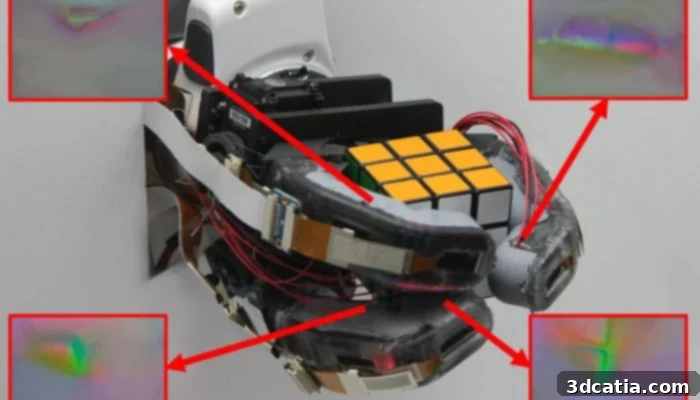
The robotic hand is equipped with several powerful sensors (Photo credit: MIT)
The Essential Blend of Strength and Softness for Advanced Manipulation
Sandra Liu, a talented student in the Department of Mechanical Engineering and a co-author of the seminal research paper on this robotic finger, eloquently articulates the profound importance of developing a hand that seamlessly combines both strength and softness. She explains, “Having both soft and rigid elements is very important in any hand, but so is being able to perform great sensing over a really large area, especially if we want to consider doing very complicated manipulation tasks like what our own hands can do. Our goal with this work was to combine all the things that make our human hands so good into a robotic finger that can do tasks other robotic fingers can’t currently do.” This insight highlights a fundamental design principle inspired by human anatomy. Our own hands possess a bony, rigid skeleton for support and power, yet they are enveloped in soft tissues that allow for delicate touch, flexibility, and adaptable gripping. MIT’s robotic hand mirrors this biological synergy, offering the best of both worlds: the robustness required for lifting heavy objects and the sensitivity needed for handling fragile items with precision and care.
The research paper detailing this innovative robotic hand was meticulously authored by Liu and her fellow student, Leonardo Zamora Yañez, under the expert guidance of their advisor, Edward Adelson. Their collective vision for this technology extends beyond the current prototype. Over time, the team aspires to continually improve the hardware, focusing on enhancing its durability to reduce wear and tear during prolonged use. Furthermore, a key area of future development involves enabling the thumb to perform a wider, more versatile array of tasks, thereby increasing the overall dexterity and adaptability of the robotic hand. This ongoing refinement promises to unlock even greater potential for complex manipulation and interaction in diverse environments, pushing the boundaries of what robotic hands can achieve.
Transformative Applications: Beyond Nursing Care
While the initial focus for this advanced robotic hand is clear – particularly in the context of nursing care and supporting an aging population – its potential applications extend far beyond healthcare. The ability to identify objects reliably and quickly with a single grasp opens doors to transformative changes across numerous industries. In manufacturing and assembly lines, robots equipped with these hands could handle a wider variety of components, including delicate or irregularly shaped parts, with unprecedented precision. This would reduce the need for specialized tools for each item, increasing efficiency and flexibility in production processes. In logistics and warehousing, these hands could revolutionize automated sorting and packaging, allowing robots to identify and pick items of various sizes, shapes, and textures with ease, significantly streamlining supply chain operations.
Furthermore, the integration of such dexterous and sensitive robotic hands could be crucial in hazardous environments, such as nuclear facilities, deep-sea exploration, or space missions, where human intervention is risky or impossible. Robots could perform intricate tasks like repairing equipment or collecting samples, providing delicate control even when remote. For individuals requiring assistive technologies or advanced prosthetics, this technology offers a glimpse into a future where artificial limbs are not just functional but genuinely sensory, allowing users to “feel” and interact with their environment in a much more natural and intuitive way. The sophisticated sensing capabilities, combined with robust yet flexible gripping, make this robotic hand a versatile tool for a myriad of complex manipulation challenges.
The Future of Robotic Gripping: Durability and AI Integration
The research team, led by Sandra Liu, Leonardo Zamora Yañez, and Edward Adelson, is committed to pushing the boundaries of this technology. Their focus on improving hardware durability is critical for real-world deployment. Reducing wear and tear will ensure that these advanced robotic hands can operate reliably over extended periods in demanding environments, minimizing maintenance requirements and maximizing operational uptime. This involves exploring new materials, refining 3D printing techniques for increased resilience, and optimizing mechanical designs to withstand repeated stress. Moreover, enhancing the versatility of the thumb component is a strategic goal. A more adaptive and multi-functional thumb would significantly expand the range of manipulation tasks the hand can perform, allowing for finer motor control and more complex interactions, mirroring the incredible adaptability of the human thumb.
Beyond hardware, the future of this robotic hand lies in its potential integration with advanced artificial intelligence and machine learning algorithms. By feeding the rich sensory data (from cameras and LEDs) into sophisticated AI models, the hand’s object identification capabilities could be refined even further, allowing it to learn about new objects and adapt its gripping strategies dynamically. This could lead to a truly autonomous robotic system capable of nuanced interaction with an unpredictable world. Imagine robots that can not only identify an apple but also discern its ripeness or detect a bruise just by touching it. This blend of cutting-edge hardware and intelligent software promises to usher in a new era of robotics where machines are not just tools, but intelligent, perceptive collaborators capable of performing tasks with human-like dexterity and understanding.
Conclusion: A New Era for Human-Robot Collaboration
The development of MIT’s 3D-printed robotic hand represents a monumental leap in the field of robotics and advanced manufacturing. By ingeniously combining a robust 3D-printed skeleton with a flexible, sensor-rich transparent skin, the researchers have created a device that elegantly resolves the long-standing challenge of reliable object identification with a single grasp. This breakthrough, championed by researchers like Sandra Liu, highlights the critical importance of blending strength and softness, mirroring the incredible capabilities of the human hand. With its potential to revolutionize industries from nursing care and manufacturing to logistics and hazardous environment exploration, this technology is poised to redefine human-robot interaction. As the research continues, focusing on enhanced durability and greater thumb versatility, we can anticipate a future where intelligent robotic hands play an increasingly integral role in our daily lives, assisting with complex tasks and improving the quality of life for many. The journey toward more intuitive, dexterous, and perceptive robotic assistants has just taken a significant step forward.
More information about the project can be found HERE.
What are your thoughts on this revolutionary 3D-printed robotic hand and its potential impact on various sectors? Share your insights in a comment below or join the conversation on our LinkedIn, Facebook, and Twitter pages! Don’t miss out on the latest advancements in 3D printing and robotics – remember to sign up for our free weekly Newsletter here, delivering the most relevant news straight to your inbox! You can also explore all our fascinating videos on our YouTube channel for more visual content and in-depth discussions.
*Cover photo credit: Robofunction Systems