
Revolutionary Robotic Fish: 3D Printed ‘Gillbert’ Tackles Microplastic Pollution
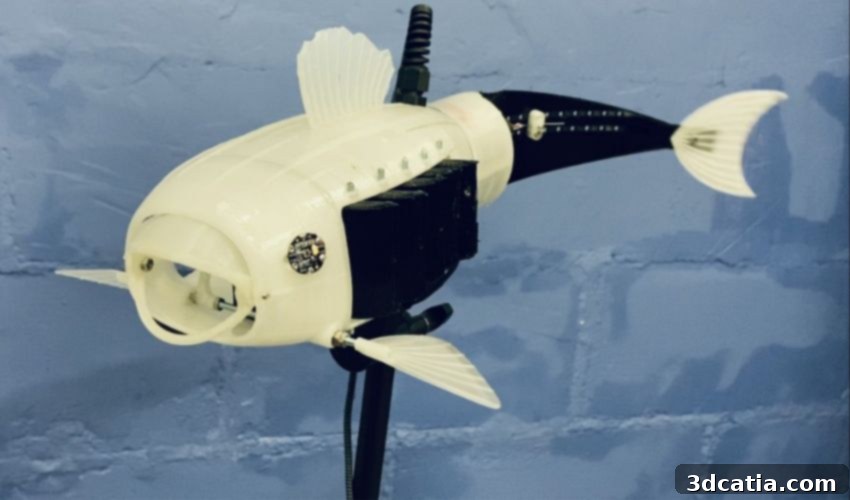
In a remarkable stride towards combating the global microplastic crisis, a student at the University of Surrey has pioneered the design of an innovative robotic 3D printed fish, affectionately named ‘Gillbert.’ This groundbreaking creation is engineered to actively collect microplastics from water bodies as it ‘swims,’ offering a potential solution to one of the most pressing environmental challenges of our time. Eleanor Mackintosh, the brilliant mind behind Gillbert, developed this concept as part of a prestigious competition orchestrated by the University’s leading robotics researchers. The competition promised to transform the winning entry into a functional prototype, a promise that has now been magnificently fulfilled with the realization of Gillbert.
The inception of this competition was lauded by Dr. Robert Siddall, a Lecturer at the University of Surrey, as a “novel piece of science communication.” He highlighted its unique advantage in leveraging the “intuitive sense of animal and plant behavior” that resonates deeply with many people. This foundational understanding allowed participants to conceptualize solutions rooted in nature’s efficiencies. From Eleanor’s initial, visionary idea, a salmon-sized robotic fish emerged, distinguished by its specially designed, mesh-covered gills. These intricate gills are the core of Gillbert’s functionality, enabling it to efficiently suck up microplastics from various water sources and securely store them within its body for later disposal and analysis.
Understanding the Pervasive Threat of Microplastic Pollution
Eleanor Mackintosh’s profound motivation for designing Gillbert stems from a deep-seated concern over the escalating crisis of marine and freshwater pollution. Her aspiration was to devise a tangible method, through the innovative application of robotic design, to mitigate this widespread environmental degradation. The urgency of this issue cannot be overstated, particularly in regions like the UK, where water pollution remains a severe and alarming concern. England, for instance, grapples with one of the poorest water qualities across Europe, with a dismaying statistic revealing that a mere 14 percent of its rivers are in a “good” ecological condition. This dire situation poses multifaceted threats, causing significant harm to delicate wildlife ecosystems and simultaneously endangering human populations who rely on these water bodies for various uses, from recreation to essential resources.
Microplastics, defined as plastic particles smaller than five millimeters, are ubiquitous pollutants found in oceans, rivers, lakes, and even tap water and air. They originate from the breakdown of larger plastic debris, industrial waste, personal care products, and synthetic textiles. These insidious particles are particularly problematic due to their persistent nature and their ability to absorb toxic chemicals, which can then be transferred up the food chain. Marine organisms, from plankton to whales, inadvertently ingest microplastics, leading to a range of physiological damages including reduced feeding, impaired reproduction, and altered behavior. For humans, exposure to microplastics through contaminated seafood and drinking water raises serious health concerns that are still being investigated, but the potential for long-term adverse effects is a growing area of scientific inquiry. Gillbert represents a proactive step in addressing this complex and pervasive challenge, by targeting the collection of these harmful particles at their source.
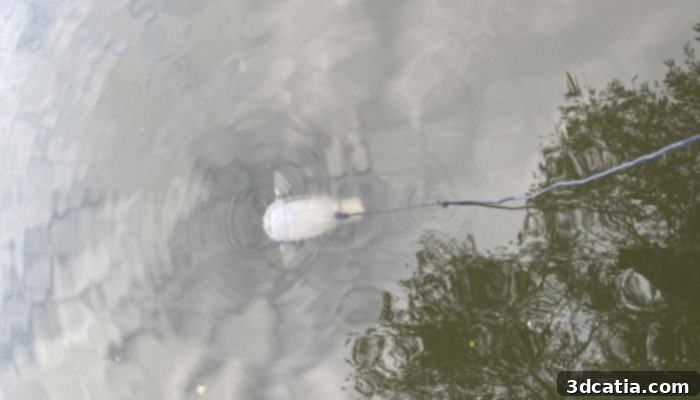
The robotic fish was tested in water
The Vision for a Cleaner Future
Dr. Siddall emphasized the profound significance of this project: “We don’t know where the vast majority of plastic dumped into our waterways ends up. We hope that this robo-fish and its future descendants are the first steps in the right direction to helping us to find and, eventually, control this plastic pollution problem.” His words underscore the critical need for innovative tools like Gillbert to not only collect existing pollution but also to provide valuable data that can inform broader conservation strategies and policy changes. The current lack of comprehensive data on microplastic distribution and accumulation makes effective remediation incredibly difficult. Gillbert, therefore, holds the promise of being an eyes-and-ears solution, mapping pollution hotspots and contributing to a more complete understanding of plastic’s journey through our aquatic environments.
Engineering Gillbert: An Accessible 3D Printing Approach
The design and fabrication of this pioneering robotic fish leveraged the power of open-source resources, making the project inherently collaborative and reproducible. The team utilized freely available design files, a strategic choice to encourage widespread adoption and further development by researchers, educators, and hobbyists globally. To produce the physical components of Gillbert, the team opted for an FDM (Fused Deposition Modeling) printer, specifically the Prusa Mini+, equipped with a 0.4mm nozzle. This deliberate selection of a low-cost, readily available printer, coupled with accessible open-source files, was crucial. It ensured that the robotic fish’s design was not only innovative but also highly reproducible by others, democratizing the potential for similar environmental clean-up efforts.
A key innovative aspect of Gillbert’s construction lies in its microplastic-trapping gills. To create these specialized components, the team ingeniously printed gill plates and periodically paused the printing process. During these pauses, segments of fine nylon mesh were meticulously added and integrated between the successive 3D printed layers. This layered integration of the mesh material created a highly effective filtration system within the gills, designed to capture even minute microplastic particles while allowing water to flow freely. This technique demonstrates a clever application of FDM printing capabilities to embed functional materials within complex structures, proving the versatility of additive manufacturing beyond simple prototyping.
Testing and Future Enhancements
Upon completion of its assembly, Gillbert underwent rigorous testing in various water sources. The results were highly encouraging: the robotic fish proved consistently successful in efficiently trapping microplastics. This validation marks a significant milestone, confirming the viability of Eleanor’s design and the team’s manufacturing approach. However, the researchers also acknowledged existing limitations and outlined ambitious plans for future development. A critical next step involves equipping the fish with the capability to analyze the collected microplastics in situ. Currently, Gillbert can collect, but not immediately test, the nature or composition of the plastics it gathers.
To address this, automation of the testing process is deemed essential for Gillbert to evolve into a truly invaluable tool for comprehensive ocean and freshwater sampling. The vision includes a sophisticated docking station concept. This proposed station would house a dedicated sampling chamber, where Gillbert could offload its collected microplastics for automated analysis. Furthermore, the docking station would be designed to thoroughly clean the fish’s collection chamber, preparing it for subsequent missions of microplastic detection and retrieval. Such an integrated system would significantly enhance Gillbert’s autonomy and efficiency, allowing for continuous monitoring and data collection without constant human intervention.
The Broader Impact: Robotics and Additive Manufacturing
The development of Gillbert is not an isolated incident but rather a testament to the growing synergy between robotics and additive manufacturing. Robotic creations have increasingly found critical applications in the field of 3D printing itself. Robotic arms, for instance, play an indispensable role in advanced 3D printing systems, often overcoming the inherent limitations of traditional gantry-based methods. Their flexibility, extended reach, and ability to print complex geometries from multiple angles open up new frontiers in additive manufacturing, enabling larger-scale prints, more intricate designs, and the integration of diverse materials. If you are intrigued by this fascinating intersection of technologies, you can explore some of the most exciting robotic solutions on the market that are revolutionizing the 3D printing landscape.
The success of Gillbert also highlights the immense potential for collaborative innovation, especially between academic institutions and enthusiastic students. It underscores how accessible technologies like 3D printing can be harnessed to address complex global challenges. For those eager to delve deeper into the specifics of Gillbert’s journey and development, a comprehensive write-up of the project is available HERE on the University of Surrey’s official website. Furthermore, for individuals with a keen interest in the intricate technical and scientific underpinnings of this project, the detailed scientific report can be accessed HERE. These resources offer invaluable insights into the research methodologies, design principles, and experimental results that brought Gillbert to life.
This project serves as a powerful example of how student-led innovation, supported by academic research, can yield practical and impactful solutions to environmental problems. It showcases the versatility of 3D printing and robotics not just for industrial applications, but also for critical ecological initiatives. The future of environmental conservation may very well depend on the continued development of such intelligent, autonomous systems, capable of working tirelessly to restore and protect our planet’s precious natural resources.
We’d love to hear your thoughts on this inspiring project! What do you think of Gillbert’s potential impact on microplastic pollution? Share your insights and comments below, or join the conversation on our LinkedIn,Facebook, andTwitter pages. Stay ahead of the curve with the latest advancements in additive manufacturing by signing up for our free weeklyNewsletter here, delivering the most relevant 3D printing news directly to your inbox. You can also explore all our engaging video content, including demonstrations and interviews, on our dedicatedYouTube channel. Your engagement helps us foster a community passionate about the future of 3D printing and its applications for a better world.
*All content credit: Rob Siddall