
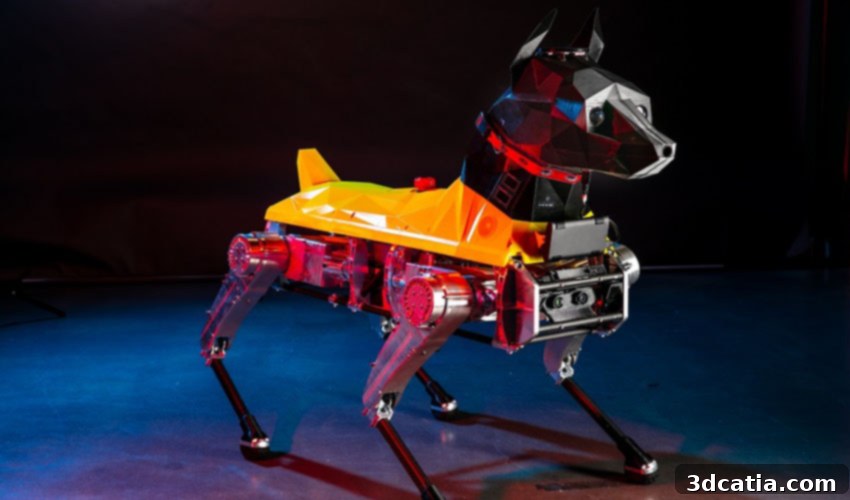
Astro: Florida Atlantic University Unveils 3D-Printed AI Robodog for Advanced Security and Cognitive Learning
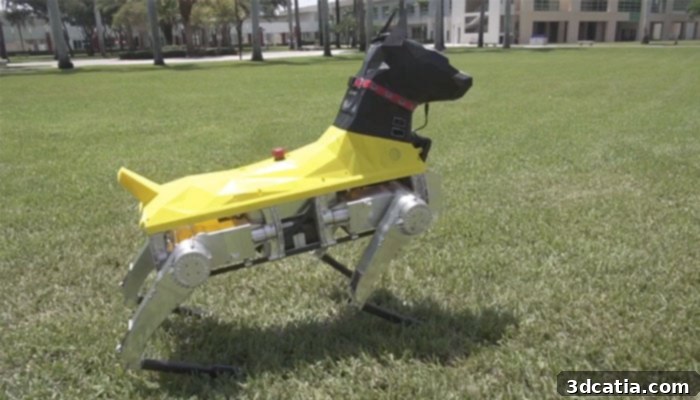
A groundbreaking innovation has emerged from Florida Atlantic University (FAU), specifically from its renowned Machine Perception and Cognitive Robotics Laboratory (MPCR). A team of dedicated scientists has engineered Astro, a highly advanced quadruped robot, affectionately dubbed a “robodog.” This pioneering prototype distinguishes itself through its sophisticated integration of deep learning and artificial intelligence (AI), granting it the remarkable abilities to see, hear, and most importantly, learn from its environment in a manner akin to a living organism. What sets Astro apart from previous robotic creations is its unique physical embodiment: it is meticulously 3D printed to strikingly resemble a Doberman pinscher, complete with a head housing its complex computational brain – a structural detail often overlooked in earlier 3D-printed robots.
Astro represents a significant leap forward in robotic development. Unlike conventional robots that operate based on rigid, preprogrammed automation, Astro’s design philosophy centers around mimicking canine learning. Its ‘brain’ is engineered to accumulate knowledge and refine its actions through continuous experience, enabling it to perform a variety of dog-like tasks with increasing proficiency. This state-of-the-art robodog weighs 100 pounds and is outfitted with an impressive array of advanced technology, including a multitude of sensors, high-tech radar imaging systems, multiple cameras for comprehensive visual input, and a highly sensitive directional microphone. These components work in concert to provide Astro with a rich, multi-modal perception of its surroundings.
The Mission of Astro: An Intelligent Information Scout
The primary purpose behind Astro’s creation is to serve as an intelligent information scout, particularly in high-stakes environments. Its designated missions are critically important, encompassing the detection of concealed guns, explosives, and residual gun particles. This capability is envisioned to provide invaluable assistance to various critical sectors, including law enforcement agencies, military operations, and private security personnel. The effectiveness of Astro in these roles is directly tied to its capacity for experiential learning; the more exposure it gains to different scenarios and data, the more adept and reliable it becomes in its detection and analysis tasks.
As Astro continues to evolve through its learning processes, its capabilities are projected to expand dramatically. The scientists anticipate that it will eventually be able to comprehend and respond to intricate hand signals, accurately distinguish between a vast spectrum of colors, and even understand and process multiple human languages. Furthermore, Astro is being developed with the capacity to seamlessly coordinate its activities with unmanned aerial vehicles (drones), creating a synergistic robotic team for enhanced surveillance and data collection. Perhaps most remarkably, Astro is expected to develop the ability to distinguish between individual human faces and even recognize other dogs, showcasing a level of cognitive sophistication that blurs the lines between biological and artificial intelligence.
Collaborative Genius: The Interdisciplinary Team Behind the 3D Printed Robot Dog
The creation of Astro is a testament to the power of interdisciplinary collaboration, bringing together a diverse group of experts. The core team of scientists at FAU, deeply immersed in the study of the intricate workings of the human brain, partnered with a broad spectrum of specialists. This includes IT experts, creative artists, insightful biologists, perceptive psychologists, and even the fresh perspectives of high school and university undergraduate and graduate students. This rich tapestry of knowledge and skills was instrumental in bringing the Astro project to fruition. Dr. Ata Sarajedini, Ph.D., Dean of FAU’s Charles E. Schmidt College of Science, emphasized the critical expertise of his team, stating, “Our Machine Perception and Cognitive Robotics laboratory team was sought out by Drone Data’s Astro Robotics group because of their extensive expertise in cognitive neuroscience, which includes behavioral, neurophysiological and embedded computational approaches to studying the brain.” This collaboration highlights the essential role of understanding biological cognition in developing truly intelligent artificial systems.
The ultimate goal for this cutting-edge 3D printed robot dog is to achieve true autonomous learning and react effectively in real-time to dynamic environmental cues. To facilitate this ambitious objective, Astro will be equipped with more than a dozen sophisticated sensors designed to ingest environmental input across an impressive array of modalities. These include optical sensors for visual data, microphones for sound analysis, gas sensors to detect airborne substances, and advanced radar for comprehensive spatial mapping and object identification. Such a diverse sensory suite ensures that Astro can build a holistic and detailed understanding of its surroundings, a crucial prerequisite for intelligent decision-making.
Processing such vast amounts of real-time sensory data and making autonomous behavioral decisions requires immense computational power. An official press release from FAU elaborated on Astro’s robust internal architecture: “To process the sensory inputs and make autonomous behavioral decisions, a set of Nvidia Jetson TX2 graphics processing units are onboard with a combined four teraflops of computing power, which amounts to about four trillion computations a second.” This extraordinary processing capability allows Astro to perform complex deep learning algorithms on the fly, enabling it to execute highly sophisticated tasks. For instance, it will be able to instantaneously search and identify specific faces against an embedded database, analyze air quality to detect illicit or dangerous substances, and accurately hear and respond to distress calls from humans, providing an invaluable layer of security and assistance.
The Future is Now: Additive Manufacturing Meets Machine Learning in Robotics
This project is undeniably a very promising endeavor, pushing the boundaries of what is possible in robotics. The field of additive manufacturing, commonly known as 3D printing, has already revolutionized numerous scientific applications, offering unparalleled flexibility in design and rapid prototyping. However, the strategic integration of advanced machine learning and artificial intelligence with 3D printing, as demonstrated by Astro, opens up a completely new realm of possibilities. This synergy allows for the creation of complex, custom-designed robotic platforms that can not only be physically optimized for specific tasks but can also learn and adapt in ways previously confined to science fiction.
Dr. Ata Sarajedini further underscored the profound impact of this research, adding, “Astro is inspired by the human brain and he has come to life through machine learning and artificial intelligence, which is proving to be an invaluable resource in helping to solve some of the world’s most complex problems.” This statement highlights the philosophical foundation of Astro’s design: drawing inspiration from biological intelligence to engineer artificial systems capable of tackling challenges ranging from security threats to environmental monitoring and beyond. The ability of such robots to learn, adapt, and operate autonomously in challenging environments signals a significant paradigm shift in how we approach problem-solving with technology.
Expanding Horizons: Potential Applications and Ethical Considerations of Astro
The potential applications for a robodog with Astro’s capabilities extend far beyond its initial role as an information scout for police, military, and security personnel. Imagine Astro assisting in search and rescue operations in disaster zones, navigating treacherous terrains unsuitable for humans, or inspecting hazardous industrial facilities for leaks or structural weaknesses. Its capacity to detect specific substances and identify individuals could make it invaluable for border security, counter-terrorism efforts, and even environmental protection, where it could monitor pollution levels or track endangered species without human interference. The agility and resilience of a quadrupedal robot, combined with its cognitive abilities, open doors to complex logistical challenges that wheeled or tracked robots might struggle with.
Moreover, Astro’s learning architecture, which mimics biological processes, positions it as a critical research platform for understanding AI evolution. By studying how Astro learns from experience, researchers can gain deeper insights into the mechanisms of artificial intelligence, potentially leading to breakthroughs in fields like machine cognition and human-robot interaction. The ability to distinguish human faces and understand languages could eventually lead to roles as highly advanced companion robots for the elderly or individuals with disabilities, offering assistance and support tailored to their specific needs. However, as with all powerful technologies, the development of intelligent, autonomous robots like Astro also raises important ethical considerations. Questions surrounding data privacy, particularly with facial recognition capabilities, the potential for misuse, and the accountability of autonomous systems, will require careful deliberation as these technologies become more prevalent in our society.
Florida Atlantic University’s commitment to pushing the boundaries of cognitive robotics and AI is clearly demonstrated through the Astro project. By fostering an environment of interdisciplinary research and leveraging cutting-edge technologies like 3D printing and advanced machine learning, FAU is not just building robots; it is shaping the future of human-robot collaboration and intelligent systems. Astro is a testament to the fact that when diverse minds unite, inspired by nature and empowered by technology, truly revolutionary advancements are within reach. This robodog is more than just a machine; it is a learning entity poised to address some of the most complex challenges facing the world today, bridging the gap between biological and artificial intelligence in unprecedented ways.
What are your thoughts on Astro and the future of intelligent robodogs? We’d love to hear your perspective! Let us know in a comment below or join the conversation on our Facebook and Twitter pages! Don’t forget to sign up for our free weekly Newsletter, with all the latest news in 3D printing delivered straight to your inbox!