

Revolutionizing Micro-Manufacturing: The 3D Printing of Pure Gold Microstructures
Imagine fabricating intricate, microscopic components from pure gold with unprecedented precision. This ambitious vision is becoming a reality thanks to groundbreaking research conducted by a dedicated team of scientists at the University of Twente in the Netherlands. Their innovative approach leverages advanced laser technology to meticulously deposit fine droplets of precious metals, enabling the design and creation of complex shapes with characteristic dimensions as small as 10 microns. This breakthrough heralds a new era for micro-manufacturing, particularly for industries where the unparalleled properties of gold – such as its electrical conductivity, biocompatibility, and corrosion resistance – are highly valued.
The field of additive metal manufacturing has witnessed exponential growth in recent years, with a myriad of solutions emerging in the global market. A diverse array of metals, including ubiquitous options like aluminum, stainless steel, and titanium, alongside high-value precious metals, are now being processed through additive techniques. Traditionally, metal structures have been produced using subtractive or bulk processes such as lithography, casting, or advanced methods like selective laser sintering or melting. While these techniques are well-established for larger scales, they often encounter significant limitations when attempting to create structures where the characteristic size falls below 10 microns. This micron-scale precision is not merely a technical challenge but a critical requirement for a vast range of advanced applications, especially in the rapidly evolving electronics sector, where miniaturization and performance are paramount.

Laser-Induced Forward Transfer (LIFT): A New Frontier in Micro 3D Printing
The core of this pioneering research lies in a sophisticated 3D printing process known as “Laser-induced forward transfer” (LIFT). This method is elegantly simple yet incredibly powerful. It involves directing an ultra-short laser pulse onto an exceptionally thin metal film, sometimes as fine as a nanometer. The precise energy of this laser pulse instantaneously melts a minuscule portion of the metal film, forming a tiny droplet. This molten droplet is then propelled forward, or “ejected,” from the film onto a predefined target substrate. Upon landing, the droplet rapidly solidifies, creating a solid metallic voxel. By repeating this process with extreme accuracy and speed, the researchers can build up complex three-dimensional microstructures layer by layer, essentially “drawing” with individual metal droplets.
The choice of laser parameters – particularly the pulse duration and energy – is crucial for the LIFT process. Ultra-short pulses minimize heat affected zones, ensuring that only the target material is precisely melted and ejected, preventing damage to the surrounding film and maintaining high fidelity in the deposited structure. This direct-write technique offers significant advantages over conventional micro-fabrication methods, including unparalleled resolution, material versatility, and the ability to fabricate complex geometries that would be impossible with traditional lithographic or etching processes. The high precision and localized heating mechanism of LIFT make it an ideal candidate for working with sensitive and valuable materials like gold, where waste reduction and structural integrity are key considerations.
Crafting Pure Gold Microstructures: A Propeller Demonstration
To demonstrate the efficacy and potential of their LIFT process, the research team focused on two key metals: copper and gold. These metals were chosen primarily due to their similar melting points, which simplifies the multi-material printing process. In this innovative setup, copper served a crucial role as a sacrificial mechanical support material, providing the necessary structural integrity during the fabrication of intricate gold components. To rigorously test their method, the team embarked on the ambitious task of 3D printing a propeller, mere microns in size, meticulously crafted from both pure gold and copper droplets.
The fabrication sequence involved depositing alternating layers or strategic placements of copper and gold droplets to form the desired propeller shape. Once the composite structure was complete, the real ingenuity of the process came into play: the removal of the support material. The researchers meticulously immersed the propeller in ferric chloride, a chemical etchant specifically chosen for its ability to selectively attack and dissolve copper while leaving the pure gold structure completely untouched. This chemical etching process precisely and completely eliminated the copper support, resulting in a free-standing, self-propelled propeller composite composed entirely of pure gold. This remarkable miniature propeller isn’t just a testament to their printing capabilities; it showcases the potential for highly functional micro-devices. Such a pure gold microstructure could serve as a miniature electric inductor, leveraging gold’s superior conductivity, or function as a micro-mechanical spring, exploiting its material properties for compliant mechanisms at the micro-scale.
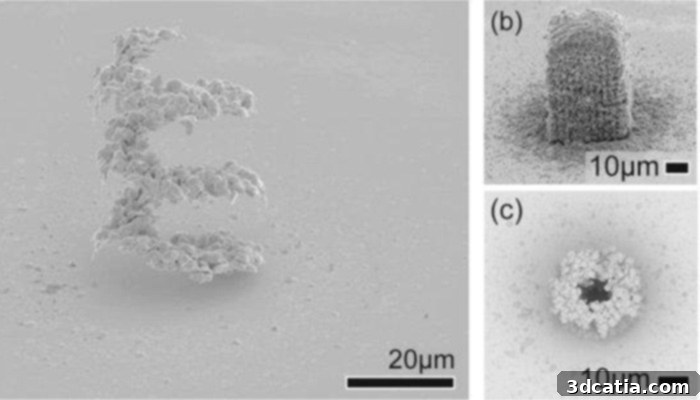
In (b), the gold is contained within its copper support, forming a box-like structure before etching.
Overcoming Challenges: Precision and Purity at the Micro-Scale
While the LIFT method offers immense promise, it is not without its inherent challenges. A significant concern for the researchers was the potential for the two distinct types of metals – gold and copper – to mix at their interface during the ejection and solidification phases. Such mixing could severely compromise the purity and desired material properties of the final 3D printed structure, potentially degrading its electrical, mechanical, or chemical performance. To circumvent this critical issue, the LIFT process was meticulously designed and optimized. This involved precise control over laser pulse energy, duration, and the physical properties of the thin metal films, ensuring that droplet ejection was clean and that intermixing was minimized or entirely prevented.
The successful implementation of these preventative measures yielded impressive results: the fabricated gold microstructures exhibited a remarkably low surface roughness, typically ranging between 0.3 and 0.7 micrometers. This level of smoothness is exceptional for additively manufactured metallic parts at this scale, indicating a high degree of control over the deposition process and minimal material deformation. Furthermore, the ability to work with metal droplets having a volume of just a few femtoliters underscores the extreme precision of this technology. A femtoliter is an incredibly small unit of volume (10^-15 liters), highlighting the ability to build structures with truly nano-to-microscopic resolution, which is essential for future generations of micro-electronic and micro-mechanical devices.
Diverse Applications and Future Horizons for LIFT Technology
The potential applications of this advanced LIFT technology are vast and transformative, spanning numerous high-tech industries. Researchers envision its widespread adoption for 3D printing highly specialized micro-components essential for next-generation electronics. This could include ultra-fine interconnects, microscopic antennas, or custom circuit elements where pure gold’s superior conductivity and reliability are indispensable. Similarly, in photonics, LIFT could enable the creation of intricate optical waveguides, plasmonic structures, or micro-lenses, pushing the boundaries of light manipulation at the chip level.
Beyond electronics and optics, the technology holds significant promise for micro-mechanical devices. The ability to precisely fabricate miniature gears, springs, actuators, and other complex mechanical parts from pure metals could revolutionize fields like microrobotics, precision instrumentation, and advanced sensor technologies. In the biomedical sector, the biocompatibility and inertness of gold make it an ideal material for miniature sensors, implantable devices, or drug delivery systems that require high precision and safety. The researchers are also keen to expand the scope of their method to include other noble metals, specialty alloys, and even combinations of dissimilar materials, further broadening its utility. This continuous development promises to unlock even more innovative solutions across scientific and industrial landscapes, offering a cost-effective and highly customizable pathway for advanced material fabrication. You can find all the intricate details of this groundbreaking research HERE.
What are your thoughts on this remarkable 3D printing method for pure gold microstructures? We invite you to share your insights and predictions in the comment section below. Connect with us and join the discussion on our Facebook and Twitter pages! And don’t forget to sign up for our free weekly Newsletter to stay updated on all the latest breakthroughs and news in the exciting world of 3D printing, delivered directly to your inbox!