
Caltech’s 3D Printed Microrobots: Pioneering Precision in Targeted Drug Delivery
The landscape of medicine is continuously being reshaped by advancements in technology, and 3D printing stands at the forefront of this revolution. For years, additive manufacturing has promised and delivered breakthroughs, from the development of 3D-printed custom drugs tailored to individual patient needs to the bioprinting of complex human tissue replicas. This innovative technology offers an unprecedented level of personalization in treatments, paving the way for more effective and less invasive therapeutic approaches. Building upon these foundations, researchers at Caltech have now introduced a groundbreaking development: minuscule robots designed for targeted drug delivery, made possible by sophisticated additive manufacturing techniques.
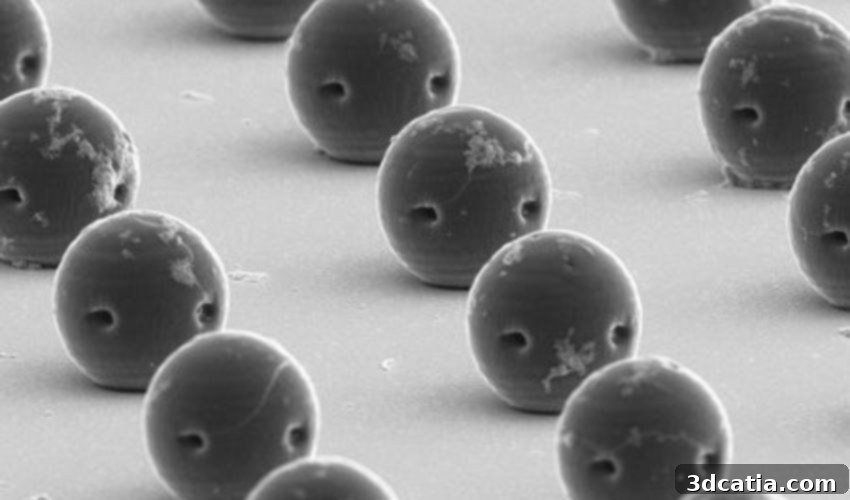
These aren’t the conventional robots one might envision from science fiction. Instead, these remarkable devices are tiny, bubble-like spheres engineered to navigate the intricate biological pathways within the human body. Once administered, they can be precisely directed to a specific disease site, promising a new era of localized treatment. However, designing such an advanced system presents a formidable set of challenges. Firstly, these microrobots must exhibit exceptional resilience, capable of surviving the harsh and varied environments of bodily fluids such as blood, urine, or stomach acid without degradation. Secondly, they require precise controllability, ensuring they reach their intended target accurately and efficiently. Only upon arrival at the specified location can they perform their crucial task: releasing their medicinal payload. Finally, and critically, after delivering their therapeutic cargo, these microrobots must be safely absorbed and cleared by the body, leaving no harmful residues or side effects. Meeting these stringent requirements is paramount for their safe and effective application in clinical settings.
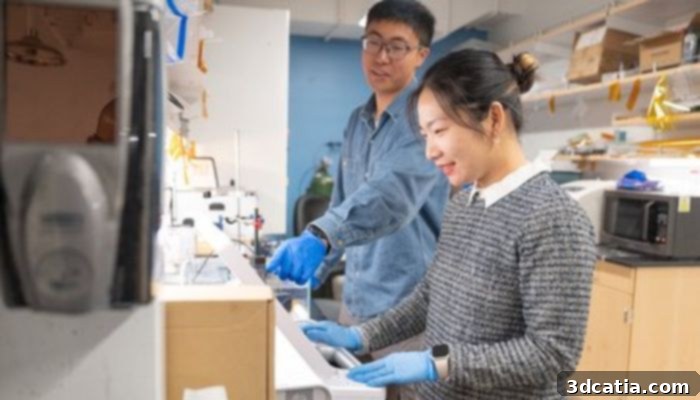
Graduate students and lead authors Hong Han and Xiaotian Ma collaborate with Prof. Wei Gao on experiments involving ultrasound imaging-guided acoustic propulsion of the microrobots.
(Photo Credit: Lance Hayashida/Caltech)
The dedicated team of Caltech researchers has successfully risen to these challenges, developing minuscule robots that not only meet all the demanding requirements but also excel in performance. They have named these innovative creations Bioresorbable Acoustic Microrobots, or BAMs. What makes BAMs particularly noteworthy is their proven efficacy: in preliminary studies conducted on mice, these microrobots successfully delivered medicine that significantly reduced the size of bladder tumors. This achievement underscores their immense potential in cancer therapy. Dr. Wei Gao, a distinguished professor of medical engineering at Caltech, a Heritage Medical Research Institute Investigator, and co-corresponding author of the seminal paper detailing these bots, eloquently articulated the distinct advantage offered by BAMs. “Rather than putting a drug into the body and letting it diffuse everywhere, now we can guide our microrobots directly to a tumor site and release the drug in a controlled and efficient way,” Gao stated. This capability represents a significant leap forward from conventional systemic drug delivery methods, which often lead to widespread distribution of drugs, limiting their efficacy at the target site and causing unwanted side effects throughout the body. By enabling precise targeting, BAMs promise to enhance therapeutic outcomes while minimizing collateral damage to healthy tissues.
Advanced Manufacturing: Printing the Microrobots
At the core of Caltech’s BAM technology lies their sophisticated design and manufacturing process. Specifically, these bioresorbable acoustic microrobots are spherical microstructures meticulously crafted from a specialized hydrogel known as poly(ethylene glycol) diacrylate. While the concept of microrobots itself is not entirely new – researchers have been exploring various iterations for the past two decades – Caltech’s innovation lies in its unique hydrogel formulation and the precise manufacturing method, which together enable these bots to navigate a living system with unprecedented ease and efficiency. Hydrogels are remarkable materials that begin in a liquid or resin state and then undergo a hardening process as their polymer chains become cross-linked. This unique structural transformation allows them to retain substantial amounts of fluid, a property that makes many hydrogels highly biocompatible, meaning they can exist within the body without eliciting an adverse immune response or causing toxicity. This biocompatibility is crucial for the safe internal application of the BAMs, ensuring they do not harm the surrounding biological environment.
The specific hydrogel formula critical to the BAMs’ success was developed by Julia R. Greer, a distinguished professor of materials, mechanics, and medical engineering at Caltech, and also a co-corresponding author on the pivotal paper. Professor Greer’s team brought extensive expertise in two-photon polymerization (TPP) lithography to this project. TPP is an advanced 3D printing technique that employs super-fast, ultrashort pulses of infrared light to selectively cross-link photosensitive polymers. Unlike traditional photolithography, which uses a single photon and exposes an entire layer, TPP uses two photons simultaneously absorbed at a focal point, allowing for three-dimensional structuring with nanoscale precision. This exceptional precision is paramount, allowing intricate, specific patterns to be meticulously followed and fabricated. Layer by layer, Professor Greer and her team employed this cutting-edge TPP process to 3D print the minuscule microrobots, achieving incredible resolution where features were separated by mere tens of microns – roughly equivalent to the diameter of a human hair. This level of detail is essential for creating the complex internal and external structures required for the robots’ functionality, including their ability to trap air bubbles and possess specific surface properties.
Crafting the specific spherical geometry of the BAMs presented a unique engineering challenge, as Professor Greer elaborated. “This particular shape, this sphere, is very complicated to write,” she explained. “You have to know certain tricks of the trade to keep the spheres from collapsing on themselves. We were able to not only synthesize the resin that contains all the biofunctionalization and all the medically necessary elements, but we were able to write them in a precise spherical shape with the necessary cavity.” This intricate spherical design, combined with its internal cavity, is fundamental to the microrobots’ ability to carry therapeutic payloads and utilize acoustic propulsion, showcasing the team’s mastery in both material science and advanced microfabrication.
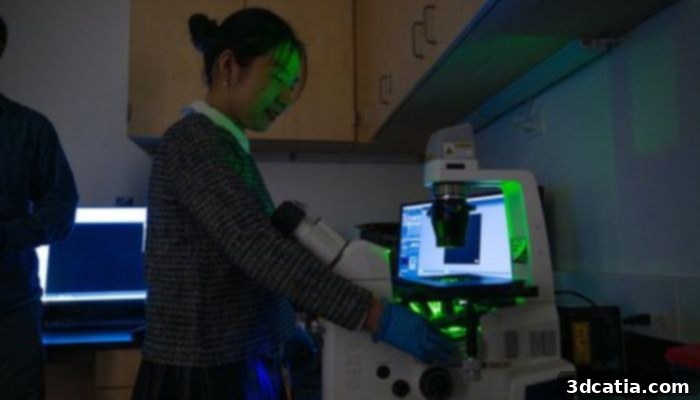
Graduate student and lead author Hong Han examines the microrobot under a fluorescence microscope.
(Photo Credit: Lance Hayashida/Caltech)
Precision Control: How Are The BAMs Directed?
A critical aspect of the Caltech team’s BAMs is their remarkable controllability, which relies on an ingenious, perhaps surprising, addition: magnets. Each BAM is not only loaded with therapeutic drugs but also infused with magnetic nanoparticles. This integration allows researchers to precisely guide the robots to a specific anatomical location within the body using externally applied magnetic fields. Once a microrobot successfully reaches its intended target, these magnetic forces can hold it firmly in place, ensuring that the therapeutic drug can then passively diffuse into the surrounding tissue. This passive diffusion mechanism ensures a gradual and sustained release of the medication directly where it is needed most, maximizing its localized effect and minimizing systemic exposure, which is a common drawback of many drug delivery methods.
According to Professor Gao, one of the most significant innovations stemming from this project was the ability to engineer the robots with a hydrophilic (water-attracting) exterior and a hydrophobic (water-repelling) interior. This asymmetric surface modification is a subtle yet powerful design choice. The hydrophilic exterior plays a crucial role in preventing individual robots from clumping together as they navigate through the body’s complex biological fluids. Aggregation of microrobots would severely hinder their movement and targeted delivery capabilities. Conversely, the interior of the microrobots was intentionally designed to be hydrophobic because it needed to securely trap an air bubble – a feature fundamental to the robots’ propulsion mechanism. A hydrophilic interior would cause the bubble to easily collapse or dissolve, rendering the propulsion ineffective. Professor Gao elaborated on the importance of this design: “This asymmetric surface modification, where the inside is hydrophobic and the outside is hydrophilic, really allows us to use many robots and still trap bubbles for a prolonged period of time in biofluids, such as urine or serum.” This meticulous engineering ensures the stability and longevity of the trapped air bubbles, enabling the microrobots to maintain functionality and deliver treatments over an extended period within challenging biological environments.

The flow patterns generated by an acoustic hydrogel microrobot vibrating at its optimal frequency were analyzed using advanced methods, including tracking tiny particles in water and computer-based simulations. The position of the microrobot’s two openings are visible here.
Remarkably, these advanced microrobots demonstrated significant improvements in operational longevity, capable of sustained functionality for several days of treatment, a vast improvement compared to earlier versions that could only last for mere minutes. This extended lifespan is crucial for applications requiring prolonged or repeated drug delivery. The trapped air bubbles within the BAMs serve multiple vital purposes, extending beyond simple flotation. They are absolutely critical for both the robots’ propulsion through bodily fluids and for their real-time tracking within the body. For propulsion, each microrobot is equipped with two precisely engineered cylindrical openings. When these robots are exposed to an external ultrasound field, the trapped air bubbles within them begin to vibrate rapidly. This vibration generates a localized acoustic streaming effect, causing the surrounding fluid to be expelled away from the robot through these openings, much like a jet propulsion system. This directed expulsion of fluid generates a reactive force that propels the microrobot forward. In their extensive research, Professor Gao and his team made a key discovery: two holes were significantly more effective than just one. This dual-opening design allows the robots to move through a wider variety of viscous biofluids with greater efficiency and achieve a higher speed compared to designs with a single opening, enhancing their versatility in diverse biological settings.
Furthermore, each microrobot incorporates an egg-shaped bubble that, as highlighted in the official press release, “serves as an excellent ultrasound imaging contrast agent, enabling real-time monitoring of the bots in vivo.” This ingenious feature means that the same bubbles used for propulsion can also be detected by standard ultrasound imaging equipment. With the invaluable assistance of expert ultrasound imaging specialists, the research team could accurately track the precise movement and location of the robots as they navigated towards their designated targets within living organisms. This real-time visualization is paramount for ensuring accurate drug delivery, confirming the robots are reaching the intended site, and adjusting their trajectory if necessary, thus adding a layer of control and validation critical for clinical translation.
To rigorously validate the efficacy of their novel microrobots, the Caltech team culminated their project by conducting comprehensive tests on mice afflicted with bladder tumors. The results were nothing short of astonishing: the researchers discovered that administering four targeted drug deliveries over a period of 21 days using the BAMs resulted in a significantly more effective reduction in tumor size compared to traditional therapeutic agents not delivered by these microrobots. This compelling evidence underscores the superior precision and therapeutic impact offered by their targeted delivery system.
Looking ahead, Professor Gao expressed profound optimism regarding the future applications of this technology. “We think this is a very promising platform for drug delivery and precision surgery,” he added. The potential implications extend far beyond bladder cancer. In the near future, researchers could evaluate the flexibility of this microrobot platform to deliver a diverse array of therapeutic payloads or agents designed for treating a multitude of different conditions, from various forms of solid tumors and chronic inflammatory diseases to localized infections. The ability to precisely deliver medicine could revolutionize treatments for conditions that currently require systemic administration, leading to widespread side effects. In the long term, the ultimate goal is to rigorously test this technology in human clinical trials, bringing it one step closer to becoming a transformative tool in personalized medicine. The journey from lab to clinic is often long and complex, requiring extensive safety and efficacy studies, but the promising initial results pave a clear path forward for these tiny, powerful innovations to make a monumental impact on human health. For a deeper dive into the specifics of this groundbreaking project, you can refer to the official press release here.
What are your thoughts on the Caltech team’s innovative 3D printed microrobots and their potential to revolutionize medical treatments? We invite you to share your insights in a comment below or join the conversation on our LinkedIn and Facebook pages! Don’t forget to sign up for our free weekly Newsletter here to receive the latest 3D printing news directly in your inbox. You can also explore all our fascinating videos on our dedicated YouTube channel, showcasing cutting-edge advancements in additive manufacturing and beyond.
*All Photo Credits: Caltech