

Tiny Vibration-Powered 3D Printed Micro-Robots: Ushering in a New Era of Miniaturized Robotics
In a groundbreaking development that pushes the boundaries of micro-robotics, researchers at the Georgia Institute of Technology have successfully engineered a novel class of 3D printed robots. These remarkable creations measure a mere two millimeters in length, mirroring the diminutive size of the world’s smallest ant. Their fabrication leverages the highly precise technique of two-photon polymerization lithography (TPP), a cutting-edge additive manufacturing method crucial for achieving such intricate micro-scale structures. What truly sets these micro-robots apart is their innovative vibration-powered locomotion system. They are designed to respond dynamically to various acoustic and mechanical stimuli, including piezoelectric actuators, ultrasound sources, and even the subtle vibrations emanating from tiny speakers, enabling them to move with remarkable agility. This breakthrough signals a significant leap forward in the field of miniaturized robotics, opening doors to an array of applications previously confined to science fiction.
The Ascendancy of Micro-Scale 3D Printing
The emergence of these Georgia Tech micro-robots is emblematic of a broader, accelerating trend in advanced manufacturing: the rapid advancement and commercialization of micro-scale 3D printing. Over the past several months, the additive manufacturing landscape has witnessed a surge in technologies capable of producing objects with micron and even sub-micron resolutions. This shift is not merely a technical novelty; it reflects an “inexorable shift towards miniaturization” across numerous industries, as aptly described by the CEO of Nanofabrica. We’ve seen significant strides from companies like Nanofabrica, which recently introduced a commercial micron-resolution 3D printing technology. This platform addresses the growing demand for extremely exacting levels of precision on both macro and micro components, underscoring the “huge potential for an AM platform” that can effectively cater to this trend. Similarly, Nanoscribe has been a pioneer in this space, utilizing two-photon polymerization (2PP) technology – a variation of TPP – to facilitate nano, micro, and mesoscale fabrication. These technologies are critical enablers for developing sophisticated miniature devices, from advanced sensors and micro-optics to intricate biomedical implants and, of course, the incredibly small robots now being developed at Georgia Tech. The ability to print with such fine detail allows for the creation of complex geometries and functional parts at scales previously unachievable with traditional manufacturing methods, thereby unlocking new design possibilities and functional capabilities.
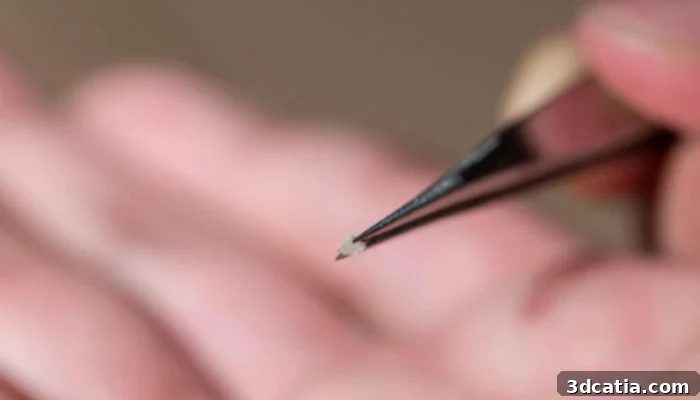
Credits: Allison Carter, Georgia Tech
Revolutionary Applications: What Can Tiny Robots Achieve?
The primary question often posed about such diminutive robots is: what is their ultimate purpose? The answer lies in a vast spectrum of potential applications, many of which could fundamentally change various industries and aspects of daily life. Imagine swarms of these miniature robots working in concert, performing tasks that are currently impossible or incredibly difficult for humans or larger machines. For instance, they could be deployed to meticulously sense environmental changes in inaccessible areas, monitoring pollution levels or detecting hazardous substances with unprecedented precision. Another exciting prospect is their ability to move and manipulate materials at the micro-scale, facilitating advanced micro-assembly processes in electronics manufacturing or even assisting in laboratory experiments that require precise handling of minute samples.
Perhaps the most transformative potential lies within the realm of medicine. Swarms of these micro-robots could navigate the intricate pathways of the human body, delivering targeted drug treatments directly to diseased cells, performing minimally invasive repairs of delicate tissues, or even assisting in complex surgeries by providing real-time diagnostic feedback and localized interventions. Azadeh Ansari, an assistant professor in the School of Electrical and Computer Engineering at Georgia Tech and a lead researcher on this project, articulates this multidisciplinary vision: “We are working to make the technology robust, and we have a lot of potential applications in mind. We are working at the intersection of mechanics, electronics, biology and physics. It’s a very rich area and there’s a lot of room for multidisciplinary concepts.” This intersectionality highlights the complex yet rewarding nature of the research, drawing insights and methodologies from diverse scientific fields to realize a truly innovative technological future. The scalability of deploying these robots in swarms also offers advantages in terms of redundancy and collective intelligence, ensuring that tasks can be completed even if individual robots fail. This collective capability could be leveraged for intricate diagnostic procedures, self-repairing materials, or even complex computational tasks.
The Ingenious Mechanism: How Micro-Bristle-Bots Move
The researchers have christened these diminutive movers “micro-bristle-bots,” a name that perfectly encapsulates their ingenious locomotion mechanism. Their movement is intrinsically linked to vibrations; critically, these bots respond to different vibration frequencies based on their specific configurations. This nuanced responsiveness is a game-changer, as it allows for the precise control of individual bots within a larger swarm by simply adjusting the frequency and amplitude of the applied vibrations. Ansari elaborates on this elegant design: “As the micro-bristle-bots move up and down, the vertical motion is translated into a directional movement by optimizing the design of the legs, which look like bristles.“
The key to this translational motion lies in the meticulously engineered design of their legs. These bristle-like appendages are not merely decorative; they are crafted with specific angles and geometries that enable them to bend and move in a predefined direction when subjected to resonant vibrational frequencies. Imagine a flexible leg that, when vibrated vertically, preferentially flexes in one direction during the upward stroke and straightens during the downward stroke, propelling the bot forward incrementally with each cycle. This principle, known as stick-slip motion or sympathetic resonance, allows for efficient and controlled movement on various surfaces. The precision offered by two-photon polymerization lithography is paramount here, as it enables the creation of these microscopic legs with the exact angles and material properties required for this highly specialized form of locomotion. This level of detail ensures that each micro-bot can be tuned to specific frequencies, paving the way for sophisticated collective behaviors and independent task execution.

Georgia Tech researchers Azadeh Ansari, DeaGyu Kim and Zhijian (Chris) Hao are shown in their laboratory. The chamber in the background is used to test the micro-bristle-bot | Credits: Allison Carter, Georgia Tech
Vibration Control vs. Magnetic Fields: A Comparative Advantage
While the Georgia Tech team has focused on vibration-powered movement, other research endeavors have explored alternative methods for micro-robot locomotion, notably those employing magnetic fields. Magnetic micro-robots certainly offer compelling advantages, particularly for applications requiring the synchronized movement of an entire swarm. A global magnetic field can easily maneuver numerous robots simultaneously, which is beneficial for tasks like bulk transport or general navigation through a fluidic environment. However, this approach often presents a significant limitation: the difficulty in individually addressing and controlling specific robots within that swarm.
In contrast, the vibration-based control mechanism developed by Ansari’s team offers a distinct and powerful advantage. By designing micro-bristle-bots that are uniquely responsive to different vibrational frequencies based on their geometry and material composition, the researchers can essentially “tune in” to individual robots. This frequency-selective control allows for complex, localized commands to be sent to specific bots, enabling highly coordinated and intricate tasks that would be impossible with a uniform magnetic field. For applications such as targeted drug delivery within the body, precise micro-assembly, or complex environmental sensing where individual agents need to perform distinct roles, this granular level of control is absolutely critical. It opens the door for swarm intelligence where individual robots can execute specialized functions, communicate with each other, and adapt to changing conditions in a much more sophisticated manner. This capability transforms a collection of simple agents into a highly adaptable and versatile micro-robotic system.
The Road Ahead: From Laboratory to Real-World Applications
Despite the remarkable progress, the journey for these micro-bristle-bots is far from over. The researchers are actively engaged in ongoing tests to further refine the technology and meticulously determine the full spectrum of their potential applications. Azadeh Ansari’s concluding remarks offer a pragmatic outlook on the challenges and inspirations guiding their future work: “We can look at the collective behavior of ants, for example, and apply what we learn from them to our little robots. These micro-bristle-bots walk nicely in a laboratory environment, but there is a lot more we will have to do before they can go out into the outside world.“
This statement encapsulates several critical areas for future development. Translating successful lab experiments into robust real-world applications often involves tackling significant hurdles, including developing miniaturized and long-lasting power sources, creating advanced control algorithms for autonomous navigation in complex and unpredictable environments, and ensuring the robots’ resilience against diverse external factors. For medical applications, achieving biocompatibility and ensuring precise, non-invasive operation are paramount. The analogy to ants is particularly insightful, suggesting an interest in understanding and replicating the principles of self-organization, emergent intelligence, and collective robustness observed in natural swarms. Learning from such biological models can inspire the development of more efficient communication protocols, fault-tolerant behaviors, and adaptable decision-making processes for these micro-robotic swarms. The ultimate goal is to enable these tiny marvels to navigate, interact, and perform complex tasks autonomously in environments far beyond the controlled confines of a laboratory, unlocking their true revolutionary potential across scientific, industrial, and medical frontiers.
For more detailed information on this fascinating research, you can find the original article HERE.
*Cover Photo Credits: Allison Carter
What are your thoughts on this pioneering research from Georgia Tech and the future of micro-robotics? Share your insights and predictions by leaving a comment below or engaging with us on our Facebook and Twitter pages! Don’t miss out on the latest advancements in 3D printing; make sure to sign up for our free weekly Newsletter, delivering all the essential news straight to your inbox!