

Revolutionizing Bone Fracture Healing: The Promise of 3D Printed Lego-Like Scaffolding
The process of healing an orthopaedic bone fracture often presents significant challenges, demanding highly complex interventions. Traditionally, severe fractures necessitate the surgical implantation of metal rods or plates to stabilize the fractured bone fragments. Following stabilization, scaffolding materials, often delivered as powders or pastes, are injected into the affected area to encourage bone regeneration. These conventional approaches, while effective, can be invasive, carry inherent risks, and may lead to prolonged recovery periods or even require subsequent surgeries for hardware removal. However, a groundbreaking advancement in additive manufacturing is poised to transform this landscape: researchers at Oregon Health and Science University (OHSU), in collaboration with teams from New York University and Mahidol University in Thailand, have pioneered a revolutionary 3D printed scaffolding system. This innovative system, no larger than a common Lego brick, comprises small, modular bone bricks designed for precise placement at the site of injury, actively stimulating the growth of surrounding cells and accelerating the healing process.
Additive manufacturing, more commonly known as 3D printing, has increasingly demonstrated its profound potential in the medical field, particularly in the development of highly efficient and patient-specific medical scaffolding. Unlike traditional methods, 3D printing allows for the creation of intricate, custom-designed microenvironments that are perfectly adapted to individual anatomical needs and specific treatment requirements. These advanced scaffolds serve as a crucial matrix, providing a supportive structure where cells can adhere, proliferate, and differentiate under optimal conditions, thereby promoting tissue regeneration. In the case of this pioneering bone scaffolding system, the research team ingeniously opted for a design reminiscent of the iconic Lego brick, featuring small internal holes and a modular external structure. This unique design is not merely aesthetic; it is engineered for functionality. Dr. Ramesh Subbiah, a postdoctoral researcher at the OHSU laboratory, highlights the precision and effectiveness of this innovative approach: “The 3D-printed microcage technology significantly improves healing by stimulating the right type of cells to grow in the right place, and crucially, at the right time. The modularity of this system allows for different growth factors to be strategically placed inside each individual block, granting us an unprecedented level of control to more precisely and rapidly repair damaged bone tissue.” This ability to deliver targeted biological cues precisely where and when they are needed marks a significant leap forward in regenerative medicine.

The 3D printed tiny cubes can be attached to each other (Image credits: OHSU)
The OHSU-led team utilized advanced additive manufacturing techniques to fabricate numerous tiny cubes, each measuring approximately 1.5 mm, which are composed of intricate hollow micro-cages. These precisely engineered tiny holes are specifically designed to be loaded with a variety of bio-gel compositions in a completely controlled and localized manner. This targeted approach creates an ideal scaffolding environment that actively encourages the regrowth of both hard bone tissue and surrounding soft tissues. A key feature of these innovative 3D printed bone bricks is their remarkable ability to interconnect and nest together, much like their Lego counterparts. This modularity allows for the creation of thousands of diverse structural combinations, offering unparalleled adaptability to various fracture geometries and patient needs. Dr. Luiz Bertassoni, the accomplished team leader and associate professor at OHSU, further emphasizes the practical advantages of this design: “Our patent-pending scaffolding system is exceptionally user-friendly. It can be stacked together seamlessly, just like Legos, and arranged into thousands of different configurations. This versatility enables us to perfectly match the complexity and specific size requirements of almost any bone injury situation, providing a truly personalized solution.” The team revealed that they employed a specialized lithography-based ceramic manufacturing (LCM) 3D printing technique, utilizing beta-tricalcium phosphate ceramic as the primary material. This choice of material is critical, as beta-tricalcium phosphate is known for its excellent biocompatibility, osteoconductivity (ability to support bone growth), and biodegradability, meaning it gradually dissolves and is replaced by natural bone over time, eliminating the need for removal surgeries.
The preliminary results of this advanced scaffolding system are exceptionally promising. So far, the 3D printed bone bricks have been rigorously tested on rat bones, yielding highly encouraging outcomes. These studies demonstrated that the innovative 3D printed scaffolds led to approximately three times more blood vessel growth compared to traditional scaffolding materials. This significant increase in vascularization – the formation of new blood vessels – is a critical factor for effective bone healing and tissue integration. Robust blood supply ensures that the regenerating bone receives adequate nutrients and oxygen, while also facilitating the removal of waste products, thereby accelerating the overall healing process and reducing the risk of complications. The ability to dramatically enhance blood vessel formation makes this technology invaluable for comprehensive tissue regeneration, not just limited to bone. Furthermore, the researchers highlighted the unparalleled customizability of their system. By working with a configuration of just four layers of 4×4 blocks, they could achieve more than 29,400 distinct combinations. This astonishing degree of customization underscores the system’s potential to be precisely tailored to the unique anatomical requirements and injury specifics of each individual patient, moving away from a ‘one-size-fits-all’ approach towards truly personalized medicine in orthopaedic treatment. This adaptability is crucial for addressing the diverse range of bone fractures and defects encountered in clinical practice, offering a personalized approach that traditional implants often cannot. For those interested in delving deeper into the scientific specifics, more comprehensive information can be found HERE.
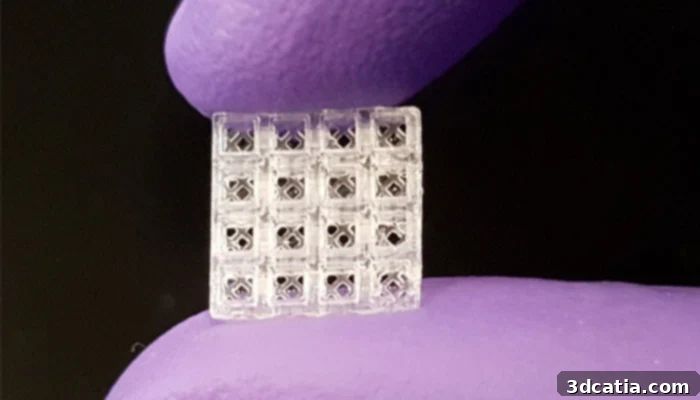
Image credits: OHSU
The implications of this innovative 3D printed bone scaffolding system extend far beyond mere fracture repair. Its modular design and enhanced regenerative capabilities hold immense promise for various challenging orthopaedic conditions, including complex reconstructive surgeries, treatment of bone defects resulting from tumors or trauma, and potentially even in degenerative bone diseases. By offering a precise, customizable, and biologically active scaffold, this technology has the potential to significantly reduce recovery times, minimize complications, and dramatically improve the long-term outcomes for patients suffering from bone injuries. As research progresses, the next critical steps will involve moving from preclinical animal studies to human clinical trials, meticulously evaluating its safety and efficacy in a broader patient population. The scalability of the manufacturing process and navigating regulatory pathways will also be key considerations for its eventual widespread adoption. This pioneering work by OHSU and its collaborators represents a monumental leap forward in regenerative medicine, harnessing the power of additive manufacturing to create truly transformative solutions for bone fracture healing and beyond, ushering in an era of more personalized and effective orthopaedic care.
We’re eager to hear your thoughts on these revolutionary 3D printed bone bricks and their potential impact on orthopaedic treatment! Please share your insights and comments below, or join the conversation on our Facebook and Twitter pages. Stay informed about the latest advancements in additive manufacturing and medical 3D printing by signing up for our free weekly Newsletter, delivering all the essential news straight to your inbox!