
Revolutionizing Agriculture: Exploring the 3D-Printed Autonomous Vehicle for Precision Farming and Beyond
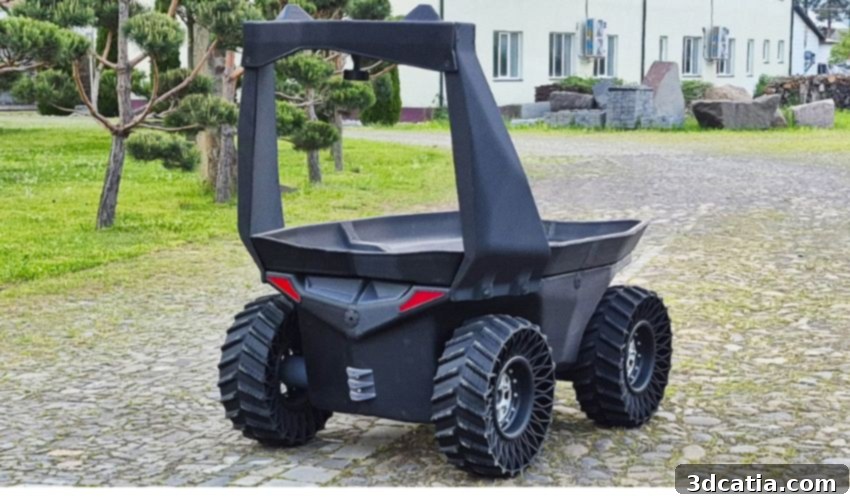
In an era where technological innovation is rapidly transforming industries, a groundbreaking autonomous vehicle prototype is emerging to redefine agricultural research and operational efficiency. This isn’t merely a concept car or a futuristic gadget; it’s a tangible, field-ready platform designed with a clear purpose: to advance precision agriculture and enhance agri-food efficiency. Developed through a pioneering collaboration between startup Lemki Robotics, iScale3D, and Zeykan Robotics, this autonomous robot showcases the incredible potential of additive manufacturing in creating robust, intelligent machinery for demanding applications.
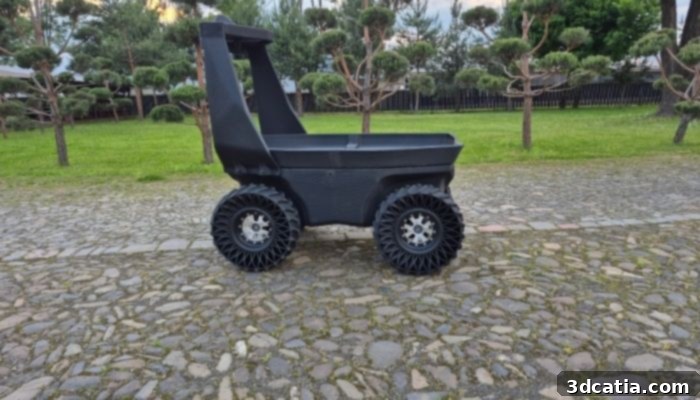
At the heart of this innovation is its unique production method, particularly the chassis, which was brought to life using an advanced pellet extrusion 3D printing process. This choice of manufacturing technique is crucial, allowing for greater material versatility and the ability to produce large, complex structures efficiently. The result is an impressive vehicle weighing in at approximately 400 kilograms (882 pounds), with substantial dimensions of 2000 x 1300 x 800 mm (78.7 x 51.2 x 31.5 inches). Engineered for endurance, it boasts an operational range of up to 100 kilometers (62 miles) on a single charge, making it highly suitable for extensive field operations. Equipped with an array of sophisticated sensors, this autonomous platform is primed to execute diverse tasks with unparalleled precision and independence.
The innovative minds behind this project, iScale3D and Lemki Robotics, are no strangers to pushing the boundaries of additive manufacturing. Many may recall their previous venture into leveraging the inherent flexibility of 3D printing for rethinking vehicle development – specifically, their 3D-printed camper van. That project underscored their commitment to exploring how additive manufacturing could provide unprecedented design freedom and production agility in the automotive sector. This time, their focus has shifted to a completely different, yet equally impactful, application: a versatile wheeled robot with a modular architecture, capable of serving as a robust surveillance and operational platform across a multitude of fields. This includes critical sectors such as defense, where it can safely access hazardous areas or optimize complex military logistics, as well as crucial applications in agriculture and infrastructure inspection, promising to revolutionize how these industries operate.
The Innovative Design of the Autonomous Agricultural Research Vehicle
Advancing Robotics Through Large-Scale 3D Printing
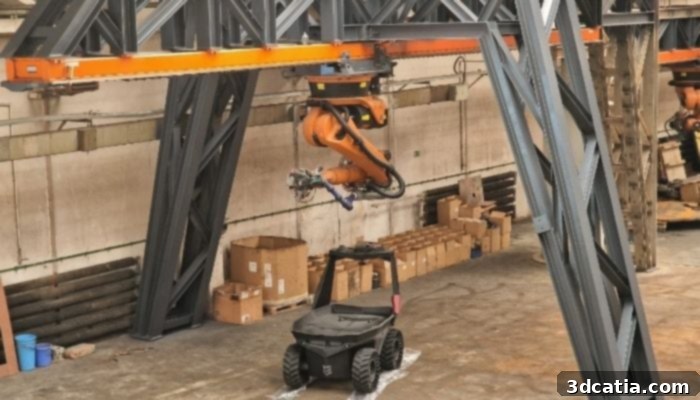
The decision to employ large-format additive manufacturing for this autonomous vehicle was strategic, capitalizing on its unique benefits for creating complex, robust, and customized structures. To design their robotic platform, the engineering teams harnessed Fused Granulate Fabrication (FGF), an innovative 3D printing process that precisely deposits plastic granules layer by layer. Unlike traditional filament-based FDM, FGF allows for the use of raw, inexpensive plastic pellets, which significantly reduces material costs and opens up a wider range of engineering-grade thermoplastics. For the crucial chassis components, they selected a high-performance material: 20% glass fiber-reinforced polypropylene (PP). This composite was chosen specifically for its exceptional strength-to-weight ratio, ensuring the vehicle’s structural integrity while optimizing its overall mass. The extrusion process itself was carried out by a sophisticated robotic arm, allowing for intricate geometries and consistent quality across large parts. While the precise total printing time for the entire chassis was not disclosed, it was confirmed that each individual component was completed in less than 60 hours, underscoring the efficiency of this advanced manufacturing technique.
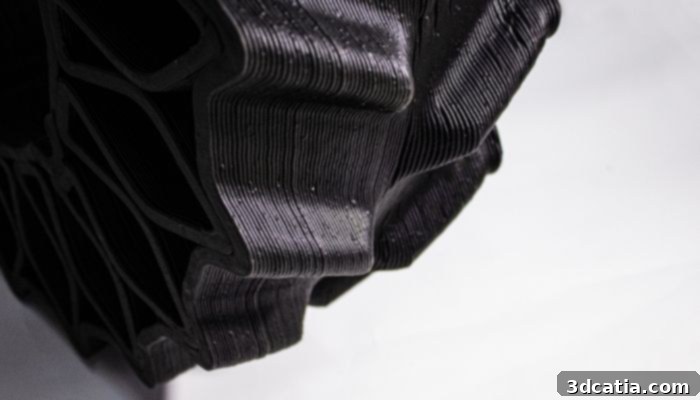
Beyond the chassis, the teams extended the application of 3D printing to other vital components of the autonomous vehicle, notably its four robust wheels. These were meticulously 3D-printed from durable nylon on a large-format additive manufacturing machine, demonstrating the material’s suitability for high-stress, functional parts. To achieve the rigorous precision required for vehicle components, a critical post-processing step involving CNC milling was subsequently performed. This hybrid manufacturing approach — combining the design freedom of 3D printing with the accuracy of subtractive manufacturing — ensured that the wheels met strict performance specifications. Furthermore, the vehicle’s tires were also engineered for maximum reliability and durability. These airless tires, inherently puncture-proof, eliminate a common point of failure in conventional pneumatic tires, making the vehicle ideal for challenging terrains. The team revealed that these innovative tires were 3D-printed using a specialized composite elastomer, highlighting additive manufacturing’s capacity to create complex, functional parts with tailored material properties for enhanced performance and resilience.
Robotic Arm Utilized for Large-Scale Pellet Extrusion 3D Printing
The prototype autonomous vehicle is not just a feat of mechanical engineering; it’s a testament to advanced sensor integration and intelligent navigation. It is comprehensively equipped with four 360° cameras, providing a full panoramic view of its surroundings, crucial for situational awareness and obstacle detection. Complementing this visual data is a sophisticated LiDAR system, which generates precise 3D maps of the environment by emitting laser pulses and measuring their return time. This combination allows for highly accurate environmental perception, even in low-light conditions. For uninterrupted connectivity and communication, especially in remote agricultural areas or challenging terrains, the vehicle integrates advanced Starlink satellite connectivity. This ensures reliable data transmission and control, irrespective of traditional network infrastructure availability. While designed for full autonomy, offering self-navigation and task execution, it retains the flexibility of manual control, allowing human operators to intervene when necessary. At its core, the vehicle features a robust neural network, empowering it to capture, process, and analyze complex environmental data in real-time. This artificial intelligence enables the robot to understand its surroundings, make informed decisions, and navigate effectively without relying on GPS, a critical capability for operating in remote, hazardous, or GPS-denied environments where traditional navigation systems might fail.
Sustainable Design and Expansive Future Applications
A cornerstone of this innovative project is its unwavering commitment to sustainability and minimizing environmental impact. The creators consciously aimed to develop a solution that aligns with eco-friendly principles, promoting a more responsible approach to robotics. The team emphatically states: “This platform proves that performance and sustainability are no longer at odds. From recycled input materials to energy-efficient autonomous navigation, every aspect of the robot is designed with the planet in mind. It is one of the first field-ready machines that aligns with circular economy principles, offering a blueprint for how the next generation of robotics can reduce environmental impact without sacrificing function or form.” This commitment to the circular economy means not only utilizing sustainable materials where possible but also designing for durability, reparability, and recyclability, ensuring a longer lifecycle and reduced waste.
3D-Printed Wheels and Puncture-Proof Tires of the Autonomous Vehicle
While this autonomous platform is currently in its prototype phase, its potential across numerous sectors is truly significant and far-reaching. In agriculture, its applications are poised to revolutionize traditional farming practices. It could be deployed for rapid and continuous plant monitoring, enabling farmers to identify issues such as disease outbreaks, nutrient deficiencies, or pest infestations early, thus facilitating more efficient crop management. Its precision capabilities could also optimize the targeted application of chemicals and fertilizers, reducing waste, minimizing environmental pollution, and lowering operational costs. Beyond agriculture, the military sector stands to gain immensely from such a versatile platform. It could serve as an advanced control platform for managing a swarm of drones during complex field operations, providing reconnaissance, logistical support, or acting as a decoy in high-risk zones, thereby enhancing soldier safety and operational effectiveness. Furthermore, the robust design and autonomous capabilities make it ideal for infrastructure inspection, surveying pipelines, bridges, remote power lines, or other critical infrastructure in challenging environments, improving safety and reducing human risk. The possibilities are truly extensive, from environmental monitoring to disaster response. Only time will tell if this cutting-edge 3D-printed platform will capture global attention and widespread adoption, but its innovative design and multi-faceted utility lay a strong foundation for future advancements in autonomous robotics. In the meantime, you can explore more details about this exciting project HERE.
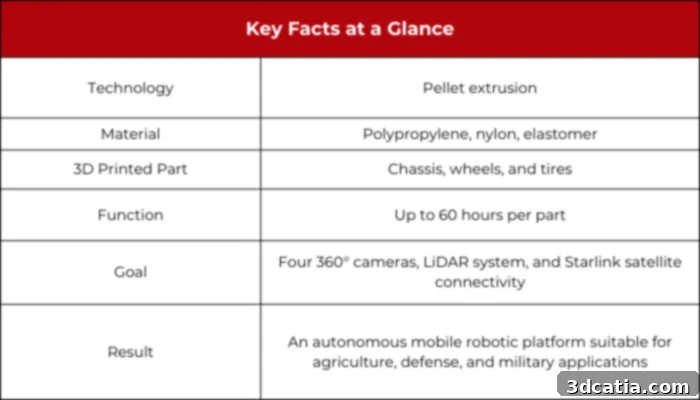
Photo Credit: 3DNatives – showcasing an autonomous vehicle
What are your thoughts on this innovative 3D-printed autonomous vehicle and its potential to transform industries? We invite you to share your insights in a comment below or join the conversation on our LinkedIn or Facebook pages! Don’t forget to sign up for our free weekly Newsletter to receive the latest 3D printing news directly in your inbox. You can also discover all our videos and interviews on our YouTube channel for more in-depth content.
*Photo Credits for All Images Except Graph: Vasyl Gonar/Lemki Robotics