
Revolutionizing Noise Control: The Power of 3D Printed Acoustic Metamaterial Panels
In our increasingly interconnected and dynamic world, effective sound insulation often operates as an invisible shield, silently enhancing our quality of life. While frequently overlooked, its importance is paramount across a diverse range of environments – from the serene comfort of our homes and the critical tranquility of hospitals, to the focused efficiency of office buildings, the safety of industrial facilities, and even the hushed interiors of modern automobiles. Traditionally, achieving robust acoustic insulation has come with trade-offs, often involving bulky, heavy materials that limit design flexibility and add significant weight. However, a groundbreaking convergence of advanced manufacturing and material science is poised to redefine these boundaries: the integration of additive manufacturing (3D printing) with innovative acoustic metamaterials.
A recent pioneering study has illuminated the transformative potential of this synergy, demonstrating that 3D printing noise-insulating panels allows for the creation of structures that are remarkably lighter and significantly narrower without any compromise on their acoustic efficiency. This research delves deep into how the meticulous control offered by 3D printing can be harnessed to fabricate intricate internal geometries, specifically focusing on the deployment of acoustic metamaterials. These specially engineered materials possess extraordinary properties not found in nature, enabling them to manipulate sound waves in unprecedented ways. By carefully designing and printing these metamaterial structures, the researchers have proposed a novel and highly effective design for superior sound insulation. This revolutionary approach promises to usher in an era of acoustic control that is more efficient, adaptable, and aesthetically integrated than ever before.
Unpacking Acoustic Metamaterials: A New Paradigm in Sound Management
The cornerstone of this study’s innovation lies in its ingenious focus on the design of large, labyrinth-shaped panels infused with acoustic metamaterials. Unlike conventional materials, which primarily rely on mass, density, or porosity to absorb and block sound, metamaterials derive their unique properties from their meticulously engineered internal structures, rather than their chemical composition alone. Acoustic metamaterials, in particular, are designed to interact with sound waves in ways that are impossible with traditional materials, such as bending sound, trapping it, or even exhibiting properties like negative effective density or bulk modulus.
In this specific context, the researchers have engineered a sophisticated labyrinth-like structure within the panels. This intricate design is not merely decorative; it serves a crucial functional purpose: to dissipate sound energy as it navigates through the material’s convoluted pathways. As sound waves enter the labyrinth, they are forced to travel a significantly extended and tortuous path within a physically compact space. This extended journey, coupled with multiple reflections, viscous damping, and resonant interactions with the internal geometry, effectively converts acoustic energy into heat, thereby achieving remarkable sound absorption. Thanks to this novel labyrinthine architecture, these panels are capable of delivering exceptionally high absorption performance across a remarkably wide range of frequencies, far surpassing the capabilities of existing conventional panel designs. This represents a significant leap forward, as broadband sound absorption is often a major challenge for traditional acoustic solutions, which tend to perform optimally only within narrow frequency bands.
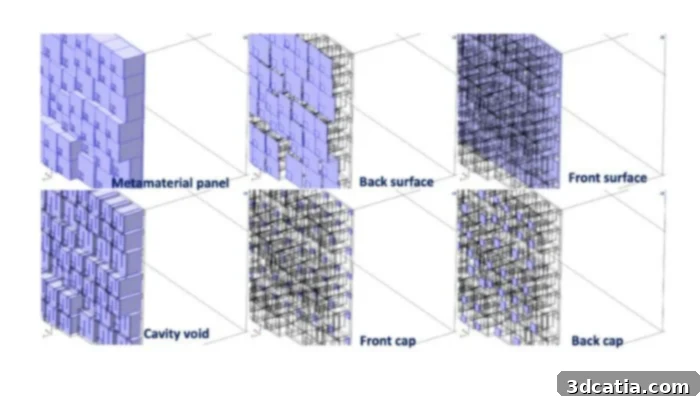
Images of the innovative 3D printed acoustic metamaterial panels. (photo credits: Federico Bosia)
Additive Manufacturing: The Key to Unlocking Intricate Acoustic Designs
The realization of such complex, high-performance acoustic structures would be virtually impossible without the precision and flexibility offered by additive manufacturing, commonly known as 3D printing. After extensive conceptualization and rigorous computational testing, the innovative labyrinthine metamaterial design was meticulously approved for 3D printing. This manufacturing method is uniquely suited for the task because it allows for millimeter-level, and even sub-millimeter-level, precision in the construction of the panels’ intricate internal structures – a level of geometric complexity that conventional manufacturing techniques simply cannot replicate.
The research specifically highlights the potential of polymeric materials, carefully optimized to enhance sound absorption characteristics. These advanced polymers can be strategically combined with porous materials, creating a synergistic effect that significantly boosts their overall efficiency. The polymers provide the structural integrity and the framework for the labyrinthine paths, while the porous elements further contribute to sound dissipation through friction and viscous effects as air vibrates within their interconnected pores. Crucially, additive manufacturing inherently facilitates an unprecedented degree of design customization. This means that acoustic panels can be precisely tailored to the specific needs of any given environment, whether it’s optimizing for a particular frequency range in an auditorium, designing for minimal weight in an automotive application, or ensuring maximum absorption in an industrial setting. This bespoke capability marks a significant departure from the ‘one-size-fits-all’ approach often associated with traditional sound insulation materials.
Tangible Advantages and Far-Reaching Applications
The study unequivocally confirms that 3D printed panels integrating acoustic metamaterials represent an exceptionally efficient and versatile solution for noise mitigation across a wide and crucial frequency spectrum. The combination of their modular, lightweight design with their superior sound absorption capacity positions them as an highly attractive and superior alternative to conventional soundproofing systems. The advantages extend beyond mere performance, offering profound implications for various industries:
- Architectural and Construction Sector: Imagine quieter open-plan offices, serene residential apartments, or hospitals where patient recovery is aided by reduced noise levels. These panels can be integrated into walls, ceilings, and even furniture, offering both acoustic benefits and aesthetic appeal without adding significant structural load. Their thin profile means less loss of valuable interior space.
- Automotive and Aerospace Industries: Weight is a critical factor in vehicles and aircraft. By replacing heavy traditional insulation with lightweight 3D printed metamaterial panels, manufacturers can achieve substantial fuel efficiency gains and extend range, all while dramatically enhancing passenger comfort by reducing cabin noise from engines, road, and wind.
- Industrial and Manufacturing Environments: Loud machinery and factory floors are a common source of noise pollution. These panels can be used to construct machine enclosures, acoustic barriers, or integrated into HVAC systems, creating safer and more comfortable working conditions for employees, and reducing noise spillover into surrounding communities.
- Consumer Electronics: From quieter home appliances to less intrusive computing devices, the application of these advanced acoustic panels can lead to more pleasant user experiences in everyday technology.
Compared to existing solutions like dense mineral wool, heavy foam panels, or mass-loaded vinyl, these 3D printed metamaterial panels offer a paradigm shift. They achieve comparable or superior acoustic performance with a fraction of the weight and thickness, leading to easier installation, reduced material consumption, and greater design freedom. Their modular nature also simplifies replacement and maintenance.
The Road Ahead: Future Research and Optimization
While the current study presents a compelling case for this innovative technology, the field of 3D printed acoustic metamaterials is still burgeoning, with vast opportunities for future research and development. Key areas for further exploration include:
- Material Optimization: Continued research into new polymeric compositions, multi-material printing techniques, and the integration of sustainable or recycled materials will be crucial. Developing panels with enhanced properties such as fire retardancy, moisture resistance, or specific aesthetic finishes will broaden their applicability.
- Scalability and Manufacturing Processes: Moving from laboratory prototypes to large-scale industrial production requires optimizing 3D printing processes for speed, cost-effectiveness, and consistency. Exploring advanced additive manufacturing techniques that allow for even larger panel sizes or higher throughput will be vital for widespread adoption.
- Real-World Implementation and Performance Validation: Rigorous testing in diverse, real-world environments, beyond controlled laboratory settings, is essential to fully understand and validate the long-term performance, durability, and practical application of these panels under varying conditions.
- Cost-Benefit Analysis: As with any new technology, a thorough analysis of the production costs versus the acoustic and other benefits (e.g., weight savings, space savings) compared to conventional methods will be necessary to drive market adoption. Continued advancements in 3D printing technology are expected to bring down manufacturing costs over time.
- Exploration of New Metamaterial Designs: The possibilities for novel metamaterial geometries are virtually endless. Research into different types of acoustic metamaterials, such as resonant structures, locally resonant designs, or phononic crystals, could unlock even more advanced sound manipulation capabilities and expand the range of applications.
- Multi-functional Integration: The potential to integrate additional functionalities into these panels, such as thermal insulation, structural support, or even embedded sensors for environmental monitoring, could further enhance their value and consolidate their position as a key solution for holistic acoustic and environmental control.
This ongoing exploration promises to further expand the applications of this fascinating technology, solidifying its role as a pivotal solution for addressing modern acoustic challenges. To delve deeper into the intricate details of this pioneering work, you can access the full study HERE.
What are your thoughts on these innovative 3D printed acoustic panels and their potential to transform how we manage sound? We’d love to hear your perspective! Share your comments below or engage with us on our LinkedIn, Facebook, and Twitter pages! Don’t miss out on the latest advancements in additive manufacturing – be sure to sign up for our free weekly Newsletter here, delivering the most current 3D printing news directly to your inbox. You can also explore all our compelling videos and interviews on our YouTube channel.
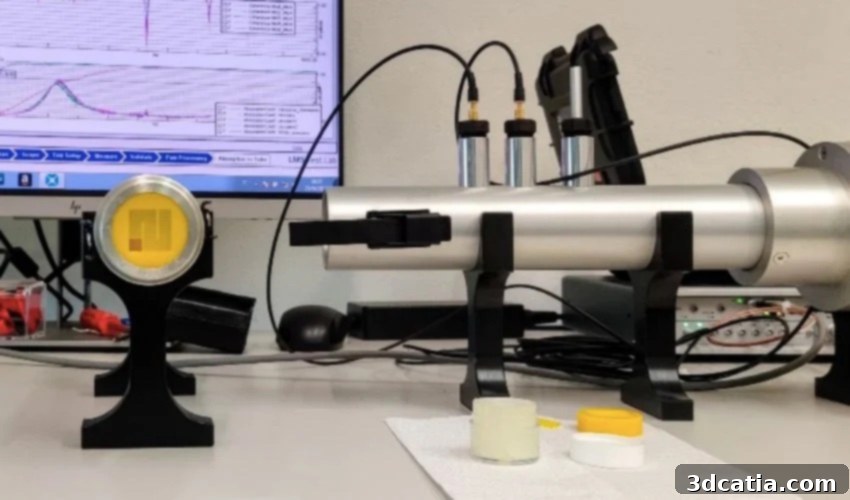
*Cover Photo: Impedance tube opened with the sample mounted on its support (photo credits: Federico Bosia)