
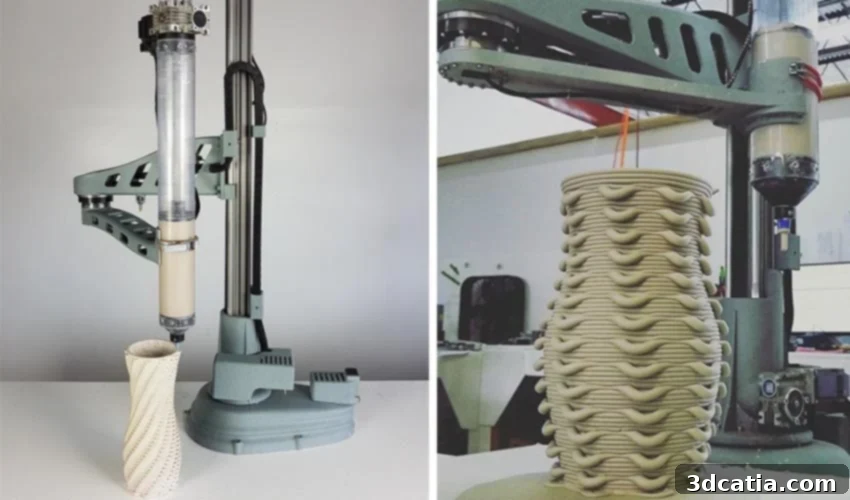
Revolutionizing Ceramic 3D Printing: Introducing the 3D Potter Scara Mini V1 Clay Printer
The world of additive manufacturing is continuously evolving, pushing the boundaries of what’s possible with various materials. Among the most exciting developments is the advancement in ceramic 3D printing, a segment poised for significant growth. At the forefront of this innovation is 3D Potter, a prominent 3D printer manufacturer and ceramic studio based in Florida. Renowned for their real clay 3D printers, which are widely adopted by over 200 universities, numerous art galleries, and even a large US-based chocolatier, 3D Potter has recently unveiled its latest marvel: the Scara Mini V1 compact clay 3D printer. This innovative machine is designed to transcend the current limitations of ceramic additive manufacturing, offering unparalleled precision, versatility, and ease of use.
The Scara Mini V1 is a testament to sophisticated engineering, combining a lightweight design with high-powered capabilities and a unique low-pressure system. Unlike many conventional clay 3D printers that rely on complex, high-pressure compressed air systems, the Scara Mini V1 employs a remarkably simple yet effective “overgrown syringe” mechanism. This design choice dramatically reduces complexity, maintenance, and noise, while significantly expanding the range of printable materials. Furthermore, its groundbreaking cardinal axis system, a departure from the common delta printer configuration, grants users exceptionally precise control with minimal effort, opening new avenues for intricate and robust ceramic creations.
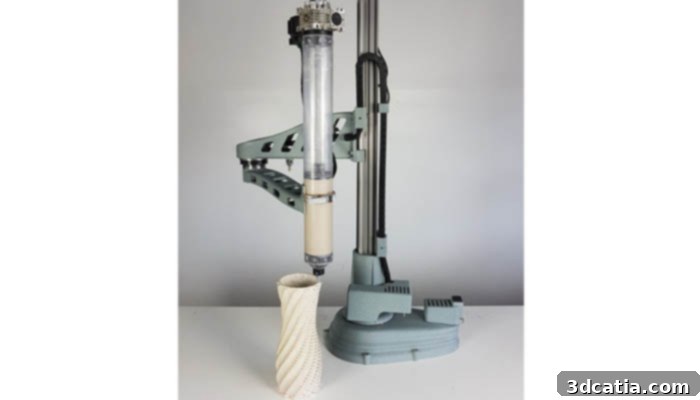
The Scara Mini V1 clay 3D printer from 3D Potter is compact and capable of printing multiple objects non-stop | Credits: 3D Potter
Unpacking the Scara Mini V1: Design and Core Innovations in Clay 3D Printing
As the compact counterpart to 3D Potter’s larger Scara V3, the Scara Mini V1 inherits and refines a legacy of robust clay 3D printing. This latest model boasts a sophisticated architecture that includes both 1-joint robotic arms and advanced rotational x and y-axis features. These engineering marvels are crucial for achieving superior print height, exceptional accuracy, and overall print quality that discerning professionals and artists demand. The manufacturer highlights a significant advantage: there is virtually no weight limit to the printed object, empowering users to create substantial and intricate pieces without concern. The final results consistently exhibit an even consistency, notably free of air bubbles, which is a common challenge in traditional ceramic printing methods. This ensures the structural integrity and aesthetic appeal of every printed item.
A cornerstone of the Scara Mini V1’s appeal is its highly efficient 2000mL extruder. Designed for both capacity and ease of maintenance, this extruder simplifies the printing process considerably. Its non-high-pressure system is a game-changer, allowing for an unprecedented range of materials to be used. This means that users are no longer limited to specially formulated, expensive clay compounds. Instead, real clay can be sourced from virtually anywhere, offering immense flexibility for artists, educators, and researchers. Beyond traditional clays, the Scara Mini V1 is fully capable of processing food-safe materials, opening doors for culinary applications, as well as various cementitious materials, expanding its utility into architectural and construction prototyping.
The Advantages of a Cardinal Axis System in Advanced Ceramic 3D Printing
One of the most defining features that sets the Scara Mini V1 apart is its reliance on a cardinal axis system. This differs significantly from the delta configurations commonly found in many 3D printers. In a delta printer, three arms control the print head from a base, moving in a coordinated fashion to achieve XYZ coordinates. While efficient for lighter, faster plastic printing, delta systems can struggle with the heavy, viscous nature of clay. The weight of the material, combined with the forces required for extrusion, can introduce inaccuracies and vibrations that compromise print quality and structural integrity in ceramic objects.
The cardinal axis system, on the other hand, operates more like traditional CNC machines or Cartesian 3D printers, but with enhanced robotic articulation. It provides direct and stable control over each axis, offering superior rigidity and precision, especially when dealing with the high viscosity and weight of clay. This translates into several key benefits for the user: enhanced accuracy in layer alignment, greater stability during the printing of tall and heavy objects, and reduced chances of print failures due to movement inconsistencies. For complex ceramic designs, this precision is invaluable, ensuring that every detail, curve, and structural element is rendered exactly as intended, pushing beyond the current capabilities of ceramic additive manufacturing.
Revolutionizing Material Use: The Low-Pressure “Syringe” System for Clay 3D Printers
The innovative low-pressure system, which 3D Potter describes as an “overgrown syringe,” is another critical differentiator for the Scara Mini V1. Many industrial clay 3D printers utilize high-pressure systems with compressed air to force the viscous material through a nozzle. While effective, these systems come with several drawbacks: they are often noisy, require substantial maintenance, are energy-intensive, and limit material options due to the pressure requirements. Furthermore, high-pressure extrusion can sometimes introduce air bubbles into the clay, leading to structural weaknesses and aesthetic imperfections in the final fired product, which can be particularly problematic for intricate designs or functional pieces.
By contrast, 3D Potter’s syringe-based system offers a gentler, more controlled extrusion. This method ensures a consistent, bubble-free flow of material, which is paramount for creating strong, high-quality ceramic objects. The absence of high-pressure components also means a significant reduction in operational noise and energy consumption, making the Scara Mini V1 suitable for various environments, from quiet art studios to busy university labs. Crucially, this low-pressure approach is what enables the printer to work with a far broader spectrum of materials, including raw, unprocessed clays from any source, as well as delicate food-grade compounds and robust cementitious mixtures, without requiring extensive material preparation or specialized additives. This material freedom empowers creators to experiment and innovate with unprecedented flexibility.
Ceramic 3D Printing: A Market on the Rise and the Role of Clay
The introduction of advanced clay 3D printers like the Scara Mini V1 comes at a time when the broader ceramic 3D printing market is experiencing robust growth. Recent ceramic 3D printing reports project this segment of additive manufacturing to generate an impressive $3.6 billion worldwide by 2028. While perhaps not as extensively established as plastic technologies or even metal 3D printing, ceramic additive manufacturing is rapidly gaining traction. Industry experts predict that by 2025, ceramic 3D printing will reach maturity as a viable and essential manufacturing technique across a diverse range of industries. This growth is fueled by an increasing demand for custom ceramic components, complex geometries impossible with traditional methods, and the unique material properties that ceramics offer, such as high heat resistance, chemical inertness, and aesthetic appeal. The ability to create bespoke ceramic parts on demand is transforming fields from aerospace to art, underscoring the importance of innovations like the Scara Mini V1.
Clay has historically been the most commonly utilized material in ceramic manufacturing, largely owing to its natural abundance, ease of acquisition from almost any environment, and its inherent malleability. The ability of modern clay 3D printers to work with raw, unprocessed clay further amplifies its appeal, promoting sustainability and reducing material costs. This blend of traditional material with cutting-edge technology creates a powerful synergy, enabling artists, designers, and engineers to explore new creative and functional possibilities in ways previously unimaginable. The environmental benefits of using a natural, recyclable material like clay also resonate with growing sustainability concerns in manufacturing, making clay 3D printing an increasingly attractive option.
Transformative Applications for Education, Architecture, and Beyond with 3D Printed Clay
The Scara Mini V1 clay 3D printer offers extraordinary benefits across a spectrum of applications, particularly for institutions of higher education and architectural firms. As Danny Defelici, a Thought Leader at 3D Potter, elucidates, “The other advantage for universities and architectural departments is that it can do architectural objects. It can actually print inside the object.” This capability is revolutionary. For architects, it means the ability to rapidly prototype complex building models, create intricate facade elements, or even design functional components with hidden internal structures for lightness or specific thermal properties. The capacity to “print inside the object” refers to its ability to create hollow structures, internal lattices, or support scaffolding that can later be removed or left as part of the design, offering unprecedented design freedom for both structural integrity and aesthetic complexity. This allows for the exploration of biomimetic designs and highly optimized structures that would be impossible with traditional fabrication methods.
For universities, the Scara Mini V1 serves as an invaluable educational tool. It allows students in art, design, engineering, and architecture departments to gain hands-on experience with advanced additive manufacturing techniques using natural, accessible materials. From creating intricate sculptures and pottery to experimenting with new material composites, the printer fosters innovation and interdisciplinary research. Art galleries can leverage its precision to produce unique installations and custom ceramic pieces that challenge traditional artistic boundaries. Beyond these sectors, the machine’s ability to handle food-safe materials presents exciting opportunities for confectioners and culinary artists, allowing for bespoke chocolate creations and elaborate edible structures. The ease of use and versatility make it an ideal platform for exploring the myriad possibilities of ceramic additive manufacturing in a wide array of creative and technical fields.
User-Friendly Design and Practical Advantages of the Scara Mini V1
Beyond its technical prowess, 3D Potter has engineered the Scara Mini V1 with the user experience firmly in mind. The machine boasts an incredibly straightforward setup process, often requiring just a single person for installation. This ease of deployment makes it highly accessible to a broader user base, from individual artists and small studios to large university departments, minimizing the learning curve often associated with advanced machinery. Its compact footprint and flexible design allow it to be used either directly on the floor for larger prints or conveniently placed on a table for more manageable projects, adapting seamlessly to various workspace constraints and studio sizes.
Maintenance is also simplified thanks to the non-pressurized system and the easy-to-clean 2000mL extruder. This thoughtful design minimizes downtime and ensures that the focus remains on creation rather than complex upkeep. Users can quickly swap materials and clean the system without specialized tools or extensive training, enhancing productivity and creative flow. The Scara Mini V1 represents not just a technological leap but also a commitment to making advanced ceramic 3D printing more accessible, efficient, and enjoyable for creators across all disciplines, ultimately democratizing access to this cutting-edge manufacturing technique.
In conclusion, the 3D Potter Scara Mini V1 stands as a monumental achievement in the field of ceramic additive manufacturing. By combining a unique cardinal axis system with an innovative low-pressure extrusion method, it overcomes many of the limitations previously associated with clay 3D printing. Its versatility in handling diverse materials, coupled with its precision and user-friendly design, positions it as an indispensable tool for artists, educators, architects, and innovators looking to explore the boundless potential of 3D printed ceramics. This compact yet powerful machine is not just a printer; it’s a catalyst for a new era of creative expression and functional design in ceramics, promising to shape the future of how we interact with and create with clay.
*Cover photo credits: 3D Potter
What are your thoughts on this revolutionary clay 3D printer and its potential impact on art, education, and architecture? We invite you to share your insights in a comment below or join the conversation on our Facebook and Twitter pages! Don’t forget to sign up for our free weekly Newsletter to receive all the latest news and innovations in 3D printing delivered straight to your inbox!