
Unlocking Ultra-Precision: An Exclusive Look at 3D MicroPrint’s Revolutionary Microlaser Sintering Technology
The landscape of additive manufacturing has been dramatically shaped by pioneers, and one name that consistently stands out is EOS. As a prominent German company with over two and a half decades of experience in the 3D printing industry, EOS has been at the forefront of innovation, particularly in pioneering laser sintering technologies. Their dedication to advancing additive manufacturing led to a significant collaboration in 2013, resulting in the formation of an innovative new startup: 3D MicroPrint. This joint venture was established with a clear vision – to push the boundaries of 3D printing into the realm of true micro-scale precision. When we first learned about their groundbreaking microlaser sintering (MLS) technologies, a method promising unprecedented detail and accuracy for metal components, we knew we had to delve deeper. This article presents our insightful interview with 3D MicroPrint, exploring their unique capabilities, their ambitious goals for the future, and the profound impact they are making on various industries.
3DN: Could you introduce 3D MicroPrint in more detail and elaborate on its origins?

CEO Joachim Göbner
3D MicroPrint GmbH was established in 2013 in Chemnitz, Germany, as a strategic cooperation between EOS GmbH, a global leader in industrial 3D printing, and 3D-Micromac AG, a specialist in laser micro machining. This powerful synergy allowed us to combine the best of both worlds: the extensive knowledge of additive manufacturing from EOS and the precision laser technology expertise from 3D-Micromac. Our core innovation, Microlaser Sintering (MLS), represents a groundbreaking procedure that seamlessly merges the principles of additive manufacturing with advanced laser micro machining. At 3D MicroPrint GmbH, our mission has been to elevate this pioneering process to an industrial level, continuously refining and developing the underlying technology. We specialize in the entire ecosystem of MLS, encompassing the development, manufacturing, and sales of cutting-edge MLS machines, alongside the production of ultra-precise micro-metal parts through our proprietary microlaser sintering process. This dual focus ensures we not only provide the tools but also the expertise and capacity to deliver exceptional micro-components.
3DN: What is the fundamental concept behind ‘microlaser sintering’ technology, and how does it significantly differ from other 3D printing technologies currently available?
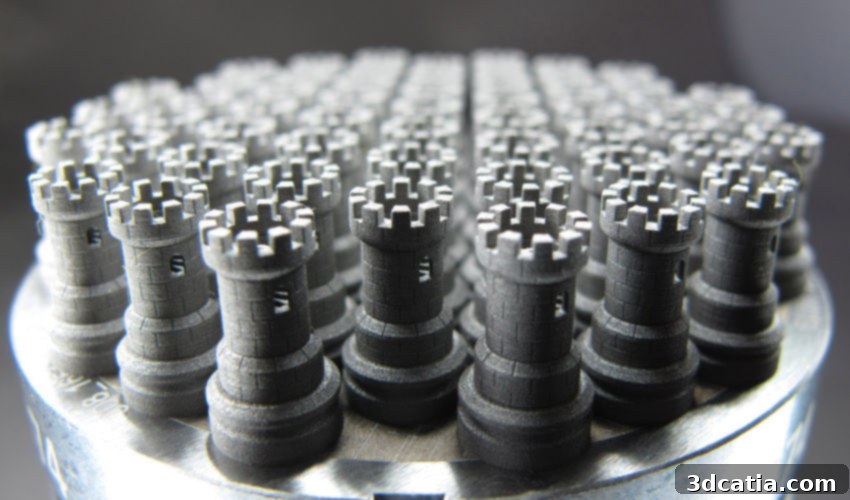
Microlaser sintering (MLS) is essentially a highly refined powder bed fusion process, similar in principle to conventional laser sintering, but executed with unparalleled precision at a microscopic scale. In this additive manufacturing technique, a three-dimensional component is meticulously built up layer by layer from a bed of fine metal powder. The critical distinguishing factor lies in the equipment and materials used. An infrared fiber laser, precisely controlled, is employed to melt the powder, but critically, this laser is focused to an incredibly small spot diameter – less than 30 micrometers (µm). This ultra-fine laser spot is just one piece of the puzzle. The most significant difference and the cornerstone of MLS’s superior resolution compared to conventional additive manufacturing methods by means of laser sintering, is the powder particle size we utilize. While traditional laser sintering employs powder particles typically in the range of 15-60 µm, our MLS process uses powder that is an order of magnitude smaller, with particle sizes equal to or less than 5 µm. This dramatic reduction in powder particle size, combined with the microscopic laser spot, allows for the creation of exceptionally fine layers and intricate geometries. As a direct result, MLS can achieve a much finer resolution and surface finish for components than previously thought possible with metal 3D printing. This level of resolution and precision, particularly for producing functional metal components, is currently unique on a global scale. It opens doors to fabricating complex micro-parts that are simply unattainable through other additive or even traditional micro-machining methods due to geometric constraints or material waste.
3DN: Which specific machines are currently utilizing this microlaser sintering method, and what types of materials are predominantly used in these processes?
Our MLS machines are meticulously designed, engineered, and continuously developed in-house by our expert teams. This ensures they are perfectly optimized for our unique process and the demanding requirements of micro-precision manufacturing. In 2013, we proudly introduced the DMP50 GP, which marked a significant milestone as the world’s first industrial-grade MLS machine, setting a new benchmark for micro-scale additive manufacturing. Building upon the success and lessons learned from its predecessor, we launched the successor machine generation, the DMP6X, in 2016. The DMP6X series represents a leap forward, characterized by its modular design, enhanced user-friendliness, and streamlined serviceability. This generation is available in three distinct variants, each tailored to specific industrial needs and production volumes. Currently, there are six of our advanced MLS machines operational worldwide, demonstrating their industrial readiness and global adoption. These machines process a variety of metals, each selected for its suitability in micro-applications. Our primary materials include the highly versatile stainless steel 1.4404 (equivalent to 316L), known for its excellent corrosion resistance and biocompatibility, making it ideal for medical and industrial components. We also extensively process the medical-grade stainless steel 17-4PH, which offers superior strength and hardness, crucial for demanding applications. Furthermore, Titanium 6-4, celebrated for its exceptional strength-to-weight ratio and biocompatibility, is currently in pilot production, expanding our capabilities for aerospace and advanced medical implants. Beyond these core materials, we have achieved successful trials with other highly specialized metals, such as tungsten and molybdenum. These refractory metals are vital for applications requiring extreme heat resistance and density. The fundamental prerequisite for any material to be processed via MLS is its availability and processability in an extremely fine powder particle size, as this is the critical enabler for achieving the unparalleled resolution and precision that defines microlaser sintering.
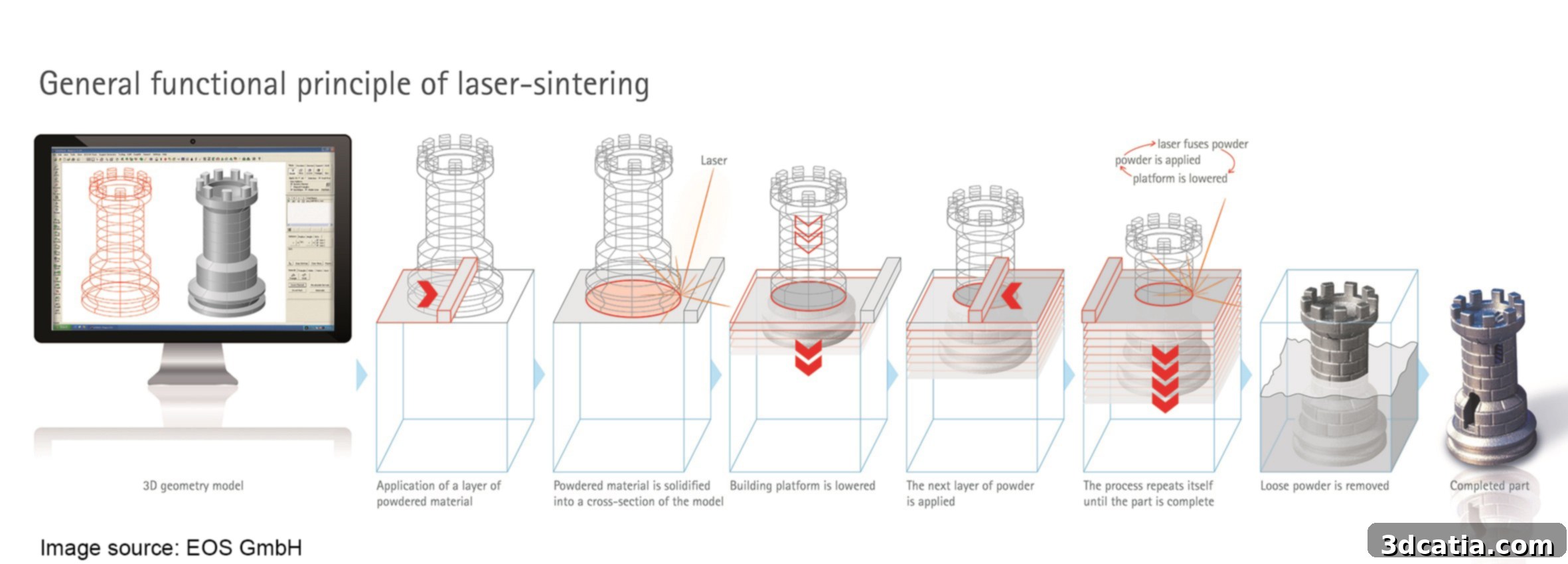
The Micro Laser Sintering process.
3DN: For whom, or in which specific industries and for what types of applications, is this process particularly well-suited?
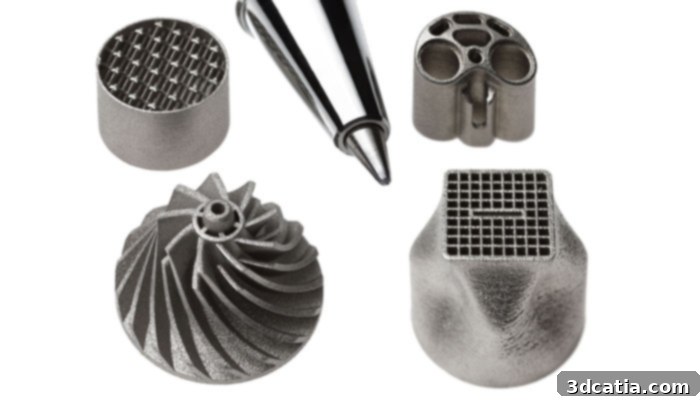
Our guiding principle at 3D MicroPrint is that we manufacture for all industries that require precision micro-components. If you are seeking an innovative and highly precise production solution for your complex micro-component, we strongly encourage you to contact us immediately. While our technology is broadly applicable, we observe a significant concentration of our current customers originating from the medical industry. This sector, with its stringent demands for precision, biocompatibility, and customizability, finds MLS perfectly aligned with its needs. Beyond medical, we also cater to customers in the energy, aerospace, and jewelry industries, where the ability to create intricate and highly functional micro-parts offers distinct advantages. MLS is exceptionally well-suited for applications involving complex geometries that are challenging, if not impossible, to produce with conventional manufacturing methods. Examples include nozzles with highly variable channel cross-sections for fluid dynamics, intricate grid structures for lightweighting or enhanced functionality, and even movable assemblies that can be printed as a single, fully functional unit, eliminating the need for costly and complex micro-assembly. In essence, MLS excels where conventional micro-machining methods, such as micro-milling or EDM, reach their limits due especially to feature size, geometric complexity, material wastage, or the need for internal channels and structures. Our technology provides a level of geometric freedom and material efficiency that is transformative for micro-component design and production, allowing engineers to realize previously unattainable designs and functionalities for parts often smaller than a grain of sand.
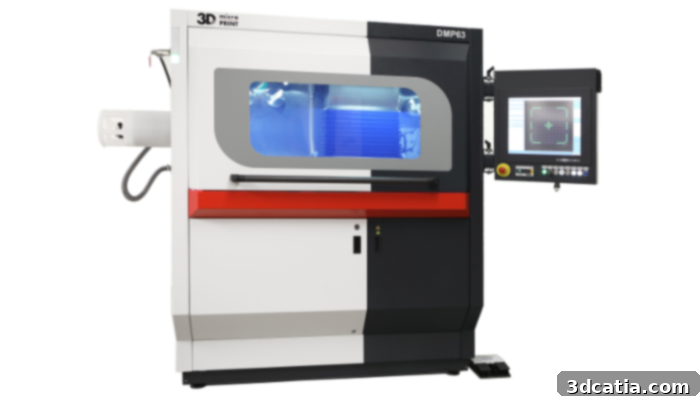
A 3D printer capable of micro laser sintering.
3DN: What are the strategic plans for 3D MicroPrint GmbH for the current year and the near future?
At 3D MicroPrint GmbH, our foremost priority remains the unwavering satisfaction of our customers. We firmly believe that this is achieved through the consistently high quality and reliability of the components manufactured using our microlaser sintering technology. To uphold and continuously elevate this standard, we are incessantly working to improve every facet of our process: from the quality and characteristics of the metal powders we use, to the precision and performance of our MLS machines, and the optimization of our process parameters. In the current fiscal year, we have made significant strategic investments in developing and integrating new, advanced processes specifically for assessing powder quality and ensuring impeccable component quality. These sophisticated methods have now been seamlessly integrated into our operational workflows, allowing us to maintain consistently high quality and deliver superior products to our discerning customers with every order. Furthermore, we are actively engaged in several ambitious research and development projects aimed at expanding our technological footprint. These projects focus on two main areas: opening up entirely new industrial sectors where MLS can offer a competitive advantage and making innovative new materials available to the market that can benefit from our ultra-precision additive manufacturing capabilities. This includes exploring novel metal alloys and potentially even ceramic compositions that can withstand the microlaser sintering process. Our long-term vision involves pushing the boundaries of miniaturization even further, enhancing the speed and efficiency of our machines, and broadening the material palette to unlock new applications in fields like micro-robotics, advanced sensors, and next-generation medical devices. We are committed to remaining at the forefront of micro-additive manufacturing, constantly innovating to meet the evolving demands of high-tech industries.
3DN: Do you have any final words you would like to share with our readers?
We extend our sincere gratitude to 3DNatives for their keen interest in 3D MicroPrint GmbH and for providing us with this valuable platform to discuss our groundbreaking microlaser sintering technology. We believe MLS represents a pivotal shift in precision manufacturing, enabling innovations that were once considered impossible. We invite all interested parties to explore our technology and capabilities further by visiting our official website: http://www.3dmicroprint.com/. If you have specific micro-components that you believe could benefit from additive manufacturing with unparalleled precision, or if you are simply curious about how MLS could transform your current design and production challenges, please do not hesitate to send us an inquiry to: in**@**********nt.com. We look forward to collaborating with you to unlock the full potential of micro-additive manufacturing.
What are your thoughts on the groundbreaking work being done by 3D MicroPrint and their microlaser sintering technology? Share your insights and opinions in a comment below or join the conversation on our Facebook and Twitter pages! Don’t forget to sign up for our free weekly Newsletter to get all the latest news and advancements in 3D printing delivered straight to your inbox!