
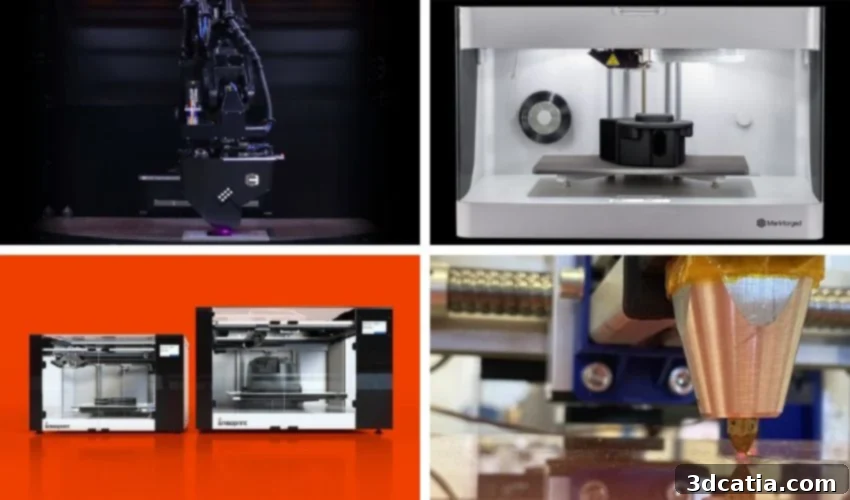
Exploring the Leading Composite 3D Printers: Advancing High-Performance Additive Manufacturing
The landscape of 3D printing technology is continuously evolving, with a growing demand for materials that offer superior mechanical properties. In this pursuit, composite materials have emerged as a critical innovation, significantly enhancing the performance capabilities of additive manufacturing. These advanced materials typically consist of a “matrix” – most commonly a thermoplastic polymer – reinforced with high-strength fibers such as carbon fiber, aramid, or glass fiber. This reinforcement dramatically boosts the strength-to-weight ratio of final parts, enabling them to withstand greater stresses, reduce overall weight, and in many instances, even replace traditional metal components. This represents a significant leap forward for industries requiring robust, lightweight, and durable parts.
While many desktop FDM 3D printers can process composite filaments, often requiring a hardened steel nozzle for abrasive materials, their capabilities are generally limited to short-fiber-reinforced plastics. The true potential of composite additive manufacturing lies in the ability to deposit continuous fibers directly into the matrix material during the printing process. This technique, known as continuous fiber fabrication, allows for precise control over fiber orientation and density, leading to parts with unparalleled strength and optimized performance characteristics. Recognizing this need, several pioneering manufacturers have developed innovative 3D printing solutions specifically designed for extruding both the matrix and continuous fibers, yielding parts that are not only stronger but also more reliable for demanding applications. In this comprehensive guide, we delve into some of the leading composite 3D printers and their underlying technologies, showcasing how these advanced systems are redefining what’s possible in additive manufacturing. These groundbreaking solutions, presented alphabetically, represent the forefront of high-performance composite 3D printing.
9T Labs and its Red Series Solution: Precision Composite Manufacturing
Founded in 2018, 9T Labs is a Swiss innovator at the cutting edge of composite 3D printing. Their patented Additive Fusion Technology (AFT) represents a significant advancement, enabling the precise, automated, and controlled deposition of continuous carbon fibers within a polymer matrix. This sophisticated process is executed through their integrated Red Series system, which comprises two key units: the Build Module, responsible for the actual 3D printing, and the Fusion Module, dedicated to post-processing. The Build Module excels in placing continuous fibers with extreme accuracy, following specific orientations and trajectories meticulously planned during the design and 3D file preparation stages. This capability is crucial for optimizing a part’s weight, minimizing material costs, and crucially, guaranteeing optimal structural integrity and solidity where it’s most needed. Furthermore, the 3D printer intelligently adapts its material deposition; for sections of a part that do not require continuous fiber reinforcement, it can seamlessly fill them with a conventional polymer or a short-fiber-reinforced plastic, ensuring material efficiency and tailored performance. The machine itself is equipped with an array of advanced sensors that meticulously monitor the entire printing process, ensuring quality and consistency. Coupled with an intelligent temperature management system, it actively minimizes moisture absorption in the material, which is vital for achieving superior adhesion between layers and overall part quality. The second component of the Red Series, the Fusion Module, employs compression molding techniques in a post-processing step. This crucial stage is designed to achieve the best possible performance in terms of surface finish, part consolidation, and overall mechanical quality, transforming the printed green part into a high-performance final composite component. 9T Labs’ Red Series offers a holistic solution for industrial production of high-performance composite parts, bridging the gap between prototyping and series manufacturing. To gain a deeper understanding of 9T Labs’ innovative manufacturing process and its applications, the following video provides an excellent visual overview:
Anisoprint: Leading the Way in Desktop and Industrial Continuous Fiber Composite 3D Printing
When the discussion turns to comprehensive, turnkey solutions for continuous fiber 3D printing, whether for desktop or industrial applications, Anisoprint consistently stands out as a pioneering force. Headquartered in Singapore and led by Fedor Antonov, the company is driven by a clear mission: “to introduce a new globally demanded industrial manufacturing technology for optimized structures made of composite materials.” Anisoprint achieves this ambitious goal through its proprietary and patented Composite Fiber Coextrusion (CFC) technology. This revolutionary process enables the seamless integration of continuous fibers into a wide array of base thermoplastics, including popular options like PLA, ABS, PETG, and Nylon, among others. The versatility of CFC technology allows for the creation of incredibly strong and lightweight parts across various applications. For the professional desktop market, Anisoprint offers the A3 (with a generous build volume of 460 x 297 x 210 mm) and the more compact A4 (287 x 210 x 140 mm build volume). These desktop solutions are remarkably capable, allowing users to produce composite parts with impressive strengths of up to 900 MPa, making them ideal for high-performance prototyping, functional parts, and small-batch production where traditional FDM printers fall short. Stepping into the industrial realm, Anisoprint’s PROM IS 500 represents their robust industrial solution. This machine is engineered for compatibility with high-temperature plastics, such as PEEK and PEI, capable of processing materials at extrusion temperatures up to 410°C, and boasts a substantial build volume of 600 x 420 x 300 mm. The PROM IS 500 is designed for the most demanding industrial applications, where exceptional mechanical properties and thermal resistance are paramount. A key differentiator that sets Anisoprint apart is the unique flexibility it offers users. Through what they term “anisoprinting,” users can precisely modify the density of the composite filler and vary the direction of the continuous fibers. This granular control allows for the creation of optimally designed parts, where strength and stiffness are strategically placed to meet specific load conditions, leading to unparalleled performance and material efficiency. Anisoprint’s dedication to both accessibility and industrial-grade performance has positioned it as a leader in making continuous fiber composite 3D printing a reality for a broader range of manufacturers.
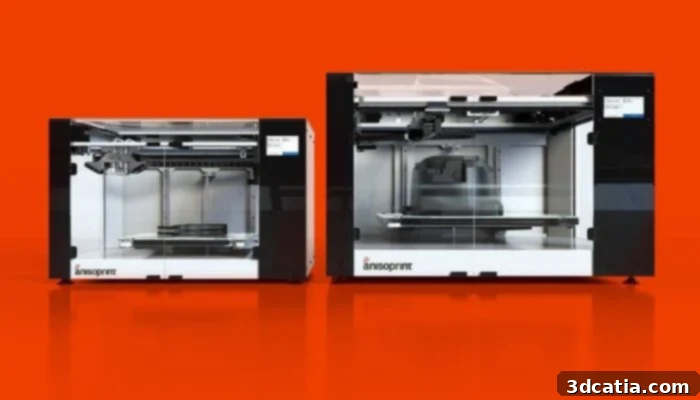
The two desktop solutions from Anisoprint, the A4 (left) and A3 (right) (photo credits: Anisoprint)
Continuous Composites: Unlocking Speed and Strength with CF3D® Technology
Established in 2015, Continuous Composites is a forward-thinking company dedicated to advancing innovative technologies for the composite manufacturing industry. The company identified critical limitations in traditional composite production – namely slow speeds, material weaknesses, and restrictive manufacturing volumes – and developed its groundbreaking CF3D® solution to overcome these challenges. CF3D® (Continuous Fiber 3D printing) is an automated additive manufacturing process that fundamentally reimagines how composite parts are created. The process initiates with a continuous dry fiber, which is then precisely impregnated with a fast-curing thermosetting resin directly at the printhead. This integrated approach ensures optimal fiber wet-out and eliminates several cumbersome and time-consuming steps typically associated with composite fabrication. A significant advantage of the CF3D® method is its ability to bypass the need for expensive and energy-intensive molds, ovens, and autoclaves, which are staples in conventional composite manufacturing. This simplification of the process translates into substantial cost savings, reduced production times, and a higher material yield, making advanced composites more accessible and economically viable. By leveraging lightweight composite materials, CF3D® technology imbues additive manufacturing with an exceptional level of performance and functionality. Parts produced with CF3D® exhibit superior strength, stiffness, and durability, opening up new possibilities for structural applications across aerospace, automotive, marine, and defense sectors. Furthermore, a truly remarkable feature of CF3D® technology is its capability to print both structural and functional fibers in a single-step process. This means that not only can parts be reinforced for mechanical performance, but they can also incorporate embedded functionalities, such as integrated sensors or electrical pathways, directly during printing. This unique ability streamlines manufacturing, reduces assembly steps, and enables the creation of highly complex, multi-functional composite components that were previously impossible or prohibitively expensive to produce.
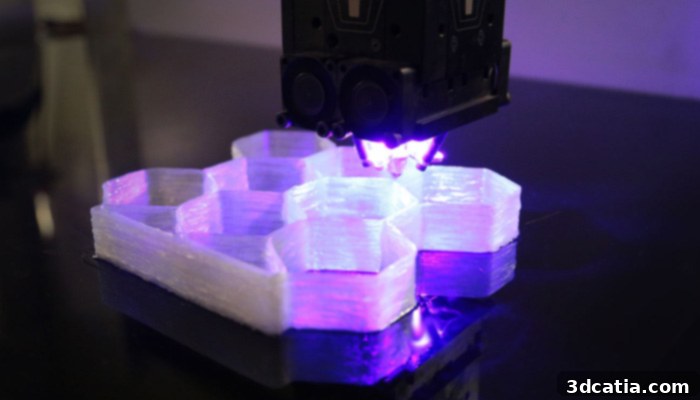
Photo Credits: Continuous Composites
Impossible Objects: High-Speed Industrial Composite 3D Printing with CBAM Technology
The American company Impossible Objects is making significant strides in industrial additive manufacturing with its innovative CBAM (Composite Based Additive Manufacturing) technology, exemplified by their flagship CBAM 25 3D printer. This cutting-edge technology is purpose-built for the efficient and high-performance production of composite materials. The CBAM 25 is specifically optimized for working with high-strength reinforcement fibers such as carbon fiber and fiberglass, seamlessly combining them with advanced, high-performance polymers like nylon and PEEK. This material flexibility allows for the creation of parts tailored to specific industrial requirements, from lightweight structural components to parts demanding high thermal and chemical resistance. Designed from the ground up to meet the rigorous demands of industrial environments, the CBAM 25 stands out for its transformative impact on additive manufacturing, delivering unprecedented levels of speed and precision. One of its most compelling features is its remarkable print speed: the technology is capable of printing each layer in under four seconds. This extraordinary speed translates directly into vastly accelerated production cycles, enabling the manufacturing of parts up to 15 times faster than many competing additive manufacturing solutions currently available on the market. Such rapid production capabilities are critical for industries looking to leverage 3D printing for large-scale production or for applications requiring quick turnaround times, without compromising on part quality or mechanical properties. Impossible Objects’ CBAM technology leverages a unique process where sheets of reinforcing fibers are loaded into the printer, selectively bound with a polymer powder, and then consolidated. This sheet-based approach contributes to the exceptional speed and material properties. The CBAM 25 is positioned to revolutionize sectors such as aerospace, automotive, and defense, where the demand for high-performance, lightweight, and rapidly produced composite parts is ever-increasing. Its ability to deliver robust, functional composite parts at industrial speeds makes Impossible Objects a key player in the future of advanced manufacturing.
Markforged: America’s Premier Producer of Continuous Fiber Composite 3D Printers
Markforged, a renowned American manufacturer of 3D printers, has firmly established itself as a leader in the continuous fiber composite additive manufacturing space. The company’s innovative approach is centered around its patented Continuous Filament Fabrication (CFF) technology. This unique process involves precisely extruding continuous fiber reinforcement layer by layer, embedding it within a robust thermoplastic matrix. The result is exceptionally strong and durable parts that can rival the performance of traditionally manufactured metal components, but with the significant advantages of lower weight and design flexibility. To cater to a diverse range of applications and performance requirements, Markforged offers an extensive portfolio of four distinct types of continuous fiber reinforcements. These include standard carbon fiber for high strength and stiffness, glass fiber for excellent strength-to-weight and electrical insulation, Kevlar for superior impact resistance and abrasion protection, and High Strength High Temperature (HSHT) glass fiber, which provides enhanced strength retention at elevated temperatures. This broad selection allows users to select the optimal material combination for their specific functional needs. These advanced composite materials are compatible across several of Markforged’s state-of-the-art 3D printers, addressing both entry-level industrial and high-volume production requirements. The Desktop series, featuring models like the Onyx Pro and Mark Two, strikes an impressive balance between industrial-grade quality and affordability. These machines are perfect for engineers and designers seeking to produce strong, functional prototypes, tools, and fixtures with continuous fiber reinforcement right from their workspace. For more demanding industrial applications, Markforged offers its powerful Industrial series, which includes the X7, FX10, and FX20. These larger-format printers are engineered for producing robust, highly reliable, and precise parts, even when working with large-scale components and high-performance materials. The FX20, for instance, is designed for printing high-temperature thermoplastics like ULTEM™ 9085 with continuous fiber, pushing the boundaries of what is achievable in additive manufacturing for critical end-use parts in aerospace, automotive, and manufacturing. Markforged’s commitment to delivering reliable, high-performance composite parts has made their printers indispensable tools for industries seeking to innovate and optimize their manufacturing processes, solidifying their position as a leading provider of continuous fiber 3D printing solutions.
Photo Credits: Markforged
Moi Composites and its Revolutionary Continuous Fiber Manufacturing (CFM) Technology
Moi Composites, a dynamic spin-off from the prestigious Politecnico di Milano, emerged in 2018 with a vision to redefine composite manufacturing through its patented Continuous Fiber Manufacturing (CFM) technology. As its name implies, CFM is a groundbreaking 3D printing method that leverages the inherent strength and versatility of continuous fiber composite materials. What truly distinguishes CFM from many other solutions on this list is its unique modularity: the core of the technology, a specialized print head, is designed to be seamlessly integrated into any existing CNC machine equipped with more than four axes. This innovative approach allows manufacturers to transform conventional robotic systems into advanced composite 3D printers, significantly reducing the entry barrier and maximizing existing infrastructure. The CFM print head boasts exceptional material flexibility, capable of working with a wide array of high-performance composite materials. These include traditional reinforcements like carbon fibers, aramids (such as Kevlar), and glass fibers, but also extends to more sustainable options, incorporating materials of bio/natural origin. This versatility not only opens up new possibilities for material innovation but also aligns with growing demands for eco-friendly manufacturing processes. A cornerstone of Moi Composites’ offering is its sophisticated, customized software. This intelligent platform plays a pivotal role in optimizing both the design and production phases through advanced generative algorithms. The program expertly manages robotic machines, precisely controls print quality throughout the entire process, and meticulously calculates the optimal path from initial CAD design to final 3D printing. This holistic software integration ensures maximum efficiency, accuracy, and repeatability, crucial for industrial applications. The applications for CFM technology are incredibly broad and diverse. Moi Composites champions its solution for creating products that demand exceptional mechanical performance, long-term durability, and advanced functionality. Industries poised to benefit most from this technology include energy (e.g., wind turbine blades, structural components), aerospace (lightweight parts, complex geometries), construction (reinforced structures, custom architectural elements), sports equipment (high-performance gear), and the maritime sector (durable boat components, propellers). Moi Composites’ CFM technology represents a powerful fusion of robotics, material science, and intelligent software, offering a flexible and high-performance solution for the next generation of composite additive manufacturing.
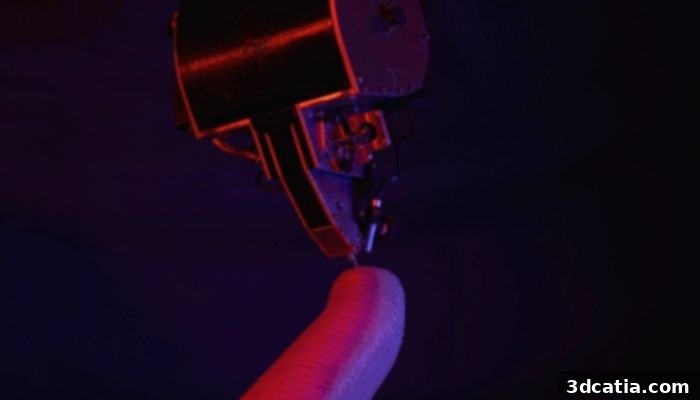
Photo Credits: Moi Composites
SphereCube’s Thermal Laser Curing: Advanced Continuous Fiber Composite 3D Printing
SphereCube, an innovative Italian company, is at the forefront of manufacturing high-performance composite components with a strong emphasis on sustainability and efficiency. Moving beyond traditional composite production methods, SphereCube has developed a unique approach that eliminates the need for molds and actively works to reduce environmental impact. Their pioneering technology, known as Thermal Laser Curing, is a cornerstone of their composite 3D printers, enabling the creation of exceptional parts with continuous fiber reinforcement and a thermoset matrix. The system’s advanced extrusion head, coupled with a sophisticated 5-axis robotic system, allows for unparalleled precision and control during the additive manufacturing process. A distinguishing feature of SphereCube’s printer is its ability to extrude the two primary composite materials – the polymer matrix and the reinforcement fibers – in distinct physical states. The polymer matrix is extruded in a viscous fluid state, ensuring excellent flow and complete impregnation of the fibers. Concurrently, the reinforcement material is fed in the form of continuous fiber, precisely placed according to design specifications. Once the extrusion of a layer or section is complete, a focused heat source, specifically a thermal laser, is employed to partially or fully cure the thermoset composite material. This method offers distinct advantages over conventional UV curing, which is often used for similar materials. Thermal Laser Curing provides greater depth of cure, better control over the curing process, and allows for the processing of a broader range of thermoset matrices. This includes a wide variety of polymer types, expanding the material palette for high-performance applications. Furthermore, SphereCube’s technology is remarkably versatile in its acceptance of continuous reinforcing fibers. It can utilize not only conventional carbon, glass, or aramid fibers but also sustainable options of natural and plant origin, such as flax and hemp. This commitment to sustainable materials aligns with global efforts to reduce the environmental footprint of manufacturing. Adding another layer of innovation, SphereCube has also patented its own unique method for preparing the reinforcing fiber, utilizing a specialized binderizing machine. This ensures optimal fiber handling and integration into the matrix. SphereCube’s brilliant work and innovative contributions to additive manufacturing did not go unnoticed, earning them a well-deserved selection as one of the esteemed winners of the Formnext Startup Challenge 2022, a testament to their potential to revolutionize composite production.
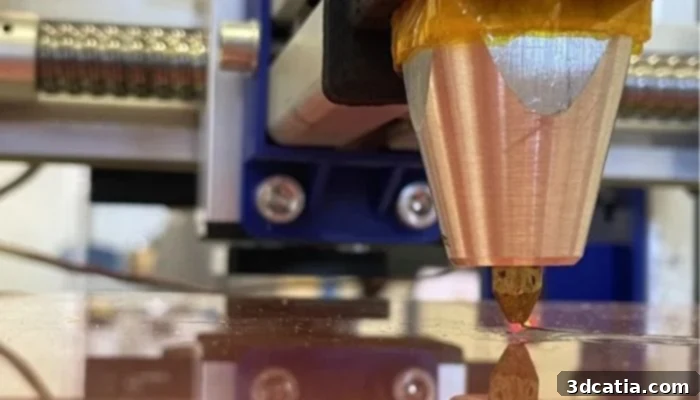
Photo Credits: SphereCube
The rapid advancements in composite 3D printing showcased by these innovative companies are truly transformative for additive manufacturing. By enabling the precise deposition of continuous fibers within high-performance polymer matrices, these technologies are breaking traditional barriers, offering unprecedented opportunities for engineers and manufacturers. The ability to create parts with exceptional strength-to-weight ratios, superior durability, and customized mechanical properties opens doors to new applications across critical industries, from aerospace and automotive to medical and consumer goods. We’ve seen how solutions like 9T Labs’ Additive Fusion Technology, Anisoprint’s versatile CFC, Continuous Composites’ mold-free CF3D®, Impossible Objects’ high-speed CBAM, Markforged’s robust CFF, Moi Composites’ adaptable CFM, and SphereCube’s advanced Thermal Laser Curing are each contributing unique strengths to this evolving field. These systems not only enhance part performance but also often reduce lead times, material waste, and overall production costs, making high-performance composites more accessible than ever before. As the demand for stronger, lighter, and more complex components continues to grow, these composite 3D printers will undoubtedly play a pivotal role in shaping the future of industrial manufacturing, pushing the boundaries of what is possible with advanced materials and additive processes.
What are your thoughts on these cutting-edge composite 3D printers and their potential impact on various industries? We’d love to hear your insights! Let us know your comments below or engage with us on our LinkedIn, Facebook, and Twitter pages. Don’t miss out on the latest advancements and breaking news in the additive manufacturing world – sign up for our free weekly Newsletter here, delivered straight to your inbox! You can also explore all our insightful videos and demonstrations on our dedicated YouTube channel.