
The Future of Additive Manufacturing: Navigating 2021 with Innovation, Sustainability, and Digital Transformation
The year 2020 presented unprecedented challenges and profound shifts across industries worldwide. Yet, within this landscape of unpredictability, the additive manufacturing (AM) sector showcased remarkable adaptability and resilience. Its ability to pivot swiftly proved instrumental, particularly in addressing critical needs within the healthcare sector where 3D printing users rapidly stepped up to produce essential personal protective equipment (PPE) and medical devices. This agile response stood in stark contrast to global supply chains, which, reliant on traditional, often geographically dispersed methods, faced severe disruptions and immense pressure during the crisis.
As we previously explored in our review of the trends that defined 2020 for the 3D printing industry, certain developments were clearly continuations of long-term shifts, such as the accelerating move from mere prototyping towards robust end-use applications. However, 2020 also introduced new imperatives and accelerated emerging trends, signaling a pivotal moment for the technology. As we now delve into the fourth decade of 3D printing, imbued with the lessons and opportunities of recent global events, we find ourselves at the cusp of a transformative period with immense potential for renewal and innovation. To cap off an extraordinary 2020 and cast our gaze forward, we engaged with several prominent figures and key players within the additive manufacturing field. We sought their invaluable insights into the current state of 3D printing, their predictions for its evolution, and their aspirations for the new year. Let’s welcome 2021 and the promising future it holds for AM!

Additive Manufacturing (AM) proved its capability to deliver significant solutions to emergent challenges, particularly those impacting supply chains.
Advancing Additive Manufacturing through Data: AI, Enhanced Process Control, and Simulation Software
DyeMansion, a company that successfully raised $14 million in 2020 for its innovative AM finishing systems, possesses a deep understanding of the critical role post-processing plays in augmenting the value and functionality of additive manufacturing outputs. Phillip Kramer, CTO and Co-Founder, articulates this perspective: “When integrated with further automation and groundbreaking innovations within the post-processing sector, 3D printing is rapidly approaching widespread recognition as a truly industrial manufacturing technology. To fully unlock the potential of these innovations, it is absolutely essential to forge strong, collaborative alliances between diverse solution providers across the ecosystem.” Achieving consistent part quality and repeatability remains a significant hurdle for many AM applications today. The inability to meet stringent repeatability requirements often leads to application failures, hindering broader industrial adoption. Kramer further elaborates: “Our hope is that as more and more machines become available in the market, generating ever-increasing volumes of data, AI-based algorithms will be able to analyze this data more effectively, bringing us much closer to achieving predictable part quality in 2021. The synergy between new additive systems and intelligent process control mechanisms will ultimately unlock a vast array of previously unattainable applications in the years following 2021.” This forward-looking view highlights the shift towards a more data-centric approach, where intelligent systems learn from production data to optimize parameters and ensure reliability.
Echoing the sentiment on data-driven advancements, Greg Paulsen, Director of Application Engineering at Xometry, shares his perspective: “I believe that advancements in software-driven digital twins, particularly in simulation capabilities, will enable us to extract far greater value from our existing and established technology base. This encompasses improvements in areas such as build preparation, robust design for additive manufacturing (DfAM) principles, and streamlined sourcing of additive projects.” As a leading platform connecting designers with extensive production resources, Xometry intimately understands the profound value that enhanced software capabilities can bring to the AM workflow. Digital twin software, already widely adopted across various industries, provides a dynamic, virtual representation or simulation of a physical asset, allowing for real-time monitoring and predictive analysis of performance. Paulsen further adds: “Beyond software, exciting new technologies are emerging on the horizon, alongside novel material formulations. This innovation is particularly vibrant within the photopolymer space, with new production systems and expertly engineered resins expanding the possibilities. On my personal wish list for 2021 is the gradual phasing out of traditional STL files in favor of more data-rich formats, such as 3MF, which can carry vital information beyond just geometry. I also aspire to see significantly improved access to advanced digital tools specifically designed for intricate texturing, complex latticing, and other sophisticated AM file preparation tasks.” This highlights a clear industry push towards more intelligent data handling and advanced design tools to unlock AM’s full potential.
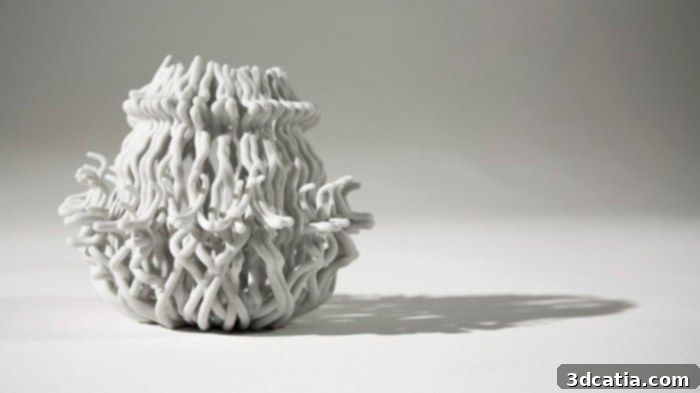
3D printing demands a refreshed approach to design engineering. With comprehensive data at hand, both part quality and repeatability can consistently meet stringent requirements | Image via AMFG
Towards a More Sustainable Future with Additive Manufacturing
The events of 2020 unequivocally demonstrated additive manufacturing’s capacity to deliver meaningful, rapid, and localized solutions to emerging global challenges. Danny Winn, VP Growth & Innovation at AMFG, reflects on this period: “2020 has undoubtedly been an extraordinary year for everyone. One undeniable positive outcome is that 3D printing was propelled into the global spotlight. The severe challenges created by the COVID-19 pandemic provided AM with an unparalleled opportunity to powerfully demonstrate its core strengths: the ability to manufacture critical items on-demand and, crucially, locally.” AMFG specializes in providing cutting-edge workflow automation software specifically tailored for additive manufacturing. Their solutions empower companies to achieve autonomous production at scale, streamlining processes and enhancing efficiency. The anticipated wider adoption of AM technology by mid-sized to enterprise-level original equipment manufacturers (OEMs) is poised to significantly accelerate the disruption of traditional manufacturing paradigms and reshape global supply chains. Winn further emphasizes: “3D printing inherently offers substantial environmental benefits, a topic that, regrettably, is often under-discussed. My fervent wish would be for more businesses to recognize the strategic alignment of additive manufacturing with their corporate net-zero objectives. Such recognition should ideally translate into increased investment in the development and deployment of AM, thereby enabling society’s broader transition towards a more sustainable and environmentally responsible future.” This underscores the potential of AM not just for industrial efficiency, but as a key enabler of ecological progress.
Stratasys, a pioneering and leading company in the additive manufacturing industry, is intently focused on accelerating the widespread application of AM across diverse sectors. Andreas Langfeld, President of Stratasys EMEA, observes: “An increasing number of companies, both small and large, are meticulously analyzing their Bill of Materials (BOM) with the strategic intent of transitioning selected product components from traditional manufacturing methods to additive manufacturing. Today, numerous AM solutions are available that offer certified additive production capabilities, and 2020 clearly demonstrated a growing openness among customers to embrace this transformative change. The ‘next big thing’ is unequivocally upon us now, and my wish is that many more companies worldwide will proactively drive efficiency, significantly reduce costs, and enhance their environmental footprint by integrating additive manufacturing into their in-house production capabilities.” Many proponents have long asserted that 3D printing will usher in significant environmental improvements. This is primarily due to its capacity for generating minimal waste during the production process and its inherent promotion of localized production through digital manufacturing principles. While comprehensive analysis of the environmental performance of 3D printing remains somewhat limited today, the clear trajectory towards more sustainable manufacturing practices is undeniably reinforced by additive manufacturing. This includes opportunities ranging from sourcing renewable materials, to implementing advanced waste management strategies, and improving product recyclability. The year 2021 presents an opportune moment to significantly advance these sustainability initiatives within the AM landscape.

The New Raw in Amsterdam exemplifies innovation by transforming plastic waste into unique urban furniture, leveraging advanced 3D printing technologies.
Shifting our focus to the end-user perspective, it becomes abundantly clear that additive manufacturing has undeniably captured market attention and garnered widespread appreciation for its innate ability to provide rapid, localized, and increasingly sustainable solutions. Anne Debauge, Digital Director Pack&Dev at L’Oréal, shared her firsthand experience, stating: “I was profoundly impressed by the sheer speed of deployment of 3D printing technology, particularly in the manufacturing of face shields for our dedicated doctors and retailers. This swift action effectively bridged critical gaps in the existing supply chain during a period of immense need. The unbeatable agility inherent in 3D printing, combined with a remarkable national mobilization of the entire 3D printing community, allowed us to become active participants and contributors during this challenging period.” Looking ahead, this ecological dimension holds significant importance for L’Oréal. However, Anne emphasizes that additive manufacturing must first achieve widespread industrial-scale deployment. The primary objective is to establish a production method that is not only easily repeatable and fast but also inherently flexible to meet dynamic market demands. Anne concludes: “Our overarching wish is to achieve industrial-scale 3D printing using recyclable and recycled food-grade materials that precisely address the evolving needs and expectations of our consumers. While the maturity of this technology is advancing at an incredibly rapid pace, it’s important to acknowledge that not all indicators are fully ‘green’ for broad, mass industrial deployment just yet.” This candid assessment highlights the remaining hurdles, particularly in material certification, scalability, and cost-efficiency for high-volume consumer product manufacturing, while underscoring the immense potential for a sustainable future.
The past year has solidified additive manufacturing’s position not just as a niche technology, but as a robust and essential component of modern industrial strategy. From enhancing supply chain resilience and pioneering sustainable production methods to driving digital transformation through AI and advanced simulation, AM is clearly poised for significant growth and impact in the coming years. The insights from industry leaders underscore a collective vision for a future where 3D printing is integrated, intelligent, and environmentally conscious. As we look forward, the focus remains on overcoming challenges related to repeatability, data management, and industrial scalability, particularly concerning novel materials and sustainable practices. The ongoing dialogue and collaboration among solution providers, manufacturers, and end-users will be crucial in unlocking the full spectrum of possibilities that additive manufacturing offers.
What are your personal aspirations and new year wishes concerning additive manufacturing for 2021 and beyond? We invite you to share your thoughts and predictions in a comment below or join the conversation on our Facebook and Twitter pages! Don’t miss out on the latest advancements and breaking news in the world of 3D printing – sign up for our free weekly Newsletter, delivered straight to your inbox!
*Thumbnail Image Credits: Siemens