
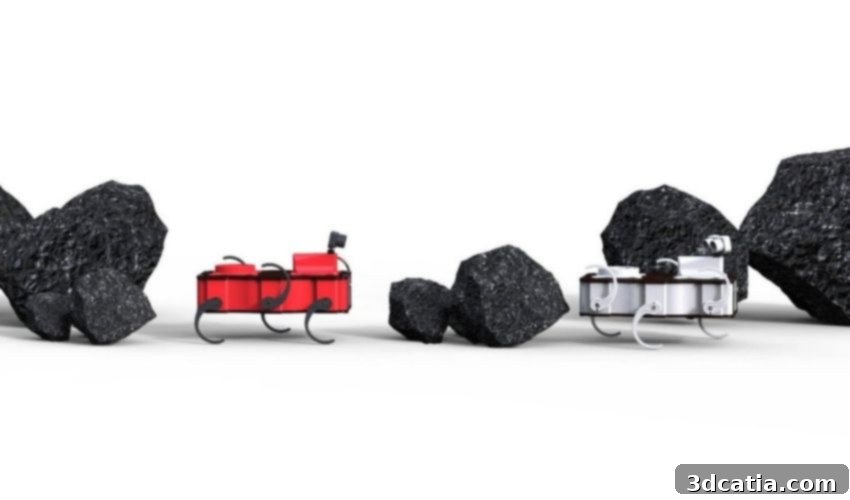
Pioneering Mars Colonization: How Zebro Robots and 3D Printing Could Build Underground Human Habitats
What once resonated purely within the realm of science fiction is swiftly transitioning into a tangible reality: the ambitious prospect of colonizing another planet. Humanity’s dream of establishing an extraterrestrial presence is being actively pursued through myriad projects, all dedicated to ensuring the long-term survival of humans beyond Earth. In our previous explorations, we’ve highlighted transformative advancements such as 3D printing on the Moon, the indispensable role of Mars rovers, and the engineering marvels of 3D-printed rocket components. However, for true human survival on a distant world like Mars, innovative and creative solutions are paramount, particularly for meeting fundamental human needs in an utterly alien environment. The Robotic Building Lab at Delft University of Technology (TU Delft) in the Netherlands is spearheading a particularly intriguing concept: enabling humans to thrive in a subterranean, ‘anthill-like’ habitat on the Red Planet. This vision hinges on the deployment of sophisticated Zebro robots, designed to excavate extensive underground living spaces, utilizing advanced 3D printing techniques as a crucial method for solidifying and reinforcing the structural integrity of the tunnel walls. But what exactly does the necessary infrastructure entail to facilitate sustainable colonization of Mars? And, more fundamentally, can humans truly adapt and survive within such a drastically different climate and ecosystem?
The ability for humans to journey to celestial bodies like the Moon or Mars via advanced rockets is no longer an extraordinary feat, but rather a testament to decades of scientific progress. Yet, the contemplation of extended stays, or even permanent settlement in these harsh environments, instantly raises a cascade of complex questions. Human evolution has meticulously adapted our species to Earth’s unique biosphere, rendering us unprepared for the intensely high levels of ionizing radiation, the abrasive Martian dust, the near-vacuum atmosphere, and the sometimes drastic, planet-wide temperature fluctuations prevalent on Mars. These formidable environmental challenges necessitate pioneering solutions, and for this reason, researchers and engineers across the globe are diligently working to develop technologies and strategies that will nevertheless enable human survival on extraterrestrial terrains. This global collaborative effort seeks to bridge the gap between our current capabilities and the ambitious goal of making Mars a viable second home for humanity.
The Harsh Realities of Mars: Why Underground Habitats are Essential
Mars presents an array of formidable challenges that demand innovative solutions for any long-term human presence. Its atmosphere is incredibly thin, less than 1% of Earth’s, and primarily composed of carbon dioxide, making it unbreathable and offering minimal protection from space. The planet is bombarded by high levels of ionizing radiation from the sun and cosmic rays, which pose significant health risks, including increased cancer rates and damage to DNA, cells, and organs. Furthermore, Mars experiences extreme temperature swings, plummeting to -100°C (-148°F) at the poles and at night, while barely reaching above freezing point during the day in equatorial regions. These rapid and severe temperature changes make surface living incredibly difficult for both humans and equipment. Additionally, the Martian surface is continuously exposed to micrometeorite impacts, and periodic planet-encircling dust storms can last for months, obscuring solar panels and damaging delicate instruments. These cumulative factors underscore the critical need for robust, shielded, and thermally stable living environments, pushing researchers towards ingenious architectural solutions that can withstand such an unforgiving world.
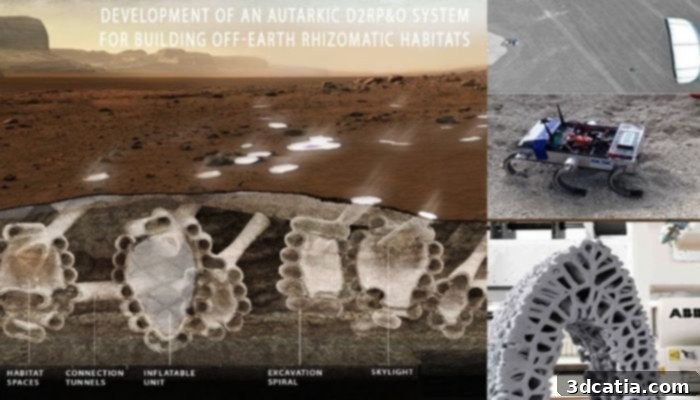
Zebro Robots could make it possible for humans to colonize Mars in the future. (Photo Credits: TU Delft)
3D Printed Support Structures Enable Underground Living Space
For several years now, the Delft University of Technology has been at the forefront of developing groundbreaking Zebro robots. These autonomous units are specifically engineered to excavate and construct tunnels beneath the surface of Mars, laying the groundwork for future human settlements. Zebro robots are innovative nano-rovers, meticulously designed to meet the extraordinary environmental demands of the Red Planet. Their distinctive multi-legged design, reminiscent of insects, provides them with exceptional mobility, enabling them to navigate and traverse highly uneven and challenging surfaces, such as jagged rock formations, treacherous slopes, and cratered terrain, as they carry out their critical excavation tasks. According to the TU Delft team, a key characteristic of these rovers is their advanced autonomy and cooperative capabilities; they are classified as ‘swarm robots’. This classification is vital, as it implies a level of collective intelligence and operational efficiency crucial for large-scale construction efforts in a remote and hostile environment.
The concept of swarm robotics is central to the Zebro project’s ambitious goals. It means that these robots possess the ability to communicate seamlessly with each other, sharing data, coordinating movements, and intelligently dividing complex tasks among the collective. For instance, one specialized group of Zebro robots can be dedicated entirely to the painstaking process of digging and extending the network of tunnels, meticulously removing Martian regolith. Simultaneously, another specialized group of Zebro robots would follow, tasked with implementing 3D-printed support structures directly onto the freshly excavated walls. These structures, fabricated from locally sourced Martian materials, are designed to immediately strengthen and stabilize the tunnels, preventing collapse and creating durable, habitable spaces. The overarching aim is to construct an interconnected network of underground living spaces, remarkably similar in structure and function to terrestrial ant colonies. In these subterranean environments, the drastic and unpredictable temperature fluctuations that plague the Martian surface are significantly attenuated, thanks to the natural insulation provided by tons of overlying regolith. This thermal stability, coupled with inherent radiation shielding, makes these underground living spaces highly suitable and, indeed, essential for potential human colonization.
Leveraging In-Situ Resources: The Power of Martian 3D Printing
A cornerstone of sustainable extraterrestrial colonization is the principle of In-Situ Resource Utilization (ISRU), which advocates for using materials found directly on the planet rather than transporting everything from Earth. This approach drastically reduces the enormous costs and logistical complexities associated with launching materials into space. For the additive manufacturing of the crucial support structures within the Martian tunnels, the Zebro robots are engineered to work with a specialized “cement” derived directly from local Martian dust and rock, commonly known as regolith. This innovative process involves collecting the regolith, processing it, and then using it as feedstock for their integrated 3D printers. This self-sufficient construction method not only minimizes the need for Earth-supplied building materials but also makes the entire colonization effort far more feasible and scalable. The ability to “live off the land” is paramount for long-term survival and expansion on Mars, transforming the very soil beneath their treads into building blocks for humanity’s future.
The feasibility of human colonization on the Red Planet is increasingly becoming a matter of “when,” not “if,” according to many leading experts in the field. Henriette Bier, the visionary founder and current head of TU Delft’s Robotic Building Laboratory, emphatically states the critical importance of utilizing resources that are already abundant on Mars. Her philosophy underpins the entire Zebro project, emphasizing sustainability and self-reliance. This groundbreaking project has garnered significant recognition and support, receiving a prestigious grant from the European Space Agency (ESA) for its continued development and advancement. This funding underscores the international aerospace community’s confidence in TU Delft’s innovative approach to Martian habitat construction. Moreover, the Zebro project is not an isolated endeavor. Building upon their expertise in swarm robotics and extraterrestrial exploration, similar nano-rovers developed by TU Delft, known as the Lunar Zebro, were slated for a mission to the Moon as early as 2022. This concurrent lunar mission serves as an invaluable precursor, providing critical data and proving ground for the technologies and operational methodologies that will eventually be deployed on Mars, showcasing TU Delft’s sustained commitment to pushing the boundaries of space exploration and habitation.
The Vision Ahead: Life in Martian Subterranean Sanctuaries
Once established, these underground ‘anthill’ habitats on Mars would offer an unparalleled sanctuary from the planet’s relentless environment. Beyond shielding from radiation and providing thermal stability, these subterranean complexes would protect inhabitants from micrometeorite impacts and the pervasive, corrosive Martian dust. Within these controlled environments, sophisticated life support systems would meticulously manage atmospheric composition, temperature, and humidity, creating Earth-like conditions for human occupants. The deep Martian underground also presents intriguing possibilities for controlled-environment agriculture, potentially enabling the cultivation of crops using hydroponics or aeroponics under artificial light, thereby reducing reliance on resupply missions from Earth and fostering true self-sufficiency. Energy for these habitats could be derived from a combination of solar panels on the surface (cleaned by robots or autonomous systems) and potentially small-scale nuclear reactors, providing reliable power for lighting, life support, and industrial processes. The psychological impact of living underground would be a significant consideration, necessitating thoughtful architectural design, virtual windows, and communal spaces to promote well-being and mitigate isolation. The scalability of the Zebro robot concept means that initial small habitats could evolve into extensive subterranean cities, housing larger populations and supporting diverse activities, from scientific research to resource extraction.
The ultimate goal is not merely survival, but thriving. This entails developing closed-loop systems for water recycling, waste management, and air purification. The very Martian regolith used for construction could also potentially be processed to extract water ice or other valuable elements, further contributing to the self-sustaining nature of the colony. This multi-generational endeavor of establishing humanity on Mars would be a testament to our species’ ingenuity, resilience, and unyielding drive to explore and settle new frontiers. It represents a profound shift in human history, moving beyond a single planetary existence to becoming a multi-planetary species. The challenges are immense, but the collaborative efforts of institutions like TU Delft and agencies like ESA, coupled with groundbreaking technologies such as Zebro robots and advanced 3D printing, are steadily paving the way for this audacious future.
Do you believe that extraterrestrial colonizations are a realistic and achievable goal for humanity in the near future? We invite you to share your thoughts and perspectives in a comment below, or engage with us on our vibrant Facebook and Twitter pages. To stay informed about all the latest breakthroughs and developments in the exciting world of 3D printing and space exploration, don’t forget to sign up for our free weekly Newsletter, delivering cutting-edge news directly to your inbox!