
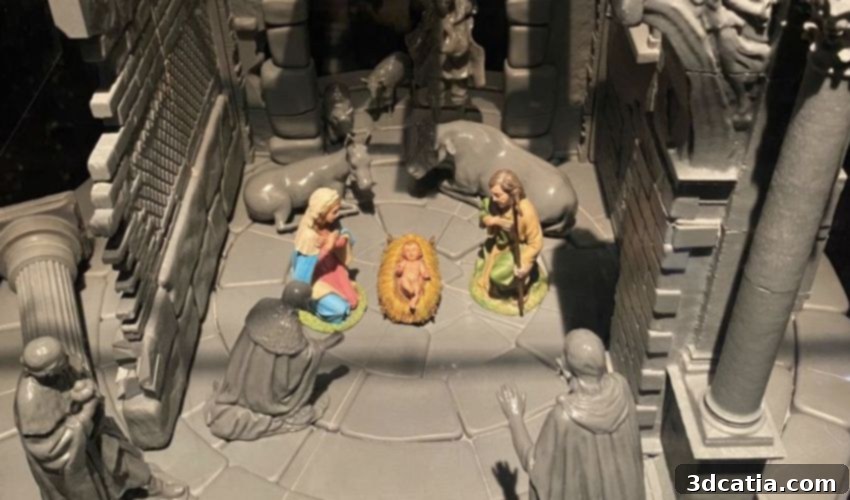
Jirama Reimagines Christmas Tradition: A 3D Printed Nativity Scene Unveiled in Naples
The nativity scene, or “presepe” as it is known in Italy, stands as one of the most cherished and enduring symbols of Christmas globally. For centuries, it has captured the hearts of millions, embodying stories of faith, community, and hope. This year, however, this deeply historic and religious icon has been given a remarkable contemporary reimagining, thanks to the innovative spirit of an Italian startup. Jirama, a pioneering company, has seamlessly blended age-old tradition with cutting-edge technology by creating a spectacular 3D printed nativity scene. This groundbreaking piece has not only become a significant addition to Naples’ renowned centuries-old nativity tradition but has also earned a prestigious place at the National Archaeological Museum of Naples (MANN). It is currently a highlight of the exhibition “The Courtly Nativity. The Legacy of Charles III,” signifying a monumental step forward in how cultural heritage can be preserved and presented through modern additive manufacturing.
Jirama, a dynamic Neapolitan startup established in 2020, is at the forefront of conceiving and developing innovative services and products. The company’s unique name, derived from Malagasy—the language of Madagascar—translates to “essence of spirit.” This name perfectly encapsulates its core mission: to delve deep into understanding and applying the diverse capabilities of various materials and advanced technologies. At the heart of Jirama’s operations is a dedicated Research & Development team. This team collaborates closely with prominent universities across Italy’s Campania Region, particularly engaging with departments specializing in Mechanical and Management Engineering. Their collective efforts are focused on studying and evolving new production models, ultimately aiming to develop sophisticated re-engineering processes and foster business innovation. The objective is clear: to achieve substantial benefits in terms of reducing material consumption and, consequently, production costs, all while rigorously upholding and often enhancing product quality. This commitment to efficiency and excellence positions Jirama as a key player in the evolving landscape of sustainable and innovative manufacturing, demonstrating how technological prowess can drive both artistic and economic advancements.
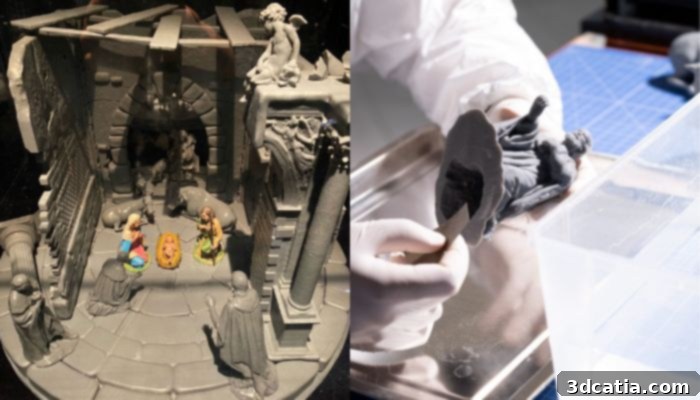
To illustrate the remarkable versatility of 3D printing, the crib creatively integrates various wall textures: a rustic tuff wall, a historically accurate Roman brick wall, and a finely stuccoed wall, demonstrating the technology’s capability for intricate detail.
The exhibition “The Courtly Nativity. The Legacy of Charles III,” hosted at the National Archaeological Museum of Naples (MANN) from December 1st to January 31st, serves as the perfect platform for Jirama’s visionary project. This prestigious event, celebrating the enduring legacy of Charles III’s patronage of the arts, provides a captivating historical context for Jirama’s modern marvel. During this period, the startup proudly unveiled its nativity scene, entirely fabricated using advanced 3D printing technology, aptly named Presepe III.ZERO. This evocative name itself suggests a new paradigm, a “third era” of nativity creation, symbolizing a significant leap forward in the craft.
Valentina Popolo, leading Research & Development of New Technologies at Jirama s.r.l., articulated the profound philosophy behind this initiative. She emphasized that the project was “created not to replace the great Neapolitan nativity classics of the centuries that preceded us, but to introduce a new era of production centered on 3D printing.” This statement highlights a respectful and forward-thinking approach, positioning additive manufacturing not as a competitor to traditional artistry but as a powerful tool for its evolution and adaptation in the modern age. It aims to inspire new forms of artistic expression while honoring the deep cultural roots of this cherished tradition, ensuring its relevance for generations to come by leveraging the precision, customization, and design freedom that 3D printing offers. The Presepe III.ZERO thus stands as a bridge between past craftsmanship and future possibilities, a testament to how innovation can both preserve and invigorate cultural heritage.
The 3D Nativity Scene Printing Process: Where Ancient Craftsmanship Meets Modern Innovation
The creation of the Presepe III.ZERO involved a meticulous and technologically advanced process, primarily utilizing Stereolithography (SLA) 3D printing technology. Jirama specifically selected the Formlabs Form 3L 3D printer for this ambitious project. The Form 3L was chosen for several compelling reasons, chief among them its generous large print volume, which allowed for the production of significant components without needing excessive segmentation, and its exceptional detail accuracy. This precision was crucial for replicating the intricate textures and delicate features traditionally found in Neapolitan nativity scenes, ensuring that even the smallest details contributed to the overall authenticity and artistic integrity of the piece.
SLA technology, known for its ability to produce highly detailed and smooth surfaces, was a clear preference over Fused Deposition Modeling (FDM) technology for this artistic endeavor. While FDM is versatile for many functional applications, SLA excels when aesthetic quality and fine resolution are paramount, making it ideal for art and display pieces. The liquid photopolymer resin used in SLA allows for the creation of incredibly fine layers and exceptionally smooth finishes directly from the printer, significantly minimizing the need for extensive post-processing to achieve a desired surface quality. This was vital for Jirama in faithfully recreating the traditional look and feel of a classic nativity scene. Furthermore, SLA offered Jirama the strategic advantage of partially hollowing out the interior of the printed pieces. This innovative technique not only conserved valuable resin material, contributing to cost efficiency and reduced waste, but also potentially lightened the overall structure without compromising external detail or structural integrity. The primary material chosen for crafting this unique 3D printed crib was Grey Resin, a robust and versatile photopolymer known for its excellent detail reproduction, consistent quality, and ease of painting, providing a perfect canvas for the subsequent artistic touches.
From Digital Design to Tangible Art: The Collaborative Creation Journey
To bring the nativity scene to life, Jirama’s team of skilled model makers embarked on a remarkable collaborative journey, enlisting the invaluable expertise of a seasoned traditional nativity artisan. This fusion of traditional craftsmanship with advanced digital design methodologies was pivotal to the project’s success. Together, they meticulously worked to digitally draw and sculpt every single element of the scene. From the expressive figures of the shepherds, each imbued with character and movement, to the intricate components of the environmental setting—such as the architectural details, natural elements like rocks and trees, and everyday objects—each piece was conceived with painstaking attention to detail in the digital realm. This precise digital craftsmanship ensured that the centuries-old aesthetic and narrative integrity of Neapolitan nativity scenes were faithfully preserved, even as they were translated into a modern manufacturing process. This approach allowed for unparalleled consistency and accuracy, while also offering the flexibility to iterate and refine designs before physical production. The entire scene, elegantly structured on a circular plan, measures an impressive 80 cm in diameter and stands 60 cm high, making it a substantial and captivating display that invites viewers to explore its many intricate layers and stories.
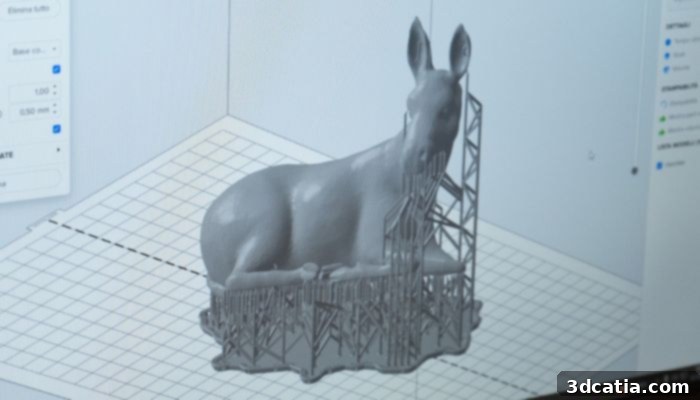
The foundational step in creating the 3D printed nativity scene involved meticulous 3D modeling, where every detail was digitally crafted before physical production began.
The Art of Refinement: Post-Processing and Artistic Finishing
Following the successful 3D printing of each individually molded component, an extensive and vital post-processing phase commenced, critical for achieving the desired traditional aesthetic and tactile quality. This elaborate process began with the careful removal of all support structures, which are temporary scaffolds necessary during the SLA printing process to prevent deformation. Each part then underwent meticulous manual sandpapering. This labor-intensive step was crucial for achieving an exceptionally smooth and homogeneous surface, diligently eliminating any residual layer lines or minute imperfections inherent to the additive manufacturing process. The ultimate goal was to make the 3D printed elements indistinguishable from traditionally crafted pieces, both to the eye and to the touch.
After the comprehensive sanding process, the finished parts were artfully dipped back into liquid resin. This re-dipping step served multiple purposes: it further refined the surface finish, effectively sealed any minute pores, and optimally prepared the material for subsequent artistic treatments. Once cured, these elements were then painstakingly hand-painted by brush, a process that required immense skill, an artist’s touch, and a deep understanding of traditional color palettes and shading techniques specific to Neapolitan nativity scenes. This was followed by a final ‘firing’ or curing process, often involving UV light, to fully harden the paint and resin, ensuring both exceptional durability and a lasting, lustrous finish. This comprehensive type of post-processing allowed Jirama to achieve a completely smooth and glossy surface over each element without needing to apply additional products such as aerosol sprays or conventional paints, which might detract from the authentic, hand-crafted feel.
However, in a fascinating deviation designed to further embrace traditional artistry and add a unique dimension to the piece, three specific elements of the nativity scene—perhaps key figures or prominent architectural features—were not resurfaced in resin. Instead, these particular components were entrusted to an outside artist and collaborator who meticulously hand-painted them using traditional methods. This deliberate choice resulted in a finish that is visually remarkably similar to, if not indistinguishable from, traditional nativity scenes crafted entirely by hand. This dual approach perfectly embodies the synergy between innovative technology and timeless artistic methods, showcasing how modern tools can empower, rather than diminish, human artistry.
A Timeless Synthesis: Tradition and Innovation United
The Presepe III.ZERO by Jirama represents more than just a technological marvel; it is a profound testament to the harmonious convergence of age-old tradition and modern innovation. This intricate project showcases a beautiful mix that has, quite incredibly, enabled the creation of an entirely new and unprecedented version of a great classic of Italian culture. It’s a reinterpretation that comes more than a thousand years after the invention of the first nativity scene, proving that even the most deeply rooted cultural expressions can evolve and thrive through contemporary means. This initiative from Jirama not only preserves but also breathes new life into the cherished Neapolitan presepe tradition, making it accessible and relevant for future generations. By embracing 3D printing, Jirama has demonstrated a forward-thinking approach to heritage, ensuring that these treasured traditions continue to captivate and inspire.
This project opens up a fascinating dialogue about the future of cultural heritage preservation and artistic creation. By demonstrating the capabilities of additive manufacturing in replicating and enhancing traditional art forms, Jirama has set a precedent for how technology can be a powerful ally in safeguarding and celebrating our past. One can’t help but ponder: what other surprises will 3D printing technologies have in store for us in the future? Could 3D printing become a standard tool for restoring ancient artifacts with unprecedented accuracy, creating accessible and tactile replicas for educational purposes, or even enabling artists to explore new dimensions of creativity that were previously unimaginable? The possibilities seem endless, extending far beyond the realm of festive decorations into areas of historical reconstruction, personalized art, sustainable production, and even interactive cultural experiences.
Jirama’s Presepe III.ZERO is a vivid example of how innovation can respect and amplify tradition, providing a vital bridge between the past and the future. It underscores the potential for technology to serve as a powerful ally in cultural storytelling, offering both precision and artistic freedom. The successful integration of such a high-tech approach into a deeply traditional context in Naples—a city renowned globally for its artisan craftsmanship and vibrant cultural heritage—is particularly symbolic. It suggests that far from being a threat, additive manufacturing can be a vibrant catalyst for cultural continuity and artistic renewal, ensuring that the stories and symbols that define us endure for centuries to come, perhaps in forms more adaptable and widely accessible than ever before.
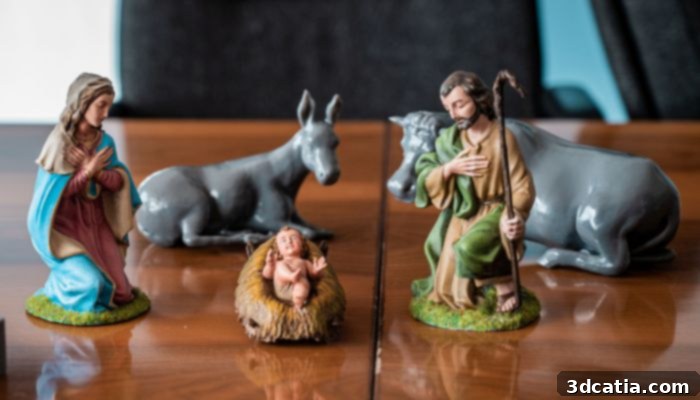
These three specific components of the nativity scene, unlike the other 3D printed elements, were individually hand-painted by a collaborating artist, showcasing a perfect fusion of technology and traditional artistic skill.
What are your thoughts on this incredible 3D printed nativity scene and its profound implications for the intersection of art and tradition? We invite you to share your perspective and join the vibrant discussion! Let us know in a comment below or connect with us on our LinkedIn, Facebook, and Twitter pages! For those eager to stay abreast of the latest developments and breakthroughs in additive manufacturing, don’t forget to sign up for our free weekly Newsletter here, delivering the most current 3D printing news straight to your inbox! Additionally, you can explore all our insightful videos, interviews, and demonstrations of cutting-edge 3D printing technologies on our YouTube channel, where innovation comes to life.
All Photo Credits: Imageware/JIRAMA