
Pioneering the Cosmos: How 3D Printing is Transforming Space Exploration and Sustaining Future Missions
The boundless expanse of space represents humanity’s ultimate frontier, a realm teeming with uncharted planets, distant galaxies, and the promise of profound discoveries. Our journey into this cosmic ocean has seen remarkable progress in recent decades, propelled forward by an relentless drive for innovation and the emergence of groundbreaking technologies. Among these, additive manufacturing, commonly known as 3D printing, stands out as a transformative force, revolutionizing how we approach space research and mission sustainability.
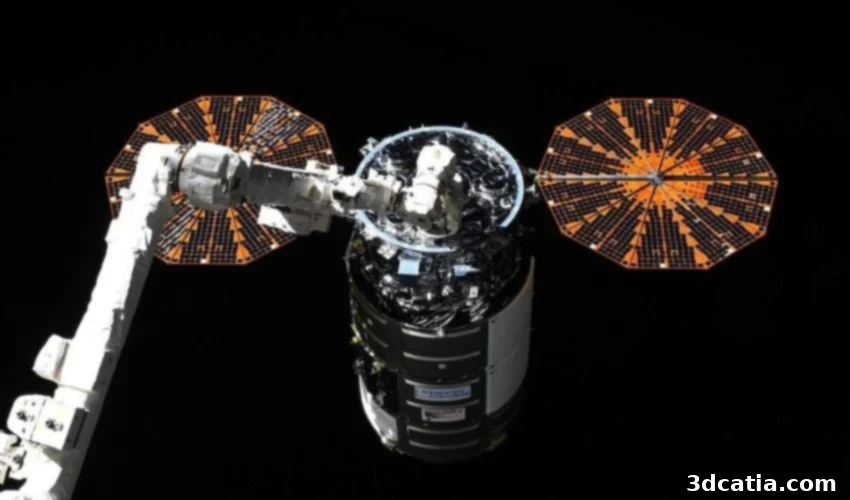
A prime example of this pioneering spirit is the eagerly anticipated Cygnus cargo spacecraft mission. Scheduled for late January, this mission will transport a cutting-edge 3D printer technology from the European Space Agency (ESA) to the International Space Station (ISS). This endeavor marks a pivotal moment, initiating a crucial study into the capabilities and potential of 3D printing in the unique environment of space, setting the stage for future advancements in orbital and deep-space operations.
A Collaborative Leap: The Cygnus Mission and ESA’s On-Orbit Printing Experiment
This ambitious mission is spearheaded by NASA, with the launch originating from the historic Cape Canaveral Space Force Station in Florida. The journey into orbit will see Northrop Grumman’s Cygnus spacecraft propelled skyward aboard a Falcon 9 rocket, provided by Elon Musk’s renowned company, SpaceX. The core objective of this collaboration is to conduct an in-depth study of 3D printing methodologies in space, leveraging the International Space Station (ISS) as a dynamic, orbiting laboratory for its development and rigorous testing.
The inspiration for this groundbreaking initiative stems from recent, extensive research conducted by the ESA. Their preliminary work involved pioneering tests of metal additive manufacturing processes within microgravity conditions, providing invaluable insights into the fundamental physics and operational challenges of such technology in an extraterrestrial setting. As ESA’s Rob Postema aptly noted, “This research gives us an initial understanding of how such a printer will behave in space.” This initial understanding is crucial, as the unique properties of microgravity can significantly alter material behavior, making Earth-based simulations insufficient for full validation.
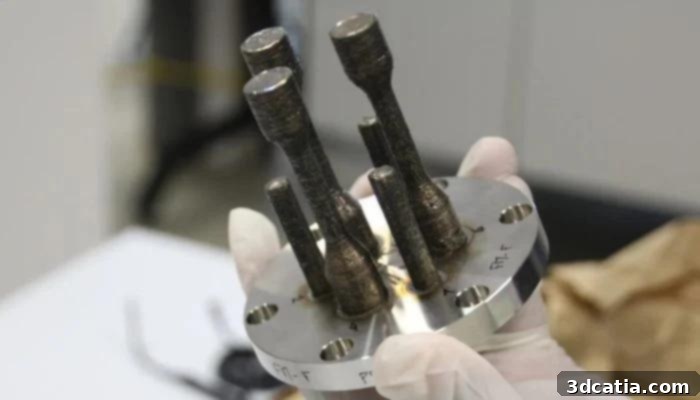
3D printed parts in microgravity
Overcoming the Cosmic Logistics: 3D Printing as the Key to Sustainable Space Missions
One of the most persistent and formidable challenges confronting extended human missions in space revolves around the intricate and prohibitively expensive nature of resupply efforts. Every kilogram launched into orbit or beyond carries a colossal price tag, making the logistical planning for even routine provisions – like food, water, and scientific equipment – an immensely complex undertaking. Beyond mere sustenance, these missions frequently necessitate an array of critical parts, intricate machinery, and specialized tools to maintain operational integrity and address unforeseen contingencies.
The current model of resupply relies heavily on Earth-based manufacturing and transportation, which is inherently slow, rigid, and susceptible to delays. A single broken component or a newly identified need for a specific tool can jeopardize an entire mission if it cannot be repaired or replaced locally. This vulnerability underscores the urgent need for on-demand manufacturing capabilities beyond our home planet.
This is precisely where additive manufacturing emerges as a potential game-changer. Should the ESA’s research successfully demonstrate the viability of 3D printing small, high-quality metal parts directly on the ISS using the Cygnus’ onboard printer, it could fundamentally transform the landscape of space logistics. The ability to produce components on-site would dramatically mitigate the reliance on costly and infrequent resupply missions, offering an unprecedented level of autonomy and operational flexibility for astronauts.
Imagine a scenario where a critical system requires a specific replacement part. Instead of waiting months for the next cargo ship, or worse, having to abort a mission, astronauts could simply download a design file and print the required component within hours or days. This capability is not just about convenience; it is about enabling longer-duration missions to the Moon, Mars, and beyond, where conventional resupply becomes logistically impossible or economically prohibitive. On-demand manufacturing allows for rapid prototyping and iterative improvements to equipment, adapting to the dynamic needs of a mission in real-time, greatly enhancing mission success and crew safety.
Assessing Quality and Unlocking Potential: The Multifaceted Benefits of On-Orbit Manufacturing
The central objectives of this research revolve around rigorously testing the quality, durability, and specific material characteristics of the parts printed in space. While the technological feat of printing onboard the ISS is already significant, a crucial question remains: will these extraterrestrially manufactured parts possess the same structural integrity, precision, and reliability as those produced under terrestrial conditions? Factors such as microgravity, vacuum, radiation exposure, and unique thermal environments could influence the printing process and the resulting material properties, demanding thorough evaluation.
The potential advantages stemming from a positive outcome of this mission are truly multifaceted and far-reaching. Beyond the immediate and obvious benefits of drastically reducing the time and financial investment associated with preparing and launching essential materials for the crew, successful validation could unlock a cascade of operational efficiencies. It would pave the way for astronauts to print vital components needed for equipment maintenance, fabricate bespoke spare parts on demand, or even create specialized tools that they may require for unforeseen tasks or scientific experiments in the future. This shift from “bring it all” to “make what you need” represents a paradigm shift in space logistics.
This capability empowers astronauts to become more self-sufficient, capable of addressing mechanical issues or crafting custom solutions without relying on external support or scheduled cargo deliveries. It not only enhances the safety and operational continuity of missions but also fosters an environment of ingenuity and adaptability. The ability to iterate on tool designs or repair components quickly on-site minimizes downtime, maximizes scientific output, and ensures the long-term viability of complex space infrastructure.
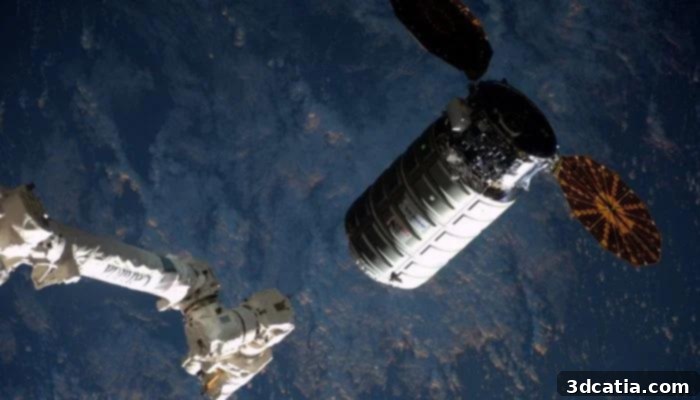
The Cygnus cargo ship in outer space.
Gazing Beyond: The Transformative Future of 3D Printing in Space
While the vision of 3D printing evolving into a fully reliable and indispensable option for advancing space endeavors remains an unfolding narrative, carrying with it a degree of uncertainty, the implications are undeniably profound. This initial phase of testing aboard the Cygnus cargo spacecraft is not merely an experiment; it is a critical stepping stone in understanding the full spectrum of its potential strengths and limitations. These tests will be instrumental in shedding light on the feasibility of manufacturing in the unique microgravity environment, providing invaluable data that will inform future designs and operational strategies.
The successful integration of additive manufacturing into space operations holds the promise of ushering in an era of unprecedented self-sufficiency for astronauts and deep-space missions. Imagine Martian outposts fabricating their own spare parts from local resources, or lunar bases constructing habitats and scientific equipment using indigenous materials combined with advanced printing technologies. This vision, known as In-Situ Resource Utilization (ISRU), represents the ultimate frontier for sustainability and expands our reach far beyond the current logistical constraints.
These early investigations into on-orbit manufacturing are foundational to realizing such ambitious goals. They address fundamental questions about material science, printer reliability, and the adaptability of manufacturing processes to extreme extraterrestrial conditions. The insights gained from missions like the Cygnus will pave the way for more sophisticated systems, enabling longer, safer, and more ambitious explorations, ultimately redefining humanity’s presence in the cosmos. To delve deeper into the precise objectives and tests associated with NASA’s Northrop Grumman Mission, you can click here for additional information.
Do you believe 3D printing will fully revolutionize space travel? Let us know your thoughts in a comment below or join the conversation on our LinkedIn, Facebook, and Twitter pages! Don’t forget to sign up for our free weekly newsletter here to get the latest 3D printing news delivered straight to your inbox! You can also find all our videos on our YouTube channel.
*All Photo Credits: European Space Agency