
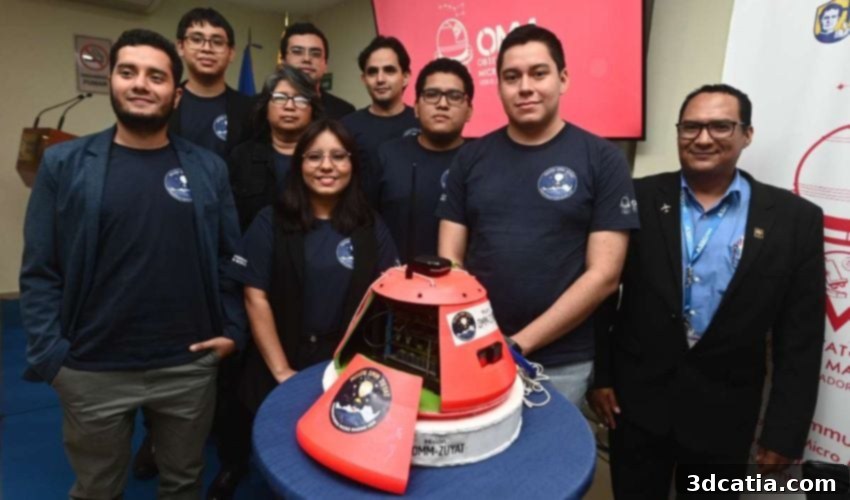
El Salvador’s Leap into Space: Don Bosco University Pioneers Stratospheric Exploration with 3D Printing
El Salvador has marked a significant milestone in its scientific and technological advancement with the successful launch of its first stratospheric probe, a pioneering project spearheaded by Don Bosco University (UDB). Through its Micro Macro Observatory (OMM), the university proudly unveiled the “Zuyat Mission,” an initiative that leverages cutting-edge 3D printing technology to push the boundaries of national space exploration. The core of this groundbreaking mission, the probe’s robust capsule, was meticulously 3D printed and achieved an impressive altitude of 31.32 kilometers, venturing far into the Earth’s stratosphere.
This ambitious project not only showcases the innovative capabilities within El Salvador but also highlights the transformative potential of additive manufacturing in the aerospace sector. The Zuyat Mission represents a culmination of dedicated research, interdisciplinary collaboration, and a visionary approach to scientific inquiry. It positions Don Bosco University at the forefront of national efforts to engage in stratospheric research, paving the way for future advancements in space technology and environmental monitoring.
From Student Initiative to National Triumph: The Genesis of the Zuyat Mission
The journey of the Zuyat Mission’s capsule, inspired by the sophisticated designs of traditional space vehicles, is a testament to years of unwavering research and development at Don Bosco University. The seeds of this ambitious undertaking were planted in 2021 when a group of enthusiastic students from the university’s Astronomy Association participated in the prestigious NASA Space Apps Challenge. It was during this international hackathon that the innovative idea emerged: to transform high-altitude balloons into a focused platform for scientific research. This initial concept, born from student ingenuity, quickly gained traction and evolved into a formal, structured program within the university, ultimately leading to the triumphant launch of the stratospheric probe.
The evolution from a student-led challenge to a formal university program underscores Don Bosco University’s commitment to fostering innovation and providing platforms for its students and faculty to engage in real-world, impactful research. This progression involved countless hours of theoretical study, practical experimentation, and design iterations, all geared towards creating a reliable and effective stratospheric platform. The success of the Zuyat Mission now stands as a proud testament to the university’s pioneering spirit and its ability to turn audacious ideas into tangible scientific achievements.
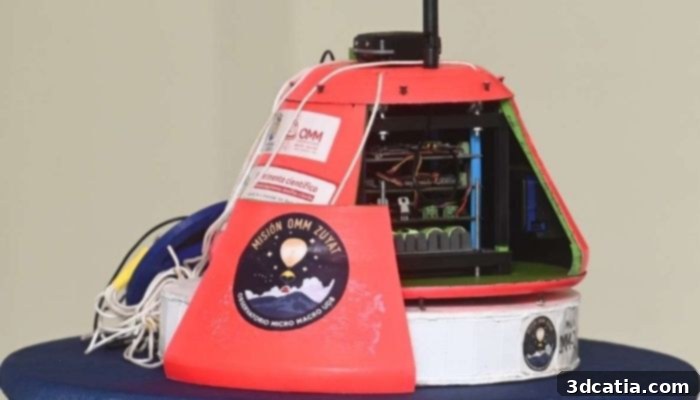
The 3D printed capsule houses an electrical system inside to transmit environmental data.
Engineering the Future: Designing and Manufacturing the Stratospheric Probe
The actual launch of the Zuyat mission’s probe earlier this year marked a critical moment, as it ascended to a remarkable altitude of 31.32 kilometers. To put this into perspective, this height is approximately three times higher than the cruising altitude of a typical commercial airplane, placing the probe firmly in the Earth’s lower stratosphere. This impressive feat was the result of extensive collaboration between students and faculty from UDB’s esteemed Engineering and Aeronautics departments, pooling their diverse expertise to bring the vision to life. The complex task of designing and manufacturing the stratospheric capsule was skillfully led by Manuel Pleitez, a distinguished aeronautical engineer and a professor at the university.
Professor Pleitez’s leadership was instrumental in navigating the myriad challenges inherent in such an advanced aerospace project. His deep understanding of aeronautical principles, combined with the practical skills of the students, ensured that every aspect of the capsule’s design met rigorous standards. The collaborative environment fostered by UDB allowed for an interdisciplinary approach, where theoretical knowledge was directly applied to solve real-world engineering problems. This synergy between academic rigor and hands-on application was crucial for the successful realization of El Salvador’s first stratospheric probe.
The Rigors of the Stratosphere: Material Selection and 3D Printing Advantages
During the official project presentation at the university, Professor Pleitez highlighted the immense challenges involved in developing the probe’s capsule. This critical component had to satisfy a stringent set of requirements, including uncompromising system safety, exceptional resistance to the extremely low temperatures found in the stratosphere, and robust pressure tolerance against significant atmospheric variations. The stratosphere presents a harsh environment characterized by drastically low pressures, intense solar radiation, and temperatures that can plummet well below freezing. Crafting a capsule capable of enduring these conditions necessitated an exhaustive study of various materials and geometries.
After meticulous evaluation, ABS (Acrylonitrile Butadiene Styrene) was ultimately selected as the ideal 3D printing material for the capsule, primarily due to its proven durability, strength-to-weight ratio, and excellent thermal stability. The choice of ABS, combined with the precision of additive manufacturing, enabled the team to create a lightweight yet incredibly resilient structure. This strategic material selection proved vital, allowing the capsule to successfully withstand temperatures as low as –60 °C during its stratospheric flight, ensuring the integrity of the internal systems and the precious data collected. The ability of 3D printing to produce complex geometries and customized designs efficiently was a key advantage, facilitating rapid prototyping and iterative improvements during the development phase.
The flexibility offered by 3D printing was paramount. It allowed the engineering team to optimize the capsule’s aerodynamic profile, integrate internal mounting points for delicate electronics, and achieve precise weight distribution – all crucial factors for a successful stratospheric mission. Traditional manufacturing methods would have been far more time-consuming and expensive for such a bespoke component. This innovative application of 3D printing not only kept development costs manageable but also accelerated the project timeline, demonstrating the technology’s critical role in modern aerospace research and development.
How Does the 3D-Printed Probe Work?
The primary objective of this inaugural Zuyat Mission was to accurately measure and transmit critical environmental variables from the stratosphere. To achieve this, the 3D-printed capsule was outfitted with a sophisticated array of equipment. As confirmed by OMM director Brisa Terezón, this payload included “a GPS, an onboard computer, a power system, and antennas for telemetry.” Each component played a vital role in the mission’s success. The GPS module meticulously tracked the probe’s altitude and trajectory, providing precise location data throughout its flight. The onboard computer served as the brain of the operation, diligently collecting data from various sensors and managing the probe’s functions.
The robust power system, carefully designed to operate in extreme conditions, supplied the necessary energy to all electronic components, ensuring continuous operation during the entire mission. Crucially, the telemetry antennas facilitated the real-time transmission of collected data. Once the probe reached its designated altitude in the stratosphere, it began transmitting environmental data – such as temperature, pressure, and potentially humidity or radiation levels – via radio frequency to a dedicated ground station located at Don Bosco University. This seamless communication link allowed the research team to monitor the mission’s progress and receive valuable scientific information as it happened, validating the successful integration and performance of all onboard systems.
The data gathered from this stratospheric journey holds immense scientific value. It provides researchers with direct measurements from a region of the atmosphere that is difficult to access, offering insights into atmospheric dynamics, weather patterns, and even climate change indicators. This initial mission serves as a proof of concept, demonstrating the university’s capability to design, build, launch, and successfully retrieve data from a complex stratospheric platform, laying robust groundwork for increasingly ambitious scientific endeavors.
Pioneering El Salvador’s Future in Space: Beyond the First Launch
During the project presentation, the leaders of the Zuyat Mission emphasized that this successful first test represents far more than a single achievement; it unequivocally opens the door to a wealth of new and transformative research opportunities for El Salvador. The immediate applications include the invaluable study of volcanoes, a particularly relevant area for a country with active volcanic activity. Stratospheric probes can be equipped with specialized sensors to monitor volcanic gas emissions, track plume dispersion, and gather thermal data, providing crucial information for disaster preparedness and geological research. By analyzing the composition of volcanic plumes from the stratosphere, scientists can gain a deeper understanding of volcanic processes and potentially predict eruptions with greater accuracy, safeguarding communities.
Looking further into the future, this foundational mission ignites the long-term ambition for El Salvador: the development and launch of its very first national satellite. While a satellite mission presents considerably greater technical and financial challenges, the Zuyat Mission provides invaluable experience in aerospace engineering, telemetry, data acquisition, and project management. This strategic roadmap, starting with stratospheric probes and progressing towards orbital capabilities, positions El Salvador as an emerging player in the regional space sector. A national satellite could offer numerous benefits, from enhancing telecommunications and weather forecasting to supporting agricultural monitoring and land-use planning, significantly boosting the country’s infrastructure and scientific capabilities.
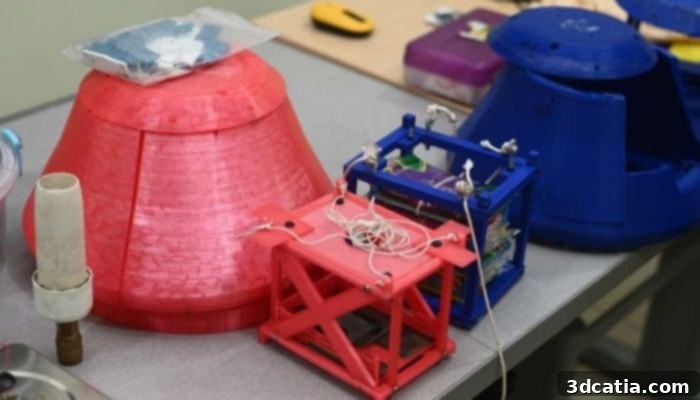
The stratospheric probe’s capsule was 3D printed using ABS.
Don Bosco University: A Catalyst for National Innovation and Education
The Zuyat Mission stands as a shining example of Don Bosco University’s unwavering commitment to fostering innovation, promoting scientific research, and empowering the next generation of engineers and scientists in El Salvador. This project has not only delivered tangible scientific results but has also provided unparalleled educational opportunities for students, offering them hands-on experience in cutting-edge aerospace and additive manufacturing technologies. By participating in every phase of the mission – from conceptual design and material selection to manufacturing, testing, and data analysis – students have gained invaluable practical skills and a profound understanding of complex engineering challenges. This experiential learning approach is crucial for developing a highly skilled workforce capable of driving future technological advancements within the nation.
Moreover, the success of the Zuyat Mission serves as a powerful inspiration for young Salvadorans, demonstrating that ambitious scientific and engineering feats are entirely within reach. It showcases the potential for local talent and resources to contribute to global scientific endeavors and address national challenges. Don Bosco University, through projects like Zuyat, is not just educating students; it is cultivating a culture of curiosity, innovation, and problem-solving that is essential for sustainable national development. This mission is a clear indicator of the university’s role as a vital hub for STEM education and research, setting a precedent for future technological leadership in El Salvador and beyond.
What do you think about El Salvador’s first stratospheric probe and its innovative use of 3D printing? We invite you to share your thoughts in a comment below or engage with us on our LinkedIn or Facebook pages! Additionally, don’t miss out on the latest advancements in additive manufacturing by signing up for our free weekly Newsletter, delivered straight to your inbox. For more insights and visual content, explore all our videos on our YouTube channel. Should your interest lie specifically in the aerospace and defense sectors, delve into our dedicated 3D printing page HERE for comprehensive coverage.
*Photo Credits: elsalvador.com