
Unlocking Innovation: Top 5 3D Printing Videos Shaping the Future of Manufacturing
Welcome to our latest showcase of groundbreaking advancements in additive manufacturing! Each week, the world of 3D printing continues to evolve at an astonishing pace, bringing forth innovative projects, ingenious solutions, and awe-inspiring creations. From transforming classic vehicles to developing cutting-edge robotics and revolutionizing local production, 3D printing is consistently pushing the boundaries of what’s possible. Our dedicated team scours the digital landscape to bring you the most compelling and insightful videos that highlight the immense potential of this transformative technology. This curated selection isn’t just about impressive visuals; it’s about demonstrating how digital fabrication is impacting diverse industries, fostering creativity, and providing sustainable solutions across various applications. Dive in and discover our handpicked TOP 5 3D printing videos of the week. We encourage you to watch, learn, and then share your favorite picks with us in the comments or across our social media channels on Facebook and Twitter. Your engagement helps us continue to spotlight the most exciting developments in the additive manufacturing community!
TOP 1: Caddy 1 3D Printed Front End – Reimagining Automotive Heritage with Additive Manufacturing
The automotive industry has long been at the forefront of technological adoption, and 3D printing is proving to be a game-changer, especially when it comes to restoration, customization, and rapid prototyping. Our first top video introduces an extraordinary joint venture known as 3i-PRINT, where several leaders in the 3D printing sector collaborated to meticulously recreate the entire front end of a classic VW Caddy 1 using advanced additive manufacturing techniques. This ambitious project transcends mere novelty; it serves as a powerful testament to 3D printing’s capability to bridge the gap between historical preservation and future-forward manufacturing. Traditional methods for producing complex or obsolete automotive parts often involve costly tooling, long lead times, and significant waste. However, by leveraging 3D printing, the 3i-PRINT initiative showcases how digital fabrication can efficiently produce intricate components, reduce material waste, and offer unparalleled design freedom. This approach not only facilitates the faithful recreation of vintage car parts but also opens up new avenues for custom designs, performance enhancements, and localized production in the automotive aftermarket. It highlights the precision, strength, and versatility that modern 3D printing technologies bring to even the most demanding engineering challenges, proving that this technology isn’t just about innovation for tomorrow, but also about honoring and revitalizing the mechanical marvels of yesterday.
TOP 2: Critter – The Adorable 3D Printed Robot for Education and Hobbies
Robotics is a field that captivates imaginations, blending mechanical engineering, electronics, and software development into functional, interactive creations. Our second featured video introduces “Critter,” an incredibly charming and highly functional 3D printed robot that exemplifies how additive manufacturing can democratize access to complex technologies. More than just an adorable gadget, Critter is designed as an excellent learning tool, making robotics accessible to a wider audience, from curious students eager to delve into STEM fields to seasoned hobbyists looking for their next project. Controlled effortlessly via a user-friendly Android application, this compact robot offers a hands-on pathway to understanding fundamental principles of robotics, coding, and mechanical assembly. The use of 3D printing in its construction is pivotal; it significantly lowers production costs, allows for intricate and lightweight designs, and enables easy customization and repair of parts. This means enthusiasts can print replacement components, modify the robot’s appearance, or even design entirely new functionalities, fostering creativity and problem-solving skills. Critter beautifully demonstrates how 3D printing empowers individuals to build, experiment, and innovate in the exciting world of robotics without the prohibitive costs and manufacturing barriers traditionally associated with such projects. It’s a prime example of how digital fabrication is fostering a new generation of inventors and engineers.
TOP 3: Open Source Scenery Building – Modular Design for Creative Freedom
For hobbyists, model builders, and tabletop gaming enthusiasts, the ability to create custom, immersive environments is a cornerstone of their passion. Our third top video highlights an incredible open-source scenery building system that leverages the power and flexibility of 3D printing to provide unparalleled creative freedom. Utilizing the innovative OpenLOCK system, designers and makers can bring their imaginative worlds to life, constructing elaborate and highly detailed scenery pieces from the ground up. What makes this system truly remarkable is its modularity; components are designed to easily interlock, allowing for rapid assembly, reconfiguration, and expansion of landscapes, dungeons, or sci-fi environments. This eliminates the need for messy glues or complex joinery, making the building process intuitive and enjoyable. 3D printing enables the production of highly intricate details that would be challenging or impossible to achieve with traditional crafting methods, opening up a universe of possibilities for personalized terrain. Furthermore, as an open-source project, it fosters a vibrant community of creators who share designs, modifications, and innovative ideas, continually enriching the ecosystem. This approach significantly lowers the barrier to entry for aspiring creators, enabling anyone with a 3D printer to produce professional-quality models and dioramas. Whether you’re building a miniature city, a fantasy realm, or a sci-fi battleground, this system truly showcases how 3D printing can empower creativity and community collaboration.
TOP 4: Plantoid Robots – Biomimicry and Robotics for a Greener Future
The intersection of biology and robotics is yielding some of the most fascinating innovations in engineering, leading to designs that are not only efficient but also harmonious with the natural world. Our fourth video presents the captivating concept of “Plantoid Robots” – a brilliant example of biomimicry taken to an entirely new level. These charming, autonomous robots are designed as explorers, but with a unique twist: they incorporate real living plants. This integration allows them to leverage the plant’s biological sensing capabilities to recognize and respond to their surrounding environment. For instance, the plant’s health can guide the robot, prompting it to gravitate towards essential elements like fresh air, optimal sunlight, and vital water sources. This innovative approach has profound implications for various applications, including environmental monitoring, smart agriculture, and even extraterrestrial exploration, where robots could autonomously seek out hospitable conditions. 3D printing plays a crucial role in the development of Plantoid Robots, enabling the creation of intricate, lightweight structures that seamlessly house both the mechanical components and the living plant. It facilitates rapid iteration of designs, allowing researchers and engineers to quickly test and refine prototypes that are tailored to specific environmental interaction needs. These little guys represent a significant leap in bio-inspired robotics, showcasing how combining natural intelligence with robotic autonomy can lead to more intuitive, sustainable, and adaptive machines that could potentially revolutionize how we interact with and understand our planet and beyond.
TOP 5: Local Motors Self-Driving, 3D Printed Car – The Future of Sustainable Urban Mobility
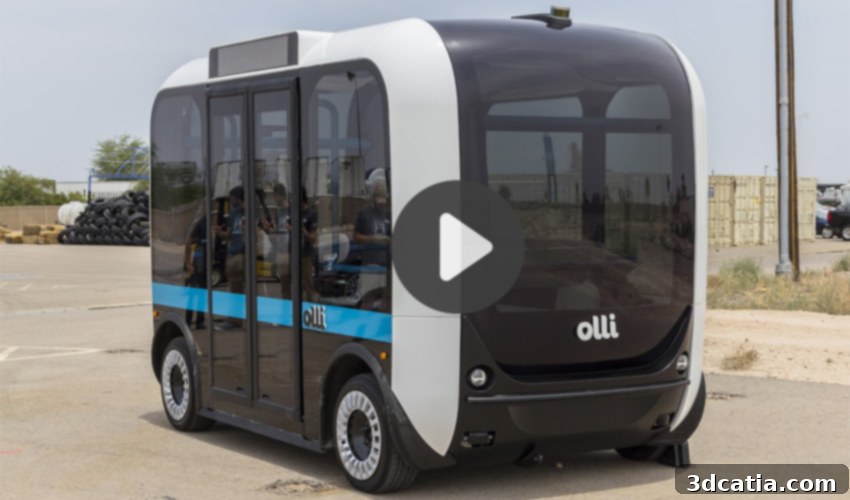
Our final top video brings us to the cutting edge of transportation and manufacturing with Local Motors, a company renowned for its pioneering work in combining autonomous driving with advanced additive manufacturing. The video showcases Olli, their self-driving 3D printed mini-bus, which has the capacity to comfortably transport up to 12 people. This project isn’t just about an autonomous vehicle; it’s a powerful demonstration of how 3D printing is fundamentally transforming the entire production lifecycle, offering a glimpse into the future of urban mobility and localized manufacturing. Local Motors eloquently explains the profound benefits that 3D technologies bring to their business model. By embracing additive manufacturing, they are able to produce complex parts locally and on demand, drastically minimizing their reliance on extensive, global supply chains. This localized production model not only slashes logistics costs but also dramatically reduces lead times, with production cycles experiencing a staggering 90% reduction. This incredible efficiency is largely attributed to their strategic use of accessible 3D printers, such as the MakerBot Replicator series, which enables rapid iteration, custom part creation, and flexible manufacturing workflows. Olli stands as a beacon of sustainable innovation, embodying the principles of distributed manufacturing, reduced environmental footprint, and agile development, all made possible by the transformative power of 3D printing. It highlights how digital fabrication is creating a more efficient, responsive, and sustainable approach to building the vehicles of tomorrow, right within our communities.
As we conclude this week’s exploration into the dynamic world of 3D printing, it’s clear that additive manufacturing continues to push the boundaries of innovation across diverse sectors. From preserving automotive history and empowering educational robotics to fostering creative open-source communities, developing bio-inspired machines, and revolutionizing sustainable urban transport, these videos collectively paint a vivid picture of a technology that is not just futuristic but profoundly impactful in the present. Each project underscores the versatility, efficiency, and creative freedom that 3D printing offers, making it an indispensable tool for engineers, designers, educators, and hobbyists alike. We hope this week’s selection has inspired you and demonstrated the incredible potential that lies within digital fabrication. Don’t forget to share your thoughts and tell us which video was your favorite, or even suggest other amazing 3D printing projects you’ve encountered. Stay tuned for more exciting developments as we continue to track the cutting edge of this transformative technology!