
Revolutionizing Stroke Recovery: The Power of 3D Printed Exoskeletons for Advanced Hand Rehabilitation
Stroke is a debilitating medical emergency that significantly impacts countless lives globally. According to the Centre for Disease Control and Prevention (CDC), an alarming number of nearly 800,000 individuals in the US experience a stroke each year. This critical event occurs when the blood supply to a specific part of the brain is interrupted, either due to a blood clot blocking an artery (ischemic stroke, accounting for about 85% of cases) or a ruptured blood vessel causing bleeding in the brain (hemorrhagic stroke). The consequences can be profound and long-lasting, often resulting in severe physical impairments such as paralysis, significant disturbances in movement, and difficulties with speech, extending far beyond the initial episode. For many stroke survivors, regaining lost motor skills and functional independence becomes a primary focus, necessitating intensive and prolonged rehabilitation.
Traditional rehabilitation approaches heavily rely on the dedicated support of physiotherapists who guide patients through repetitive exercises designed to relearn basic movements and improve muscle control. While effective, these methods can be labor-intensive and may not always provide the consistent, targeted assistance needed for optimal recovery. Recognizing this challenge, researchers at ETH Zurich have embarked on an innovative project aimed at enhancing hand movement rehabilitation. Their solution involves the development of a cutting-edge exoskeleton – an external wearable frame meticulously designed to support and augment the body’s natural capabilities. This exoskeleton specifically targets the hands, offering a pathway for patients to actively participate in their recovery process. To ensure superior performance, particularly concerning optimal force transmission and durability, the team collaborated with igus, a renowned Cologne-based company specializing in components crafted from high-performance plastics. Through this partnership, igus is leveraging advanced 3D printing techniques to produce specialized finger joints for the innovative exoskeleton, demonstrating a significant leap in medical assistive technology.
Unveiling the Mechanics: How the Hand Rehabilitation Exoskeleton Functions
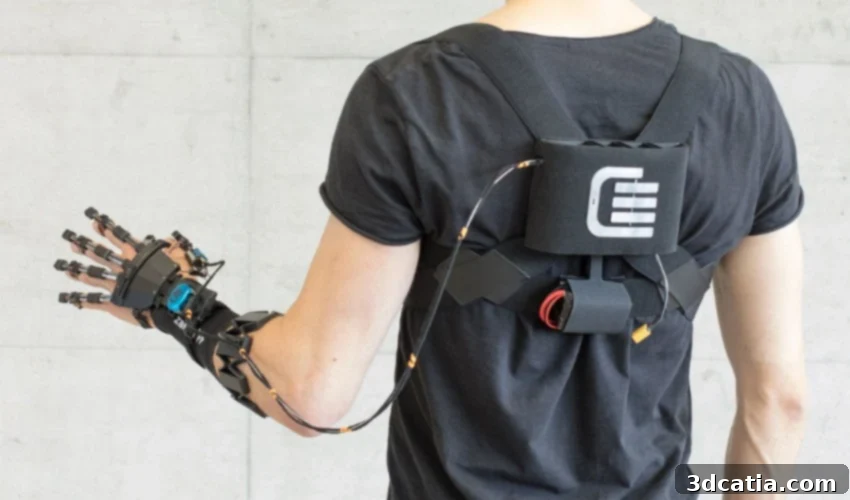
The ETH Zurich exoskeleton represents a sophisticated blend of engineering and biomechanics, meticulously designed to facilitate active hand rehabilitation for stroke patients. This innovative system is comprised of three primary components: a hand module, a wristband sensor, and a compact backpack. The hand module is precisely fitted to the patient’s hand using comfortable leather straps, ensuring a secure yet flexible attachment. Simultaneously, the patient wears a wristband and a lightweight backpack. The genius of the system lies in its ability to interpret the patient’s intent to move. When a patient initiates even a subtle attempt at movement, the wristband sensor detects the corresponding electromyographic (EMG) signals – the electrical impulses generated by muscle activity. These minute signals are then wirelessly transmitted to a powerful minicomputer housed within the backpack.
The backpack itself is a hub of advanced technology, containing not only the minicomputer but also essential motors, long-lasting batteries, and sophisticated control electronics. Upon receiving the EMG data, the minicomputer employs intricate algorithms to swiftly recognize and interpret the patient’s intended action, such as a grasping movement. Once the intention is clear, the computer activates the integrated motors. These motors, in turn, precisely stretch and flex the leaf springs that form the functional fingers of the exoskeleton. This synchronized action gently assists and guides the patient’s hand through the desired movement. Jan Dittli, a leading researcher at ETH Zurich’s Department of Health Sciences and Technology, explains the efficacy of this design: “Per finger, the exoskeleton applies a force of six newtons.” This carefully calibrated force is sufficient to support and guide delicate hand movements, allowing the exoskeleton to effectively cover an impressive 80% of daily activities, significantly aiding in the recovery of functional independence for stroke survivors.
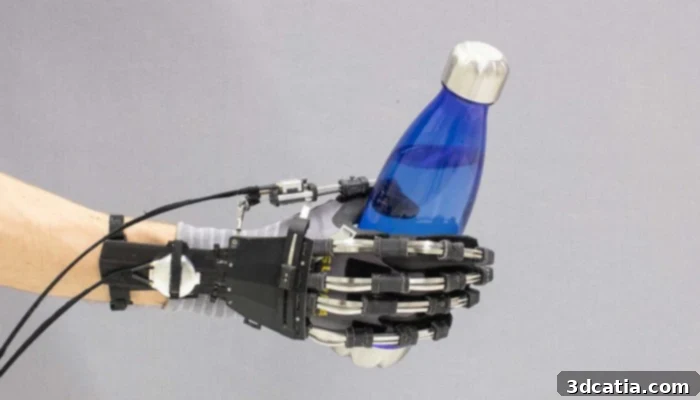
With the exoskeleton, the patient should be able to lift up to 500 grams | Photo Credit: Stefan Schneller (ETH Zurich)
Overcoming Manufacturing Hurdles: The Limitations of FDM for Critical Components
A primary objective for the ETH Zurich researchers was to design an exoskeleton that was not only effective but also practical and suitable for everyday use. This meant a relentless focus on minimizing the device’s weight while maximizing its durability and comfort. To achieve this crucial weight reduction and facilitate complex geometries, the team naturally turned to additive manufacturing, commonly known as 3D printing. In the initial prototyping phase, FDM (Fused Deposition Modeling) 3D printing proved to be an invaluable tool. Its comparative low cost, user-friendliness, and rapid production capabilities made it ideal for quickly iterating through design concepts and testing various configurations.
Both the back-of-hand component and the intricate finger joints were initially fabricated using FDM technology with ABS (Acrylonitrile Butadiene Styrene) plastic. While FDM technology and ABS plastic demonstrated adequate performance for the less mechanically demanding back-of-hand module, they quickly proved inadequate for the highly challenging functionality required of the finger joints. These small yet critical components serve multiple vital roles: they are responsible for securely holding together the three stacked thin stainless steel leaf springs that form the exoskeleton’s fingers, and they also incorporate a locking mechanism for the leather straps that attach the device to the patient’s hand. The precision and low-friction movement required in these joints were simply not met by the FDM-printed ABS parts.
As Jan Dittli elucidated, the primary issue was excessive friction: “The friction between the joints and the leaf springs would have been too high with this material. As a result, we would have lost too much energy when moving the fingers.” This high friction would not only hinder the smooth operation of the exoskeleton but also waste valuable energy, potentially shortening battery life and reducing the efficiency of rehabilitation movements. Furthermore, the inherent limitations of FDM printers meant they could not achieve the fine resolution and intricate details required for the finger joints’ complex locking mechanisms and smooth articulation. The need for superior material properties and greater printing precision became unequivocally clear, prompting the ETH Zurich researchers to seek specialized expertise and advanced additive manufacturing solutions from igus.
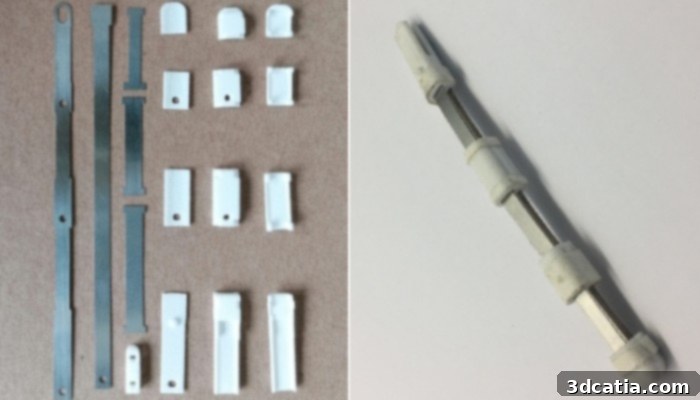
The individual components of a finger can be seen on the left, the leaf springs on the left and the finger joints printed from Iglidur I6 (material) on the right. On the right is the fully assembled finger | Photo Credit: Stefan Schneller (ETH Zurich)
The igus Solution: Precision 3D Printed Finger Joints from High-Performance Plastic
The critical need for enhanced precision, reduced friction, and superior material properties led ETH Zurich to partner with igus and utilize their advanced 3D printing services. Through the igus 3D printing service, the researchers gained access to Selective Laser Sintering (SLS) technology, a far more sophisticated additive manufacturing process compared to FDM for complex, functional parts. SLS technology works by using a high-powered laser to selectively fuse powdered material layer by layer, building the part from the ground up. This method is particularly advantageous because it allows for the creation of intricate geometries and fine structures without the need for support materials, as the unsintered powder acts as its own support. The elimination of support structures directly translates into a significant benefit: the complete removal of time-consuming and labor-intensive post-processing steps, streamlining the production workflow and reducing overall manufacturing costs.
Crucially, igus also provided access to its specialized iglidur I6 high-performance plastic, a material specifically engineered for tribological applications – that is, applications involving friction, lubrication, and wear. The combination of SLS printing with iglidur I6 unlocked new possibilities for the exoskeleton’s finger joints. Beyond mere manufacturing efficiency, SLS technology enabled an unprecedented level of personalization for the exoskeletons. As Jan Dittli highlights, “We developed an algorithm to adapt the digital model of the exoskeleton to the patient’s hand size with just a few clicks.” This groundbreaking approach meant that each exoskeleton could be custom-fitted to individual patients, optimizing comfort and therapeutic effectiveness. Once the personalized digital model was finalized, it could be swiftly uploaded to igus’s service, where printing often occurred overnight, allowing the precisely manufactured 3D printed finger joints to be ready for use within a matter of days. This rapid turnaround time is crucial in medical device development, accelerating research and patient access to innovative rehabilitation tools.
The material properties of iglidur I6 were equally transformative for the exoskeleton’s performance. The 3D printed finger joints exhibited the exact combination of toughness and abrasion resistance required for a device that undergoes repetitive, dynamic movements. As a tribologically optimized plastic, iglidur I6 was explicitly developed to excel in moving applications where low friction and high wear resistance are paramount. A standout feature of this material is its integration of solid lubricants directly into the SLS powder. This innovative formulation means that the components are inherently self-lubricating, eliminating the need for any external lubrication during assembly or ongoing maintenance. This significantly promotes ease of handling and reduces the operational burden. According to igus, the service life of iglidur I6 is designed to be exceptionally long, setting it apart from many other conventional plastics and ensuring the longevity and reliability of the exoskeleton in continuous use.
The Impact and Future: Lightweight, Portable, and Mind-Controlled Rehabilitation
The adoption of advanced 3D printing techniques, particularly SLS with igus’s specialized plastics, has yielded a rehabilitation exoskeleton that is not only highly effective but also remarkably quick and cost-effective to produce. Furthermore, the design and material choices have resulted in an incredibly lightweight device, a decisive advantage over existing solutions. The hand module, for instance, weighs a mere 148 grams, while the entire backpack system, containing all the electronics and motors, tips the scales at just 720 grams. This remarkable lightness and compactness are critical for translating the device from a laboratory setting into practical, everyday therapeutic use. Jan Dittli emphasizes this transformative aspect: “Many exoskeletons used in rehabilitation are currently not portable. Our solution, on the other hand, is light and compact enough to prove itself in everyday life as well, and can thus expand the field of therapy.”
The portability of the ETH Zurich exoskeleton opens up new avenues for rehabilitation, allowing patients to engage in therapy not just in clinical settings but also within the comfort and familiarity of their own homes. This increased accessibility can lead to more consistent and personalized rehabilitation regimens, potentially accelerating recovery and improving long-term outcomes for stroke survivors. By integrating seamlessly into daily life, the device empowers patients with greater independence and enhances their overall quality of life. Looking towards the future, the researchers envision even more sophisticated control mechanisms. One ambitious goal is to eliminate the need for the wristband sensor altogether, moving towards a system that measures brain waves directly. This would allow the control system to be run via the patient’s mind, offering an intuitive and seamless interface between human intention and robotic assistance. While this “mind-controlled” future is still an aspiration, as Dittli cautiously notes, “However, that’s still up in the air,” it represents a fascinating frontier in medical technology and human-computer interaction, promising even greater autonomy for individuals recovering from neurological impairments.
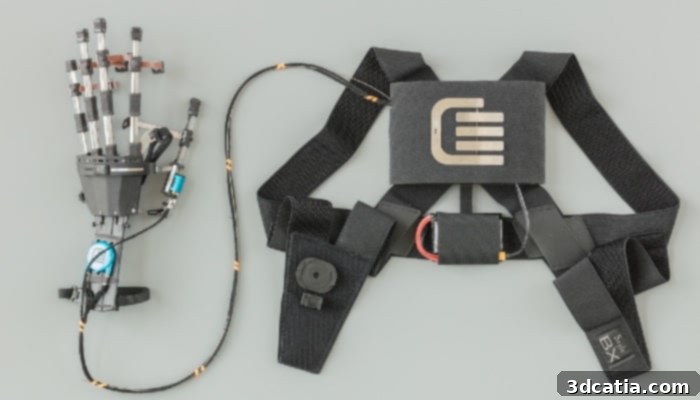
The exoskeleton and its 3 components, the hand module, the sensor wristband and the backpack | Photo Credit: Stefan Schneller (ETH Zurich)
This pioneering work by ETH Zurich and igus showcases the immense potential of 3D printing and advanced materials in developing life-changing medical devices. From overcoming design challenges to enabling personalized and portable rehabilitation tools, additive manufacturing is clearly at the forefront of innovation in healthcare. What do you think of this remarkable use of 3D printing to optimize performance and enhance recovery? Share your thoughts in a comment below or join the conversation on our Facebook and Twitter pages! Don’t miss out on the latest advancements in additive manufacturing – sign up for our free weekly Newsletter and get all the cutting-edge news in 3D printing delivered straight to your inbox!