

Revolutionizing Cancer Immunotherapy: 3D Printing Polysaccharide Microneedles for Targeted Drug Delivery
In the realm of medical innovation, particularly in the fight against cancer, researchers are constantly exploring novel approaches to drug delivery. One promising avenue involves the use of microneedles, tiny structures designed to painlessly penetrate the skin and deliver therapeutic agents directly to the target site. A recent comprehensive review published in late December 2025 by a research group in China has shed light on an emerging material in the microneedle landscape: natural polysaccharides.
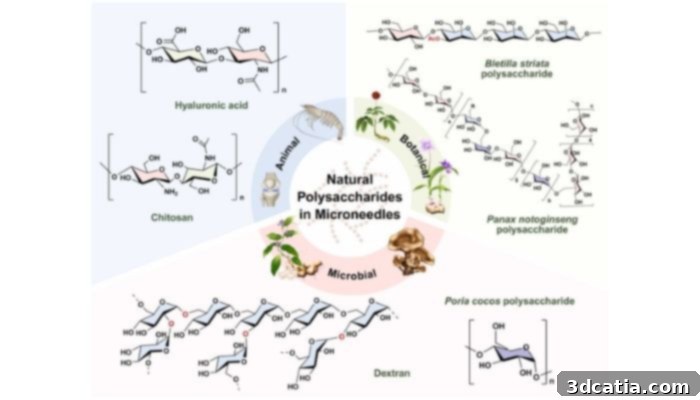
These “complex carbs,” derived from plant, animal, and microbial sources, are proving to be anything but basic in their potential for 3D fabrication. Unlike traditional silicon or synthetic polymer microneedles that primarily serve as passive delivery vehicles, polysaccharide microneedles (PMNs) are emerging as active therapeutic platforms. Their inherent biocompatibility, biodegradability, and ability to stimulate the immune system make them particularly attractive for cancer immunotherapy. The review, featured in Glycoscience & Therapy, delves into how micro molding and 3D printing technologies are being harnessed to create these innovative tools. Let’s explore why polysaccharides are gaining prominence as a desirable material for microneedle fabrication and how additive manufacturing (AM) technologies are unlocking their full potential.
The Allure of Polysaccharide Microneedles: Biocompatibility, Bioactivity, and Biodegradability
Natural polysaccharides offer a compelling alternative to the inert or brittle materials traditionally employed in 3D printing for medical applications. Inorganic substances like silicon and glass, while possessing certain advantages, carry a significant risk of fracturing during insertion, potentially leaving hazardous shards within the skin. In contrast, polysaccharides are bioresorbable, meaning they safely dissolve into harmless metabolites after delivering their therapeutic payload. This eliminates the need for retrieval and minimizes the risk of adverse reactions.
More importantly, polysaccharides are bioactive, especially beneficial in oncology applications. They act as natural adjuvants, substances that enhance the immune system’s response to antigens. In the context of cancer immunotherapy, polysaccharides can “prime” the immune system to recognize and attack tumor cells more effectively. This immune-boosting property is a crucial advantage over traditional microneedle materials, which often lack inherent biological activity.
Overcoming Rheological Challenges: The Role of 3D Printing in Polysaccharide Microneedle Fabrication
While natural polysaccharides offer numerous advantages, engineers face challenges related to their rheology and mechanical properties. These materials, despite their biological power, often lack the structural integrity required to penetrate the skin’s tough outer barrier without buckling or deforming. The key lies in leveraging 3D printing’s precision to reinforce these soft materials and create microneedles with the desired mechanical strength and geometry.
The research group identified three primary fabrication strategies that utilize 3D printing to address these challenges and harness the full potential of polysaccharide microneedles:
1. Indirect Fabrication: Mastering Microneedle Geometry Through Molds
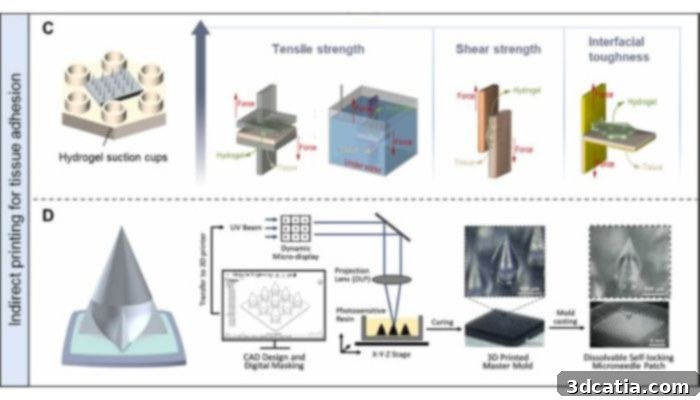
One of the most common hurdles in working with polysaccharides is their inherent viscosity or structural softness, which can hinder high-resolution direct printing via techniques like stereolithography (SLA). To overcome this limitation, researchers often employ indirect additive manufacturing techniques. This approach involves using high-resolution digital light processing (DLP) or SLA to print a precise “master” microneedle array with sub-micron accuracy. This master then serves as a template for creating a negative silicone mold.
By shifting the 3D printing process to the mold creation stage, engineers gain the ability to achieve complex biomimetic geometries that would be difficult or impossible to achieve with direct printing of the polysaccharide material. These geometries could include features like octopus-inspired suction cups or barbed tips designed to maximize skin adhesion and improve drug delivery efficiency. The polysaccharide is then cast into these meticulously crafted molds, inheriting a sophisticated architecture that would be unattainable through traditional methods like etching or milling.
2. Hybrid Structural Skeletons: Reinforcing Polysaccharides with 3D-Printed Frameworks
In situations where a mold alone is insufficient to provide the necessary mechanical strength, researchers turn to a composite architecture. Rather than relying solely on the polysaccharide to provide both the drug payload and the structural support, 3D printing is utilized to create a rigid internal skeleton. This approach combines the biocompatibility and bioactivity of polysaccharides with the structural integrity of other materials.
In this method, a structural core is printed using a high-strength polymer, providing the necessary backbone for the microneedle. This skeleton is then dip-coated in a polysaccharide solution, allowing the polysaccharide to encapsulate the framework and deliver the therapeutic agent. For example, continuous liquid interface production (CLIP), a high-resolution 3D-printing technology that utilizes oxygen-permeable membranes and controlled photopolymerization, can be used to rapidly generate microneedles with optimized surface topographies. This technique has been shown to increase drug-loading capacity by over 30% compared to monolithic needles, ensuring a uniform distribution of the therapeutic layer across every needle.
3. Smart Hydrogel Reservoirs: Integrating Iontophoresis for Controlled Drug Release
In advanced cancer immunotherapy, a microneedle patch needs to be more than just a delivery system; it needs to function as a programmable pump, enabling precise control over drug release. To achieve this level of sophistication, researchers are utilizing fused deposition modeling (FDM) to print integrated “iontophoretic” systems. These devices employ a small electric current to drive medication through the skin, offering a high degree of control over the rate and duration of drug delivery.
In this innovative setup, the 3D printer builds the rigid structural housing for the device, while the “engine” responsible for drug delivery is a polysaccharide hydrogel, such as agarose. This gel serves a dual purpose: it acts as a reservoir for the drug and an electrolyte that conducts the electric current. The combination of the 3D-printed frame with ultrasound-activated transport allows these hybrid systems to “drive” medication into the body with incredible precision, achieving up to 93% delivery efficiency for both small molecules and complex proteins.
The Future of Scalable Oncology: Personalized Medicine Through 3D-Printed Polysaccharide Microneedles
The convergence of polysaccharide science and 3D printing represents a significant step away from “one-size-fits-all” drug delivery and toward intelligent, personalized oncology. By harnessing 3D printing to overcome the inherent structural limitations of natural sugars, researchers have created a versatile platform akin to a high-precision transport vehicle for therapeutic agents. These intelligent patches offer a scalable, minimally invasive alternative to traditional immunotherapy approaches. The ability to customize microneedle design, drug loading, and release kinetics based on individual patient needs holds immense promise for improving treatment outcomes and minimizing side effects.
As the technology continues to evolve, it will be crucial to further investigate the long-term biocompatibility and biodegradability of these materials in vivo. Further research will also focus on optimizing the manufacturing processes to ensure consistent product quality and scalability for clinical translation. These intelligent patches offer a scalable, minimally invasive alternative to traditional immunotherapy, and its progress warrants close observation. For a deeper dive into the subject, you can access the complete review HERE.
What are your thoughts on the potential of 3D printing polysaccharide microneedles in the future of medicine? Share your insights in the comments below or connect with us on our LinkedIn and Facebook pages! Don’t forget to subscribe to our free weekly Newsletter to stay informed about the latest advancements in 3D printing. You can also find our videos on our YouTube channel. For more medical and dental 3D printing news, visit our dedicated page HERE.
*All Photo Credits: Zhang et al.