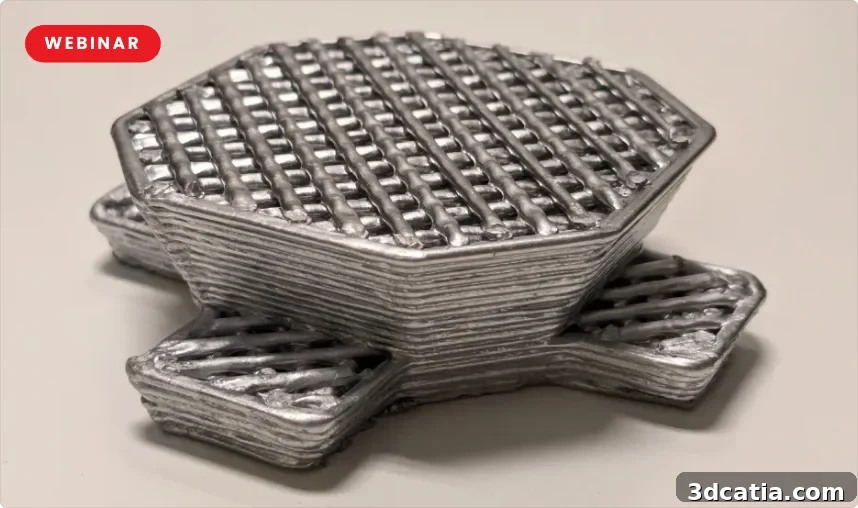
Metal additive manufacturing has long been difficult to adopt in university and small research lab environments. Conventional methods such as laser powder bed fusion (LPBF) require dedicated laser enclosures, extensive powder-handling procedures, inert gas systems and high-capacity three-phase electrical service. Binder jetting introduces its own downstream demands, including debinding and high-temperature sintering furnaces. These infrastructure, safety and utility requirements create a high barrier to entry for labs that want to research aluminum and other lightweight metals.
The landscape changes when those infrastructure constraints are removed. In this webinar, 3Dnatives and ValCUN present practical research findings from teams at the University of Manchester and the University of Twente who have worked with ValCUN’s Minerva system and its Molten Metal Deposition (MMD) process. They demonstrate how a compact, wire-fed, single-step deposition approach can dramatically reduce cost, footprint and complexity for aluminum additive manufacturing research.
September 24, 2026 | 10 – 11 AM EDT / 4 – 5 PM CEST, including live Q&A
REGISTER NOW
What We’ll Cover:
MMD is a wire-based, single-step metal deposition process that melts industry-standard aluminum wire and deposits molten material to build parts and features. Unlike powder-based systems, MMD operates from a standard single-phase electrical supply (110 V or 230 V) and fits through a typical doorway. The Minerva platform weighs roughly 1.1 tonnes and does not require ATEX certification, dedicated gas manifolds, or clean-room conditions. Its open architecture exposes process parameters, raw data capture and hardware configuration to users, which is particularly valuable for academic and industrial research projects focused on process understanding and materials development.
▸ Positioning MMD among aluminum AM technologies: We compare single-step wire deposition to powder-based aluminum additive manufacturing in terms of capital and operating cost, facility footprint, lead time and production scalability. The discussion will outline which applications are best suited to MMD—such as rapid prototyping, remanufacturing and larger-format structural features—and which are better served by powder-bed or hybrid approaches.
▸ Research results from the University of Manchester: Dr. Wajira Mirihanage and his team share controlled experiments that investigate how nozzle temperature, substrate preheat and deposition strategy affect melt-pool dynamics, solidification behavior, microstructure evolution and defect formation in aluminium 4043. The presentation links microstructural observations to mechanical performance and highlights process windows that minimize porosity and improve repeatability.
▸ The value of an open architecture for lab research: Full access to tool parameters and high-fidelity data capture enables reproducible experiments, systematic optimization and publishable results. Open control of deposition variables supports hypothesis-driven studies into heat flow, solidification kinetics and in situ sensing during additive manufacturing of aluminum alloys.
▸ Additive manufacturing’s role in remanufacturing and sustainability: As manufacturers in Europe and beyond respond to regulations and market demand for circular product lifecycles, right-first-time remanufacturing routes become essential. Prof. Ian Gibson from the University of Twente will outline early findings from the Dutch ADD-reAM program, showing where wire-fed MMD can integrate with remanufacturing strategies to extend component life, reduce waste and lower energy consumption compared with traditional replacement parts.
Meet Our Speakers
Manuel Delgado, Business Director at ValCUN
Manuel brings a decade of experience in polymer and metal additive manufacturing across sales, commercial strategy and business development. At ValCUN he focuses on commercial expansion, strategic partnerships and introducing flexible metal AM systems into academic and industrial environments.

Dr. Wajira Mirihanage, Senior Lecturer in Materials Science at the University of Manchester
Dr. Mirihanage’s research targets solidification phenomena and additive manufacturing of metallic alloys. His work emphasizes melt-pool control, microstructure-property relationships and strategies to reduce defects in aluminum AM.

Prof. Ian Gibson, Professor of Advanced Manufacturing, Sustainable Products and Energy Systems at the University of Twente
Prof. Gibson leads research into advanced manufacturing and sustainable product systems. With over 30 years of experience studying 3D printing, he contributes expertise in integrating additive technologies into industrial and circular-economy applications.
If your metal AM program has been halted by facility constraints, power availability or safety approvals rather than technical challenges, this webinar will show practical alternatives and research pathways that remove those barriers. Register now to hear experimental results, practical considerations and early roadmap recommendations for using wire-fed Molten Metal Deposition for aluminum research and remanufacturing studies.
Will you attend the webinar? Share your plans in the comments below. For updates and related content, follow industry news channels and university publications. Sign up for newsletters from trusted industry sources to receive announcements about events, research findings and new tool capabilities.