
Revolutionizing Space Exploration: Archinaut and the Future of In-Orbit 3D Printing
The cosmos, once an unreachable frontier, is slowly but surely becoming an arena for human innovation. At the forefront of this new era is the groundbreaking convergence of advanced manufacturing and space technology: 3D printing. This transformative technological trend is no longer confined to Earth-bound developments; it is poised to expand its reach into the vast and challenging environment of outer space. Leading this monumental effort is Made In Space, a pioneering Californian company and a frequent, trusted collaborator of NASA, which has firmly set its sights on taking additive manufacturing into orbit.
Recently, the space community was introduced to Archinaut, a critically important Technology Demonstration Mission (TDM). This ambitious project aims to rigorously test the capabilities of 3D printing large-scale structures within the harsh, unforgiving environment found beyond Earth’s protective atmosphere. Archinaut represents a significant leap forward, moving us closer to a future where we can build and assemble complex infrastructure directly in space, rather than relying solely on the constraints of terrestrial construction and costly rocket launches.
The mere concept of developing structures of any size outside of Earth typically conjures images of massive, expensive fleets of rockets ferrying pre-fabricated components into orbit. Such traditional approaches are laden with immense logistical challenges, volume restrictions, and exorbitant costs. However, with Archinaut, Made In Space and NASA are striving to develop truly “cutting-edge” technology that will enable the on-demand fabrication of complex hardware and intricate structures directly in the vacuum of space. This paradigm shift promises to unlock unprecedented possibilities for space exploration, research, and commercial endeavors.
The Made In Space team working on Archinaut TDM
Made In Space’s strategic location at Moffett Field, a historic air base that notably hosts NASA’s Ames Research Center, places it at the heart of space innovation. This vibrant hub is home to numerous startups and established entities actively collaborating in the grand pursuit of space exploration and scientific discovery. Among these pioneering actors is Space X, the renowned aerospace manufacturer and space transportation services company founded by Elon Musk. It was within the advanced facilities of Moffett Field’s Engineering Evaluation Laboratory that the crucial Archinaut test series was meticulously conducted. Utilizing Made In Space’s proprietary Extended Structure Additive Manufacturing Machine (ESAMM) within a specialized vacuum chamber, the team was able to replicate the extreme conditions of space, allowing for real-world testing without ever leaving Earth’s gravity well.
The successful execution of these tests marked a monumental milestone in the journey towards in-space manufacturing. Eric Joyce, Archinaut project manager for Made In Space Inc., headquartered in Mountain View, California, proudly announced, “To our knowledge, this is the first time additive manufacturing has been successfully tested on such a large scale in the vacuum and temperature conditions of space.” This statement underscores the unprecedented nature of Archinaut’s achievements, highlighting the team’s ability to overcome significant technical hurdles and demonstrate the viability of creating robust structures in an environment notoriously hostile to complex machinery and delicate materials. The ability to simulate space conditions on Earth provides invaluable data and confidence for future orbital deployments.
Equipment testing in space-like environments
The core focus of these meticulous tests was the creation and rigorous evaluation of large structures, specifically substantial beam segments. These components are fundamental building blocks for future space infrastructures, such as larger satellites, telescopes, and even orbital habitats. The fabricated beam segments were subjected to a battery of stress tests, including various pressures, extreme temperatures, and other environmental characteristics meticulously designed to simulate the harsh realities of life and operation in space. The successful endurance of these structures under such demanding conditions provides compelling evidence for the robustness and reliability of Archinaut’s additive manufacturing process.
Archinaut is not merely an isolated experiment; it is one of three strategic projects currently receiving critical funding from NASA. All these initiatives share the overarching goal of determining whether advanced in-space manufacturing technologies have “sufficiently matured to pursue flight” or if they can be seamlessly incorporated into future, more ambitious missions in space. NASA’s investment highlights the agency’s strategic vision for self-sufficiency and expanded capabilities beyond low Earth orbit, paving the way for sustainable long-duration missions to the Moon, Mars, and beyond. This coordinated effort signifies a commitment to leveraging innovative solutions to overcome traditional limitations in space infrastructure development.
The future implications of Archinaut are truly profound. As envisioned by Eric Joyce, Archinaut could evolve into a revolutionary “Build-to-order space platform.” In this transformative scenario, various space vehicles, from compact probes to multi-ton satellites, could seamlessly dock with the platform for on-demand construction, repair, or upgrade. This platform would not only facilitate the assembly and integration of new hardware or complex systems but also enable the creation of bespoke components as needed, minimizing the need to launch every single part from Earth. Imagine telescopes with primary mirrors larger than any rocket fairing, or intricate satellite components customized for specific mission parameters, all built directly in orbit. This capability would drastically reduce launch mass, volume constraints, and the inherent risks associated with launching fully assembled large structures.
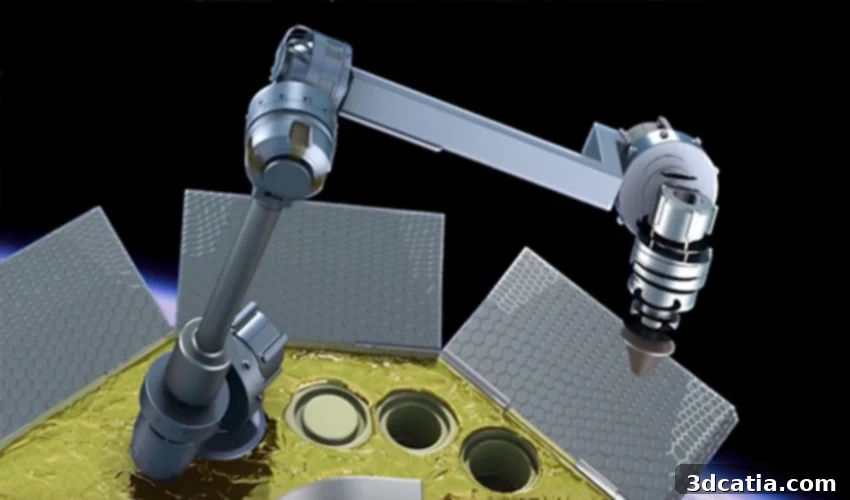
Building on the success of these initial revelations, the Archinaut project team scheduled another crucial series of tests for early 2018. These subsequent evaluations were designed to further refine the capabilities of the ESAMM prototype and meticulously enhance the precision and versatility of Archinaut’s sophisticated robotic manipulator. The continuous iteration and improvement of these key technologies are paramount to ensuring the system’s reliability and effectiveness for future operational missions. The robotic arm, in particular, is critical for tasks such as component placement, assembly, and potentially even maintenance, acting as the dexterous hand of the in-space manufacturing system.
The Archinaut Robotic Arm
Eric Joyce encapsulates the far-reaching impact of this innovation perfectly, stating, “This technology is absolutely transformative.” He further elaborates on its potential to reshape humanity’s venture into space: “Archinaut has the potential to dramatically advance discovery in space, reducing the time and money spent launching hardware and equipment and putting the focus on the human explorers who will use that made-in-space equipment to explore the cosmos.” This statement highlights the dual benefits of in-space manufacturing: not only does it offer significant economic and logistical advantages by eliminating the need to send pre-assembled hardware from Earth, but it also empowers human explorers. By enabling astronauts to produce tools, spare parts, or even entire habitats on demand, Archinaut minimizes reliance on Earth-based supply chains, making longer, more ambitious missions safer and more feasible. It shifts the focus from merely surviving in space to thriving and exploring with unprecedented autonomy.
As of now, the dedicated team behind Archinaut is actively seeking their next ambitious project, eagerly anticipating the next frontier for in-space manufacturing. However, no definitive plan has yet been formalized regarding the exact nature of this upcoming endeavor. As Joyce sagely remarked, “Time will tell.” The possibilities are vast, ranging from developing more sophisticated materials for space construction to enhancing the autonomy of orbital manufacturing systems, or even deploying the technology on a live mission. The rapid evolution of 3D printing and robotics promises a future where space construction is not just a dream, but a tangible reality.
https://youtu.be/phaonMhOC8Q
Do you believe that groundbreaking projects like Archinaut will significantly accelerate humanity’s path to living and working in space? Share your thoughts and predictions in the comments section below, or join the conversation on our Facebook or Twitter page! To stay informed about all the latest advancements in 3D printing and space technology, don’t forget to sign up for our free weekly Newsletter, delivering the most relevant news straight to your inbox!