Revolutionizing Additive Manufacturing: Aerosint Unveils Breakthrough in Multi-Metal Laser Powder Bed Fusion
The landscape of additive manufacturing is continuously evolving, pushing the boundaries of material science and engineering. A significant leap forward has just been announced by Belgian manufacturer Aerosint, which has successfully 3D printed intricate components and small cubes using a groundbreaking dual-metal approach within the Laser Powder Bed Fusion (LPBF) process. This innovation marks a pivotal moment for the industry, promising to unlock unprecedented material properties and design possibilities for a multitude of industrial applications.
For the first time on the additive manufacturing market, Aerosint has demonstrated the capability to combine distinct metals in a single build. Their successful trials include a complex part fabricated from stainless steel and CuCrZr (Copper with Chromium and Zirconium alloy), alongside small cubes printed with a combination of steel and a copper alloy. This achievement is not merely an engineering feat but a testament to the potential for creating parts that exhibit tailored, localized mechanical properties, superior performance characteristics, and extended functionalities that were previously unattainable with single-material 3D printing.
Understanding Laser Powder Bed Fusion and Its Limitations
Laser Powder Bed Fusion is a cornerstone technology in the metal 3D printing market. The process works by precisely melting metallic powder, layer by layer, with a high-power laser beam, gradually building up a three-dimensional object from a digital design. This method is highly valued for its ability to produce complex geometries with high precision and excellent mechanical properties, making it ideal for prototypes, functional tools, and durable end-use parts across various sectors, including aerospace, medical, and automotive.
However, a long-standing limitation of traditional LPBF systems has been their reliance on a single metal powder or alloy during a print job. While this has yielded impressive results for single-material components, it inherently restricts the ability to leverage the unique advantages of multiple materials within a single part. Each metal possesses distinct physical and chemical properties, including varying melting points, thermal conductivities, and mechanical strengths. Successfully combining these materials in a controlled manner within an LPBF environment presents significant technical challenges, primarily related to temperature management, material compatibility, and preventing cross-contamination.
The vision of multi-metal 3D printing has long captivated researchers and engineers, as it promises to overcome these limitations. Imagine a component that combines the biocompatibility of a specific steel alloy with the lightweight characteristics of aluminum, or a part with a hard, wear-resistant surface fused seamlessly with a tough, ductile core. Such hybrid structures could revolutionize product design, enabling the creation of components optimized for multi-functional performance, reduced weight, and enhanced durability. Aerosint’s recent breakthrough brings this exciting vision much closer to reality, paving the way for a new generation of high-performance parts.
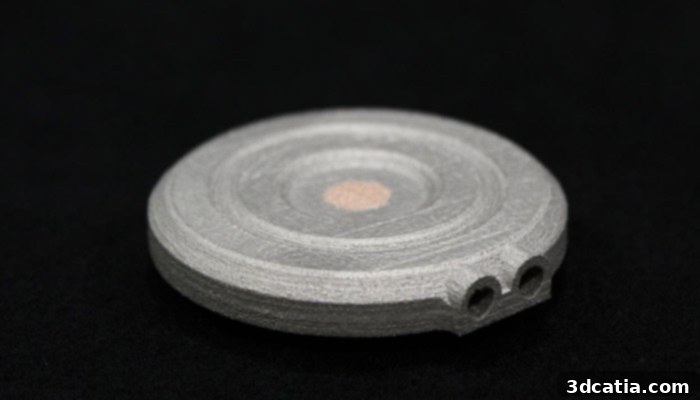
The circular part combines steel and CuCrZr | Credits: Aerosint
Aerosint’s Multi-Metal Additive Manufacturing Process: The Innovation Unveiled
Aerosint’s success lies in its innovative approach to powder management within the LPBF process. The Belgian manufacturer utilized a tailor-made machine developed by Aconity3D, but the key differentiating factor is Aerosint’s proprietary recoater system. In conventional LPBF, a recoater blade or roller spreads a uniform layer of a single metal powder across the build platform. Aerosint’s recoater, however, is engineered to selectively deposit different powders in specific areas of the build layer, effectively enabling the creation of multi-material parts.
This selective powder deposition technology is crucial for preventing unwanted mixing of different metal powders, which could compromise the final material properties. By precisely controlling where each material is placed, Aerosint can dictate the material composition at a microscopic level, allowing for the fabrication of parts with truly integrated multi-material designs. This level of control opens up avenues for creating functionally graded materials, where the composition of a part gradually changes from one material to another, or for embedding distinct material zones within a single component.
Demonstrating Dual-Metal Capabilities
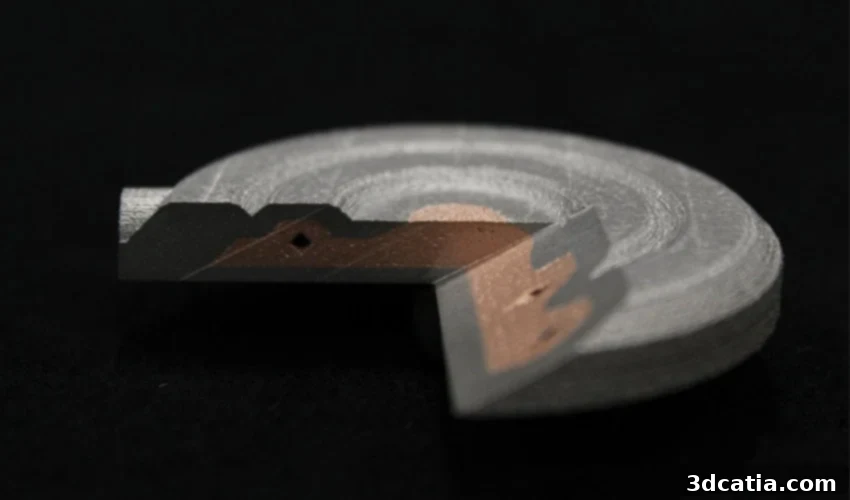
To prove the efficacy of their technology, Aerosint conducted several rigorous tests. Initially, they successfully printed small cubes using a combination of steel and copper. These initial experiments laid the groundwork for more complex geometries and material pairings. Building on this success, Aerosint then designed and fabricated a sophisticated circular part, measuring 60 mm in height and 55 mm in width. This part was meticulously constructed from 174 individual layers, each just 40 microns thick, alternating between 316L stainless steel and CuCrZr.
The entire printing process for this complex component took 5 hours and 40 minutes, showcasing the feasibility and efficiency of their multi-metal LPBF system. The ability to precisely deposit and fuse such distinct materials – stainless steel known for its strength and corrosion resistance, and CuCrZr valued for its high electrical and thermal conductivity – within a single build is a monumental achievement. This demonstrates not only the technical prowess of Aerosint’s system but also its immediate potential for creating parts with optimized thermal management, enhanced electrical performance, or improved mechanical strength where needed.
Aerosint’s team expressed immense pride in this accomplishment, stating: “We are very proud of this achievement. No other technology is capable of producing such bimetallic parts today. Multi-metallic laser powder bed fusion creates a range of new use cases and applications that we look forward to exploring with our partners in the future.” This sentiment underscores the pioneering nature of their work and its potential to redefine what’s possible with additive manufacturing.
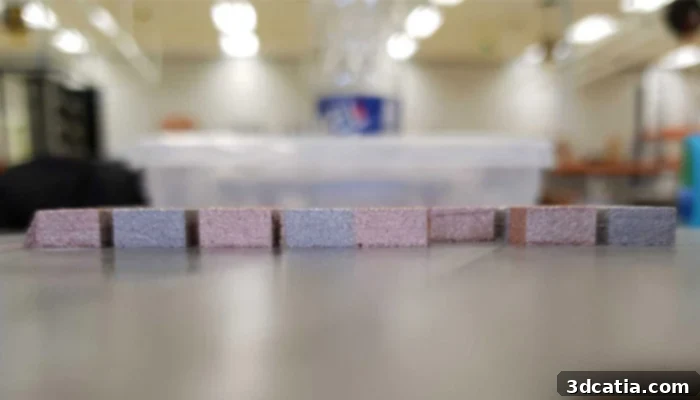
Multi-metal cubes | Credits: Aerosint
Unlocking New Horizons: Applications and Future Potential
The ability to combine multiple metals within a single LPBF build opens up a vast array of new applications across various high-tech industries. The potential for creating components with tailored, localized properties is immense, far surpassing the capabilities of traditional manufacturing methods or even single-material 3D printing.
Aerospace and Automotive
In aerospace, multi-metal printing could lead to lighter, more efficient turbine blades or engine components. Imagine a blade with a high-temperature resistant alloy in the core and a corrosion-resistant, lightweight alloy on the surface. Similarly, for the automotive sector, performance parts could be optimized with wear-resistant surfaces fused onto ductile bases, or components with integrated cooling channels made from highly conductive materials precisely located where heat dissipation is critical.
Medical Implants
The medical field stands to benefit significantly from this technology. Custom implants could be designed with distinct zones: a biocompatible titanium alloy for bone integration and a flexible nitinol section for enhanced elasticity and physiological movement. This could revolutionize prosthetics and surgical implants, offering superior patient outcomes and personalized medical devices.
Electronics and Thermal Management
For electronics, the integration of highly conductive copper alloys with structural steels could enable the creation of sophisticated heat sinks or electrical contacts directly within complex structural components. This would allow for superior thermal management in compact electronic devices, improving reliability and performance by efficiently dissipating heat from critical areas.
Tooling and Manufacturing
In tooling, multi-metal capabilities can lead to improved molds and dies with extended lifespan and enhanced performance. For instance, a tool could have a hard, abrasion-resistant surface made from a robust steel alloy, backed by a softer, more impact-resistant material, or even incorporate internal cooling channels for rapid thermal cycling.
The long-term vision for Aerosint is to further explore and expand the possibilities of this dual-metal technology. The manufacturer is already planning to test additional challenging metal combinations, including 316L stainless steel with Inconel 625 or 718 – superalloys known for their extreme temperature resistance and strength, crucial for aerospace applications. They also anticipate exploring combinations like titanium alloys with nitinol, opening doors for advanced biomedical devices and smart materials. To accelerate this exploration and drive broader adoption, Aerosint is actively seeking partnerships with other manufacturers and industry leaders to print diverse test pieces and fully demonstrate the transformative potential of multi-metal additive manufacturing.
Conclusion: A New Era for Additive Manufacturing
Aerosint’s breakthrough in multi-metal Laser Powder Bed Fusion represents a monumental step forward for additive manufacturing. By overcoming the long-standing challenge of processing multiple distinct materials within a single build, the company has paved the way for a new generation of high-performance components. This innovation promises to deliver parts with unparalleled mechanical efficiency, optimized thermal and electrical properties, and tailored functionalities that were once confined to theoretical discussions.
The ability to combine the best attributes of different metals in a precise, localized manner will empower engineers and designers to reimagine product development across countless industries. From lighter, stronger aerospace components to more effective medical implants and advanced electronics, the impact of multi-metal 3D printing is set to be profound. As Aerosint continues to expand its material palette and forge strategic partnerships, the full potential of this groundbreaking technology will undoubtedly continue to unfold, marking the beginning of a truly multi-functional era in additive manufacturing.
What type of parts could be manufactured using such a technology? We invite you to share your thoughts and innovative ideas in a comment below or on our Facebook and Twitter pages! Don’t forget to sign up for our free weekly Newsletter to receive all the latest 3D printing news straight to your inbox and stay ahead of the curve!