
Revolutionizing Sustainability: 3D Printing Coffee Grounds into Eco-Friendly Packaging and Beyond with Mycelium Technology
The aroma of freshly brewed coffee is a daily ritual for millions, particularly in the United States, where over 80 percent of daily coffee drinkers consume two or more cups per day. This habit translates into a staggering amount of coffee. At a conservative estimate, this means at least 14 cups weekly, accumulating to approximately 728 cups annually for an individual. Collectively, this widespread consumption results in a monumental waste problem: Americans alone discard an astonishing 1.1 billion pounds of spent coffee grounds into landfills each year. This enormous volume of organic waste poses significant environmental challenges, contributing to greenhouse gas emissions and depleting landfill space. The pressing question then arises: how can these spent coffee grounds be meaningfully repurposed, given a second life, and transformed from waste into valuable resources? This very question captivated Danli Luo, a diligent doctoral student in engineering at the University of Washington. Recognizing a profound scientific opportunity in her routine encounters with the coffee machine, Luo, alongside her dedicated colleagues, embarked on a pioneering journey. Their innovative research led to the development of a groundbreaking method to 3D print coffee grounds, shaping them into entirely new and functional structures. This remarkable scientific advancement offers a tangible and ecologically sound alternative to conventional plastics, heralding a new era for sustainable material innovation.
From Coffee Bean to Breakthrough Material: The Power of Mycelium
Coffee grounds, often perceived as mere waste, are in fact remarkably rich in nutrients. Furthermore, the brewing process effectively sterilizes them, creating an ideal substrate for specific biological processes. These characteristics make spent coffee grounds a perfect breeding ground for fungi. When fungi proliferate, they first establish a complex, intricate network of filamentous roots known as mycelium, often appearing as a fine, whitish skin. This mycelial network is not merely a byproduct of fungal growth; it is an increasingly recognized and valuable fabrication material. Across various sectors, numerous companies, forward-thinking researchers, and innovative designers are actively experimenting with mycelium due to its exceptional properties. It is naturally lightweight, impressively robust, and possesses inherent water-repellent qualities, making it a highly attractive sustainable alternative for a myriad of applications. Leveraging this burgeoning interest, Luo and her multidisciplinary team combined the nutrient-rich coffee grounds with spores from the reishi mushroom – a species well-known for its vigorous mycelial growth. This strategic combination aimed to harness the advantages of both materials. To create a printable paste, they also incorporated brown rice flour, which serves as an additional nutrient source for the growing mycelium, and xanthan gum, functioning as a binder to give the mixture the necessary viscosity for 3D printing. The result was an innovative, coffee-based printable paste, aptly named “Mycofluid,” which would serve as the foundational printing material for their novel sustainable structures. This fusion of organic waste and biological engineering offers a compelling pathway toward a circular economy.
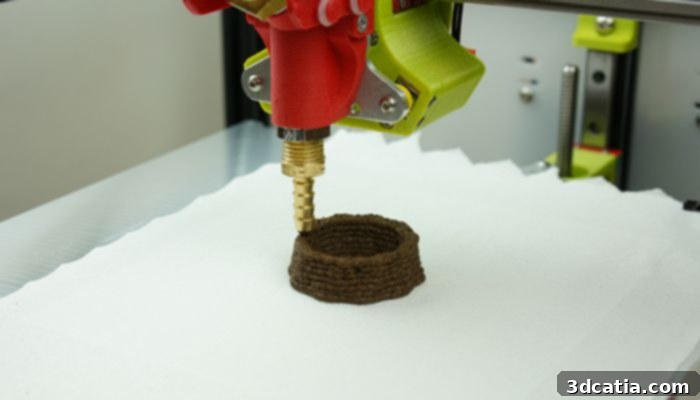
The coffee grounds paste, known as “Mycofluid”, is processed into new structures using advanced 3D printing technology.
Engineering for Sustainability: The 3D Printing Process with Mycofluid
To successfully implement their vision, Danli Luo’s team faced the engineering challenge of adapting existing additive manufacturing technology for their unique biopaste. They specifically upgraded a Jubilee 3D printer located in the Machine Agency Lab at the University of Washington. Luo meticulously designed and developed a specialized print head with a significantly larger capacity of 1 liter. This enhanced print head was crucial for handling the substantial volume and specific rheology of the Mycofluid paste, allowing various objects to be extruded smoothly and continuously. The ingenious part of their process lies in the biological integration: the reishi mushroom spores, carefully mixed into the paste, are activated during and after printing. These spores are essential as they facilitate the formation of a robust mycelium skin around the printed structure. For this vital biological process to occur effectively and for the mycelial network to develop adequately, the printed structures must be stored in controlled conditions for a period of ten days. During this crucial curing phase, the mycelium proliferates, binding the coffee grounds particles together and significantly contributing to the structural integrity and stability of the printed object. This biological reinforcement is key to the material’s strength and resilience, effectively turning a soft paste into a self-supporting structure. Following the mycelial growth period, an equally important step is implemented to ensure the longevity and practical utility of the objects: drying. To prevent continued actual fungal growth, which could lead to spoilage or degradation, the parts must be thoroughly dried. As soon as the moisture content is reduced to a specific level, the fungi enter a dormant state, ceasing their growth and preventing any undesirable mold formation. This careful interplay of mechanical engineering and biological principles ensures the creation of stable, durable, and truly sustainable materials from humble coffee grounds.
Sustainable Solutions: Coffee Grounds for Eco-Friendly Packaging and Beyond
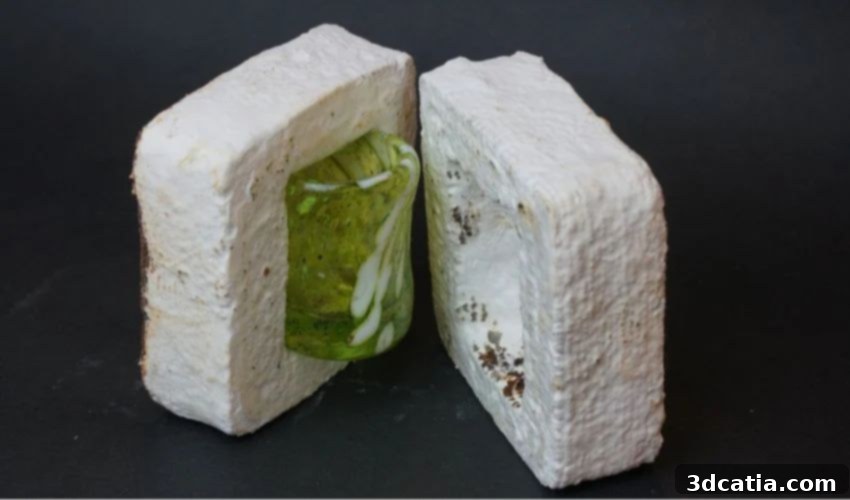
The final product derived from this innovative 3D printing process presents a highly promising sustainable material. The parts created are slightly heavier than conventional polystyrene, a common plastic often used for packaging, yet they boast a similar density to cardboard. Critically, these mycelium-bound coffee ground structures exhibit strength and toughness comparable to polystyrene, making them highly effective for protective applications. Beyond their impressive mechanical properties, the most significant advantage of these printed structures lies in their environmental credentials: they are fully compostable, breaking down naturally into organic matter without leaving harmful residues. Furthermore, the paste, and consequently the final product, is theoretically edible, although its palatability might be questionable for human consumption. This combination of strength, compostability, and biodegradability positions Mycofluid as an exceptionally suitable material for developing packaging solutions. It represents a truly ecological alternative to widespread, non-biodegradable materials like plastic and polystyrene, which continue to overburden our planet’s ecosystems. To demonstrate the versatility and practical applicability of their innovation, the research team successfully printed a variety of objects. These included custom packaging designed to securely hold a delicate glass, intricate vase parts, and even two halves of a replica Moai statue, showcasing the material’s ability to form complex geometries and protective enclosures.
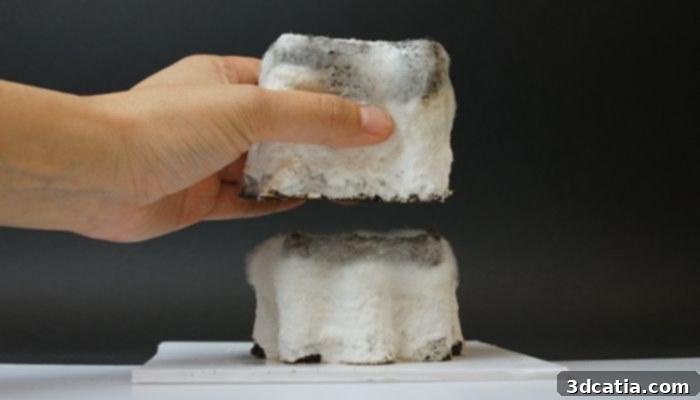
A custom-designed packaging solution for a jar, innovatively printed from coffee grounds and reinforced with a strong mycelium skin, highlighting its potential for sustainable packaging.
Danli Luo articulated the specific target audience and market niche for this groundbreaking technology, emphasizing its suitability for smaller-scale operations. “We’re especially interested in creating systems for people like small business owners producing small-batch products — for example, small, delicate glassware that needs resilient packaging to ship,” Luo stated. Her vision is clear: to empower entrepreneurs and small-scale manufacturers with sustainable options. “So we’ve been working on new material recipes that can replace things like Styrofoam with something more sustainable and that can be easily customized for small-scale production.” This focus on customization and adaptability for artisanal and niche products underscores the practicality and immediate impact of their research. It addresses a critical need for eco-friendly packaging solutions that are accessible and flexible enough for businesses that don’t operate on a mass-production scale, offering a tangible pathway for them to reduce their environmental footprint without compromising on product safety or aesthetic appeal.
Scalability, Future Directions, and the Broader Impact on Waste Management
While the potential for coffee grounds 3D printing is immense, Luo candidly addressed the current limitations regarding large-scale industrial series production. The primary challenge for scaling up this process lies in the consistent availability of large quantities of homogeneous used coffee grounds. Coffee grounds vary significantly depending on the bean type, grind size, brewing method, and even the source, making it difficult to maintain a standardized material input for massive manufacturing operations. Such variability could lead to inconsistencies in the Mycofluid’s properties and the final printed objects’ quality. For this reason, the research group is not stopping at coffee grounds. They are actively expanding their investigations into developing similar bio-based pastes for 3D printing, leveraging the same foundational approach but utilizing a wider array of organic waste materials. This broader scope promises even greater impact.
“We’re interested in expanding this to other bio-derived materials, such as other forms of food waste,” Luo added, outlining a future where diverse organic byproducts could be transformed into valuable resources. This forward-thinking approach is not about finding a single, universal solution, but rather about fostering a versatile and adaptable framework for sustainable material development. “We want to broadly support this kind of flexible development, not just to provide one solution to this major problem of plastic waste.” This highlights the team’s commitment to creating a systemic change in how we perceive and manage waste, promoting a circular economy where waste streams are consistently re-evaluated for their potential as raw materials. Their work provides a powerful example of how scientific ingenuity, combined with an environmental conscience, can lead to innovative solutions that address some of the most pressing challenges of our time, pushing the boundaries of additive manufacturing towards a more sustainable future. The comprehensive findings of this seminal study, offering detailed insights into the methodologies and results, were officially published in the esteemed journal 3D Printing and Additive Manufacturing on January 23. Interested readers can delve deeper into the research by accessing the full study HERE.
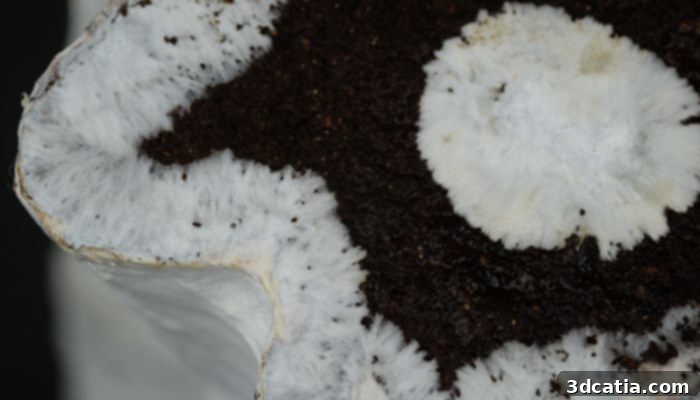
The intricate mycelium skin forming around the printed structure made of coffee grounds is crucial for ensuring the stability and strength of the final product, demonstrating nature’s engineering prowess.
The innovative approach of 3D printing coffee grounds into new, functional, and eco-friendly shapes represents a significant leap forward in sustainable manufacturing and waste utilization. It transforms a ubiquitous waste product into a valuable resource, offering a tangible path to reducing our reliance on plastics and fostering a healthier planet. What are your thoughts on this exciting development in 3D printing and sustainable materials? We invite you to share your perspectives and ideas in a comment below, or engage with us on our social media platforms: LinkedIn, Facebook, and Twitter! Don’t miss out on the latest advancements and news in the world of additive manufacturing; make sure to sign up for our complimentary weekly Newsletter here to have cutting-edge 3D printing insights delivered directly to your inbox. You can also explore a wealth of informative videos and content by subscribing to our YouTube channel.
*All Image Credits: Luo et al./3D Printing and Additive Manufacturing