
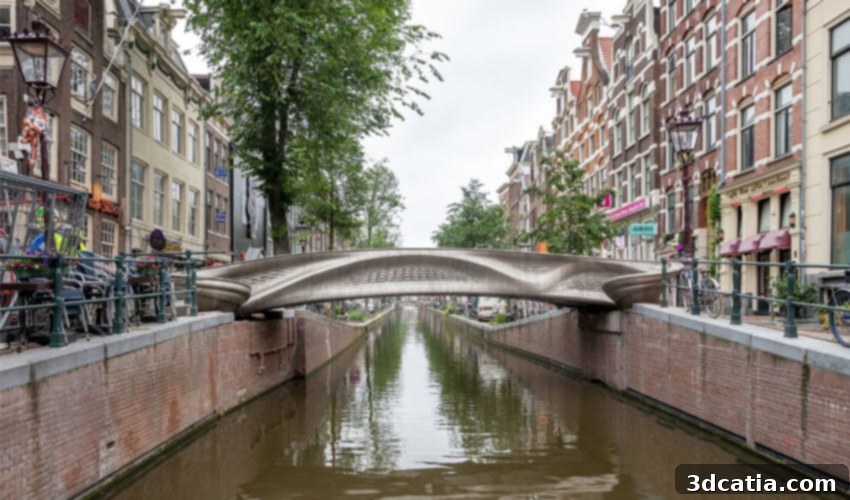
Amsterdam’s Revolutionary MX3D 3D-Printed Metal Bridge: A Smart Infrastructure Marvel and Additive Manufacturing Triumph
On July 15, 2021, a monumental stride in urban infrastructure and advanced manufacturing was unveiled in the heart of Amsterdam. Her Majesty Queen Máxima of the Netherlands officially inaugurated the world’s first large-scale 3D-printed metal bridge, a groundbreaking achievement by the Dutch company MX3D. This innovative structure, gracefully spanning a canal in the city’s historic Red Light District, culminates six years of dedicated research, development, and engineering. It marks a pivotal moment, allowing the public to finally walk across a bridge constructed layer by layer using cutting-edge Wire Arc Additive Manufacturing (WAAM) technology, showcasing the immense potential of metal 3D printing in real-world applications.
The journey to bring the MX3D bridge from concept to reality was an ambitious one, requiring not only immense technical prowess but also unwavering perseverance. What began as a visionary idea in 2015 evolved into a tangible testament to human ingenuity, demonstrating that the future of construction is already here. The city of Amsterdam, known for its blend of historical charm and forward-thinking innovation, embraced this project, granting a multi-year permit that underscored its belief in the bridge’s potential. The inauguration by Queen Máxima herself further solidified its status as a landmark project, capturing global attention for its unprecedented approach to urban development.
The Genesis of a Marvel: Technology and Design Unpacked
For those closely following advancements in additive manufacturing, the MX3D Bridge has been a beacon of innovation since its inception. This structure is not merely a bridge; it is a meticulously engineered masterpiece, brought to life by four synchronized robotic arms. The core technology behind its creation is Wire Arc Additive Manufacturing (WAAM), a process that leverages the heat from an electric arc to melt metal wire, depositing it layer by layer to build complex 3D forms. Unlike traditional manufacturing methods, WAAM allows for the creation of intricate geometries and custom designs with remarkable precision and material efficiency.
The collaborative spirit of this project was instrumental, bringing together a consortium of industry leaders including Air Liquide, ABB, and Autodesk. Each partner contributed specialized expertise, from welding gases and robotics to advanced design software, ensuring every facet of the bridge’s creation was optimized. The bridge itself boasts impressive dimensions, measuring 12.2 meters (approximately 40 feet) in length, 6.3 meters (20.7 feet) in width, and standing 2.1 meters (6.9 feet) high. Its robust construction required an astonishing 6,000 kilograms (over 13,200 pounds) of steel, all precisely deposited through the WAAM process.
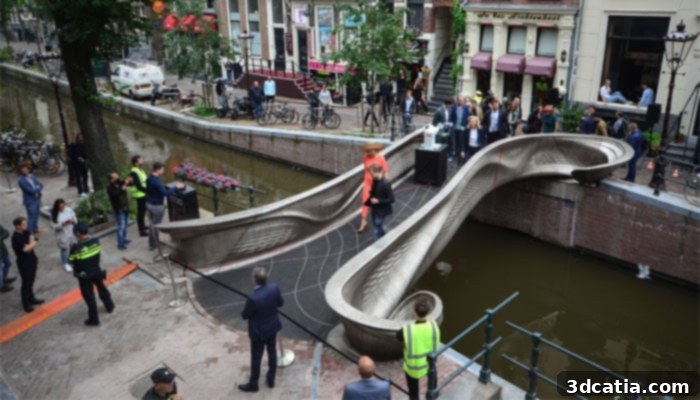
The inauguration of the MX3D 3D-printed metal bridge by Queen Máxima. (Photo Credit: Adriaan de Groot)
The actual printing process for the bridge spanned from 2017 to 2018, a testament to the scale and complexity involved. This period saw the integration of advanced computational design techniques, such as topological optimization and generative design. Topological optimization allowed engineers to fine-tune the bridge’s structure, removing unnecessary material from areas under less stress while reinforcing critical points, resulting in a design that is both lightweight and incredibly strong. Generative design, on the other hand, employed AI algorithms to explore thousands of design variations, ultimately leading to an organically shaped, highly efficient, and aesthetically unique structure that would be impossible to achieve with conventional fabrication methods.
Pushing Boundaries: The MX3D Vision
“When we started this project, the bridge was over 100 times bigger than any other part ever 3D printed in metal, and now that it’s finished, I still have good reason to believe that it will remain the largest printed metal object for years to come. Our robotic technology finally enables the 3D printing of optimized designs of larger sizes in metal. This results in a significant reduction in weight and reduced impact for parts manufactured in the tooling, oil and gas, and construction industries.”
— Gijs van der Velden, CEO and co-founder of MX3D
Gijs van der Velden’s statement perfectly encapsulates the pioneering spirit of MX3D. The bridge is not just a structural marvel; it’s a paradigm shift in metal additive manufacturing. Its sheer size challenged existing limits, proving that industrial-scale metal 3D printing is not only feasible but also highly advantageous. The ability to print “optimized designs of larger sizes” unlocks new possibilities for various sectors. In the tooling industry, it means creating lighter, more complex molds and dies. For oil and gas, it allows for custom, high-performance components with reduced material waste. And in construction, it heralds an era of bespoke, structurally efficient, and environmentally friendly building elements.
The inherent strength and design freedom offered by WAAM, combined with advanced design methodologies, mean that future large-scale metal structures can be fabricated with unprecedented material efficiency. This translates directly to significant reductions in raw material usage, manufacturing energy, and transportation costs. Moreover, the lightweight yet robust nature of these optimized designs contributes to a reduced environmental footprint, aligning perfectly with modern sustainability goals in urban development and industrial production.
The MX3D Metal Bridge: A Smart Infrastructure and Data Hub
Beyond its impressive fabrication, the MX3D Bridge distinguishes itself as a pioneering example of ‘smart infrastructure’. According to the partners involved in its realization, this is not merely a static structure; it is a living, breathing source of invaluable information. The bridge is ingeniously equipped with a sophisticated network of sensors designed to continuously monitor and record a wide array of data points. These sensors are strategically embedded throughout the structure, transforming the bridge into an active data hub that provides real-time insights into both its structural performance and its interaction with the urban environment.
The data collected from these sensors is multifaceted and serves several critical purposes. Firstly, it captures information on the behavior of crowds crossing the bridge, offering unique insights into pedestrian flow, congestion patterns, and how people interact with urban spaces. This data can be crucial for urban planners and architects to design more efficient and user-friendly public areas. Secondly, the sensors help assess the impact of tourism, particularly in a high-traffic area like Amsterdam’s Red Light District, providing empirical data on how urban infrastructure copes with varying levels of activity. Thirdly, and perhaps most significantly for the construction sector, the bridge serves as a powerful case study for the role of connected objects and IoT (Internet of Things) in modern infrastructure.
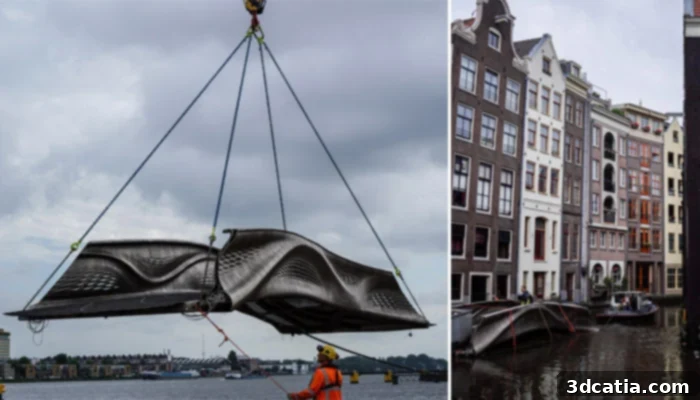
Installation and routing of the MX3D bridge in Amsterdam. (Photo Credit: Merlin Moritz)
Furthermore, these sensors are critical for monitoring the structural integrity and performance of the bridge itself. They track any minute deformation, the load exerted on the structure by pedestrians and environmental factors, vibrations from passing boats or traffic, and even subtle movements caused by temperature changes. This continuous stream of data allows project leaders to gain an unprecedented understanding of how the 3D-printed steel behaves under real-world conditions over time. From the wealth of collected data, engineers are able to create a highly accurate “digital twin” of the bridge. This digital replica, constantly updated with real-time information from its physical counterpart, allows for predictive maintenance, performance optimization, and a deeper comprehension of how the structure evolves throughout its lifespan. This concept sets a new standard for smart infrastructure, providing a living laboratory for future urban development.
Overcoming Obstacles: A Six-Year Journey to Success
The realization of the MX3D bridge was not without its share of formidable challenges, stretching the project timeline over six years. Despite the Dutch government’s strong support for this visionary endeavor, the team encountered several significant obstacles that tested their resolve. One primary hurdle was the initial ambition to print the bridge directly on-site. While a fascinating concept, the complexities of managing a robotic fabrication process within a bustling urban environment, coupled with logistical and safety concerns, ultimately led to the decision to print the bridge in a controlled off-site facility before its intricate installation.
Adding to the complexity were the extensive renovations required for the canal walls in the chosen location. These historical structures needed considerable reinforcement and modernization before the new bridge could be safely installed. Such work involved navigating strict heritage preservation guidelines and coordinating with various municipal departments, adding layers of bureaucracy and planning to an already demanding project. Furthermore, the numerous formalities, permits, and regulatory approvals typical of any large-scale urban infrastructure project, especially one employing entirely novel technology, proved time-consuming. However, the unwavering commitment of MX3D and its partners, coupled with the foresight of the Amsterdam municipality, ensured that each obstacle was systematically addressed and overcome, culminating in the successful placement and inauguration of this engineering marvel.
The MX3D 3D-printed bridge stands as a powerful symbol of what is achievable when innovation meets perseverance. It is a testament to the transformative power of additive manufacturing and a bold step towards a future where infrastructure is not only built but intelligently monitored and adapted. If your travels take you to Amsterdam within the next few years, make sure to seek out this remarkable 3D-printed bridge in the Red Light District. It offers a tangible glimpse into the future of urban design and construction, and a truly unique experience. You can find more detailed information on the project’s timeline and milestones HERE.
What are your thoughts on this pioneering 3D-printed metal bridge? Do you believe it heralds a new era for urban infrastructure and additive manufacturing? Share your insights and comments below, or engage with us on our Facebook and Twitter pages. And don’t miss out on the latest advancements in the world of 3D printing – be sure to sign up for our free weekly newsletter, delivered directly to your inbox!
Cover Photo Credit: Thea van den Heuvel