
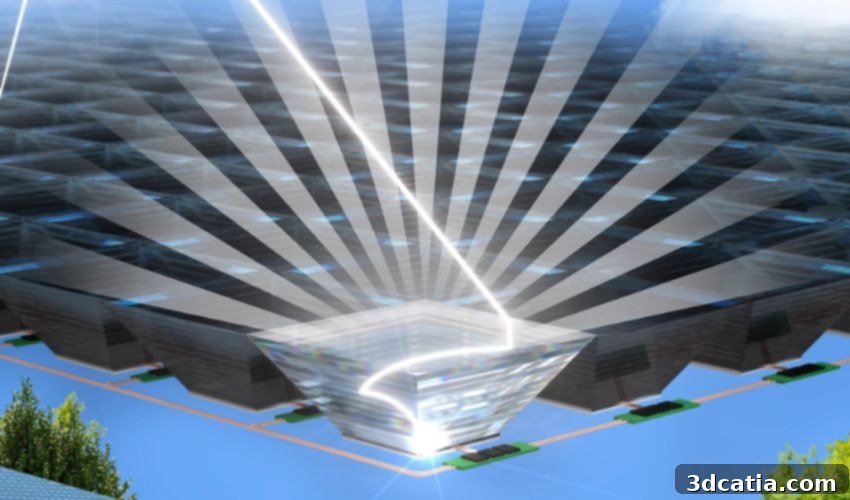
Revolutionizing Solar Energy: Stanford’s 3D-Printed AGILE Concentrator Boosts Efficiency and Affordability
As the global community confronts the urgent challenges of climate change and dwindling fossil fuel resources, the imperative to transition towards sustainable and eco-friendly energy sources has never been more pronounced. Among the myriad of renewable options, solar energy stands out as a leading contender, boasting abundant availability and minimal environmental impact. Yet, despite its immense potential, conventional solar technologies still present significant avenues for innovation and enhancement, particularly concerning efficiency, cost, and practicality. Addressing these critical areas, a groundbreaking development from Stanford University promises to redefine how solar power is harvested.
Recently, scientists from Stanford University in California unveiled a revolutionary 3D-printed optical concentrator designed to dramatically improve the performance of solar panels. This innovative device, named the Axially Graded Index Lens (AGILE), takes the form of a distinctive pyramid-shaped lens. Conceived by engineering researcher Nina Vaidya, the AGILE lens is engineered to substantially increase the power collection capacity of solar panels. Crucially, this advancement is achieved not at the expense of economic viability, but by simultaneously reducing production costs and streamlining the overall process, making solar energy a more practical and accessible solution for a wider range of applications.
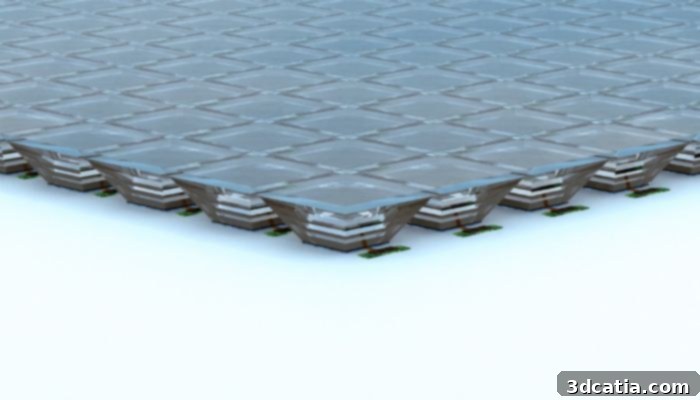
The new AGILE solar concentrators are shaped like inverted pyramids, a design that enhances light capture (photo credits: Stanford)
The Limitations of Conventional Solar Panels
Traditional solar panels, while effective under ideal conditions, are inherently constrained by several factors that limit their broad application and efficiency. Their performance is heavily dependent on direct sunlight, meaning the sun’s rays must strike the panel’s flat surface at a perpendicular or near-perpendicular angle. As the sun traverses the sky throughout the day, its angle relative to the Earth’s surface constantly changes. To counteract this, many large-scale solar arrays incorporate complex and energy-intensive tracking systems that actively rotate the panels to follow the sun. This continuous mechanical adjustment, while improving energy capture, adds significantly to the system’s overall cost, maintenance requirements, and operational complexity, consuming a portion of the energy they produce in the process.
Moreover, conventional solar cells often struggle with diffuse light, such as during cloudy weather or at dawn and dusk. The flat surface design is optimized for direct beam radiation, and its efficiency drops considerably when light comes from multiple angles or is scattered. This necessitates larger panel installations to compensate for periods of lower output, leading to increased land use and higher initial investment. The quest for higher efficiency in solar technology has long focused on improving the photovoltaic material itself, but innovations in light capture and concentration, like AGILE, offer a complementary and potentially more impactful path to widespread solar adoption. The need for constant reorientation not only complicates installation but also introduces points of failure, raising long-term operational costs and reducing overall system reliability.
Introducing AGILE: A Breakthrough in Light Concentration
The Axially Graded Index Lens (AGILE) represents a significant leap forward, designed to overcome the inherent limitations of static solar panels and elaborate tracking systems. This revolutionary device, conceptualized by Nina Vaidya and her doctoral advisor Professor Olav Solgaard, was recently featured in the July issue of Microsystems & Nanoengineering. Unlike flat panels, AGILE’s unique tipless inverted pyramid structure allows it to capture and concentrate sunlight coming from virtually any angle, rendering the need for active tracking systems largely obsolete. This elegantly simple, yet profoundly effective, design fundamentally alters how solar energy is collected, promising greater output from a more compact and passive system.
How the AGILE Lens Works: A Masterclass in Optics
At the heart of AGILE’s innovation lies its sophisticated optical design and material composition. The lens is crafted from a precise combination of different types of glass and specialized polymers. These materials are layered together in such a way that they create an “Axially Graded Index” — meaning their refractive index, or how much they bend light, changes gradually along the axis of the device. This graded index property is crucial: it enables the pyramid-shaped lens to effectively bend and redirect solar power from diverse incident angles, focusing all of it onto a single, concentrated spot. Imagine using a magnifying glass to focus sunlight to a tiny point, regardless of the sun’s exact position; AGILE achieves this dynamic light concentration on a larger, more sophisticated scale for solar energy collection. This intricate layering allows the lens to guide incoming light internally, regardless of its angle of entry, ensuring it always reaches the photovoltaic cell below with maximum intensity.
Nina Vaidya articulated the core principle behind their invention, stating, “We wanted to create something that takes in light and concentrates it at the same position, even as the source changes direction. We don’t want to have to keep moving our detector or solar cell or moving the system to face the source. It’s a completely passive system – it doesn’t need energy to track the source or have any moving parts. Without optical focus that moves positions or need for tracking systems, concentrating light becomes much simpler.” This philosophy underscores the elegance and efficiency of AGILE, presenting a maintenance-free solution that significantly simplifies solar energy harvesting and minimizes energy waste associated with active tracking.
The Role of 3D Printing in Advancing Solar Technology
The manufacturing process of the AGILE lens is as innovative as its design, heavily relying on advanced 3D printing technology. While the exact additive manufacturing techniques employed remain proprietary, the method involves precisely layering together the aforementioned glasses and polymers. This additive approach is critical for several reasons. Firstly, it allows for the creation of intricate, non-planar geometries like the inverted pyramid, which would be challenging or impossible to produce with traditional manufacturing methods. Secondly, 3D printing offers unparalleled control over material composition and structure at a microscopic level, enabling the precise gradient of refractive indices necessary for AGILE’s function. The ability to customize each layer’s properties, from its specific polymer blend to its optical characteristics, is fundamental to achieving the desired light-bending capabilities, ensuring optimal performance across the lens.
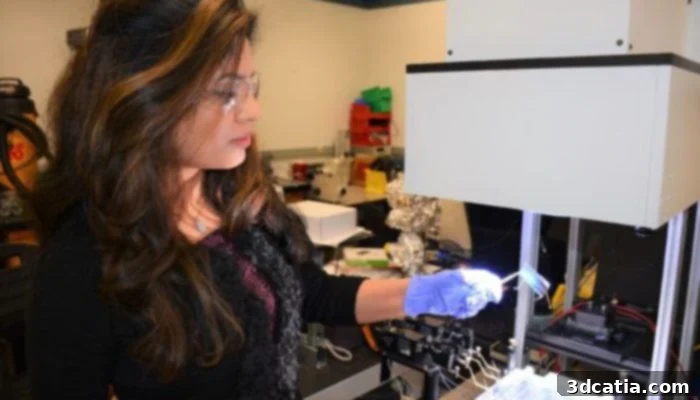
Nina Vaidya, the brilliant mind behind the AGILE lens, at work (photo credits: Nina Vaidya)
Furthermore, 3D printing facilitates rapid prototyping and iterative design improvements. Through a rigorous phase of trial and error, Nina Vaidya and her team were able to produce and test numerous different prototypes, refining the design and material combinations until optimal performance was achieved. This agile development cycle, enabled by additive manufacturing, has been instrumental in bringing the AGILE concept from theoretical possibility to a tangible, high-performing device. The inherent efficiencies of 3D printing also contribute to the reduced production cost of the concentrators, making this advanced optical technology more economically viable for widespread adoption in the solar industry and beyond. The precision offered by 3D printing ensures that each pyramid is manufactured with the exact optical properties needed, minimizing waste and maximizing effectiveness.
Transformative Benefits and Future Prospects
The implications of AGILE technology extend far beyond incremental improvements in solar energy panel design. Its capacity to collect and concentrate sunlight from any angle signifies a profound shift towards more resilient and efficient solar energy systems. By eliminating the need for complex and energy-consuming tracking mechanisms, AGILE solar arrays can be installed with greater ease and lower maintenance costs, especially in challenging environments or on irregularly shaped surfaces where traditional tracking systems are impractical. This makes solar power a more attractive option for urban integration, building-integrated photovoltaics, and off-grid applications where space and infrastructure are often limited. The static nature of AGILE means it’s less prone to mechanical failures, enhancing system longevity and reducing operational downtime.
Moreover, the enhanced light concentration achieved by the AGILE lens means that a smaller surface area of photovoltaic material can yield the same or even greater power output compared to larger, conventional panels. This contributes to significant material savings, further lowering the overall system cost and reducing the environmental footprint associated with manufacturing. The combination of increased energy collection capacity, reduced production and operational costs, and simplified installation makes AGILE a compelling solution for accelerating the global transition to clean energy. This innovation holds the potential to make solar energy not just a viable alternative, but a truly dominant force in the energy landscape, pushing the boundaries of what is possible in renewable power generation.
Nina Vaidya’s confidence in the future of her design is palpable: “To be able to use these new materials, these new fabrication techniques, and this new AGILE concept to create better solar concentrators has been very rewarding. Abundant and affordable clean energy is a vital part of addressing the urgent climate and sustainability challenges, and we need to catalyze engineering solutions to make that a reality.” This vision aligns perfectly with global efforts to combat climate change and ensure a sustainable future for generations to come. The research, as a testament to Stanford University’s commitment to cutting-edge innovation, is detailed further on their official website, providing deeper insights into this remarkable engineering feat. You can read more about it on Stanford University’s website HERE.
Conclusion: Paving the Way for a Sustainable Energy Future
The development of the 3D-printed Axially Graded Index Lens (AGILE) by Stanford University researchers marks a pivotal moment in the evolution of solar energy technology. By innovatively combining optical science with advanced additive manufacturing, Nina Vaidya and her team have engineered a device that not only enhances the efficiency and power collection capabilities of solar panels but also drastically reduces their complexity and cost. This passive, pyramid-shaped concentrator, capable of harnessing sunlight from any angle, addresses many of the long-standing limitations that have hindered the widespread adoption of solar power. AGILE is more than just a new component; it represents a paradigm shift towards simpler, more robust, and more affordable solar energy systems, paving a clearer path to a future powered by clean, renewable sources. As we continue to seek scalable solutions for our energy needs, breakthroughs like AGILE will be instrumental in making sustainable energy a global reality, ensuring a brighter, cleaner tomorrow for everyone.
What are your thoughts on these innovative 3D-printed solar concentrators and their potential impact on the renewable energy sector? We invite you to share your perspectives in the comments section below or join the conversation on our LinkedIn, Facebook, and Twitter pages! For the latest updates and breaking news in 3D printing and sustainable technologies, don’t forget to sign up for our free weekly Newsletter here, delivered straight to your inbox. You can also explore our video content on our YouTube channel.
*Cover Photo Credits: Stanford University