
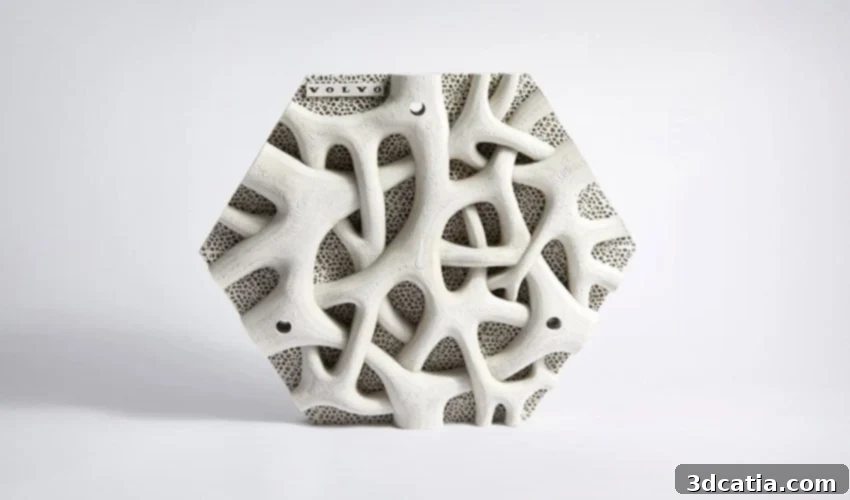
Volvo’s Living Seawall: Pioneering 3D Printing for Marine Biodiversity in Sydney Harbour
In a groundbreaking collaboration demonstrating the powerful synergy between innovative technology and environmental conservation, the Swedish automotive giant Volvo has partnered with two leading Australian organizations – the Sydney Institute of Marine Science (SIMS) and Reef Design Lab. Together, they have engineered and deployed an extraordinary solution to coastal degradation: the “Living Seawall.” This innovative project, situated in the iconic Sydney Harbour, utilizes 50 meticulously designed, 3D-printed tiles that ingeniously mimic the intricate root structures of native mangrove trees, aiming to significantly enhance and restore marine biodiversity in urbanized waterways.
The Living Seawall is more than just an architectural marvel; it’s a strategic intervention designed to breathe new life into an ecosystem under considerable stress. By integrating advanced additive manufacturing techniques with deep ecological understanding, this initiative offers a tangible pathway towards creating thriving habitats where concrete structures once stood barren. Its deployment represents a beacon of hope for urbanized coastlines globally, showcasing how thoughtful design and cutting-edge technology can be harnessed to repair and rejuvenate our precious marine environments.
Sydney Harbour’s Ecological Crisis: A Call to Action
The Decline of Natural Habitats
For over two centuries, Sydney’s once pristine natural coastline has undergone a dramatic transformation. Relentless urbanization and development have led to the systematic conversion of vast stretches of natural shorelines, teeming with life, into manmade seawalls. This process, driven by the expansion of infrastructure and human habitation, has resulted in the widespread removal of critical ecosystems, including extensive mangrove forests and intertidal zones that are vital nurseries and feeding grounds for countless marine species. The impact of this landscape alteration extends far beyond a change in scenery; it has fundamentally disrupted the delicate ecological balance of Sydney Harbour.
The consequences of this extensive habitat loss have been profound and far-reaching. As natural mangrove jungles gave way to impermeable concrete and steel, the rich tapestry of marine and coastal wildlife that once thrived here steadily began to disappear. This ecological decline is not merely an aesthetic concern; it has disastrous implications for the overall health of the harbour’s ecosystem. Many marine organisms play a crucial role in maintaining water quality by feeding on toxins, chemical pollutants, and particulate matter—byproducts of human activity and urban runoff. With their disappearance, the harbour’s natural filtration systems are compromised, leading to a build-up of harmful substances and a decline in water clarity and quality, further exacerbating the challenges faced by remaining marine life.
Designing for Life: The Living Seawall’s Approach
The “Living Seawall” directly addresses this ecological void by transforming existing, ecologically inert seawalls into vibrant, life-supporting habitats. The 50 unique 3D-printed tiles have been strategically installed on a conventional seawall structure within Sydney Harbour. These tiles are not merely decorative; they are engineered with biomimicry at their core, replicating the complex, textured structure of mangrove roots with remarkable precision. This intricate design is crucial for attracting and providing shelter for a diverse array of marine organisms, from tiny invertebrates to fish, by offering crevices, surfaces, and niches similar to those found in natural ecosystems.
Researchers from the Sydney Institute of Marine Science will embark on an ambitious 20-year monitoring program to meticulously track the ecological impact of these tiles. This long-term study will assess various metrics, including increases in biodiversity, improvements in water quality, and the colonization rates of different species. The expectation is that the biomimetic structure will significantly improve local biodiversity and contribute to the natural filtration processes of the harbour, demonstrating how purpose-built habitats can foster ecological recovery and resilience in urban marine environments.
The Transformative Power of 3D Printing
Unlocking Complex Geometries for Conservation
Additive Manufacturing, commonly known as 3D printing, stands at the forefront of this environmental innovation. Its unique capability to generate highly complex, intricate designs that rely heavily on bio-mimicry—replicating structures found in nature—is unparalleled. Such designs, with their organic curves, hidden pockets, and varying textures, would be exceedingly difficult, if not impossible, to produce using conventional manufacturing processes like subtractive manufacturing (where material is removed from a larger block). The inherent freedom of shape introduced by 3D printing technology is truly revolutionary, opening up a vast array of opportunities for addressing pressing environmental challenges and driving sustainable solutions across various sectors.
A fascinating aspect of the Living Seawall tiles is that the distinct layers resulting from the FDM (Fused Deposition Modeling) 3D printing process are still visible on their surfaces. Far from being a drawback, this textural characteristic has been identified as a significant advantage by researchers. They draw comparisons between these layered textures and the natural surfaces of oysters and other filter-feeding organisms, anticipating that such a rough, varied topography will actively encourage these vital filtering species to colonize the tiles and establish new colonies. This biomimetic textural detail underscores the deep understanding applied in the design, demonstrating how even seemingly minor details of the manufacturing process can contribute positively to ecological outcomes.
Economic and Ecological Benefits
Beyond its environmental efficacy, the 3D printing of these specialized tiles has proven to be both cost-effective and environmentally friendly. The localized, on-demand fabrication minimizes waste and reduces the logistical footprint associated with traditional construction materials. This efficiency was highlighted by the Mayor from North Sydney, who enthusiastically stated, “These 50 tiles were incredibly cheap to fabricate and install but could have a huge impact on the health of the Sydney coast, and eventually the world’s oceans.” This statement encapsulates the profound potential of such projects: delivering significant ecological benefits through economically viable and sustainable manufacturing methods. The ability to produce complex structures affordably and efficiently makes the Living Seawall model a highly scalable and replicable solution for coastal restoration efforts globally, offering a promising alternative to conventional, environmentally inert seawall construction.
Volvo’s Vision for a Sustainable Future
Beyond Automotive: A Commitment to Our Oceans
Volvo’s involvement in the Living Seawall project is a testament to its broader commitment to environmental sustainability, extending far beyond the realm of automotive manufacturing. This initiative is deeply rooted in the company’s established environmental efforts, particularly those associated with the Volvo Ocean Race. For years, the Volvo Ocean Race has been a powerful platform for raising awareness about ocean health, actively combating plastic pollution through global beach clean-ups and educational campaigns. The transition from marine sports to direct marine conservation through the Living Seawall partnership exemplifies Volvo’s dedication to actionable, impactful environmental stewardship.
Alex Goad, the Industrial Designer at Reef Design Lab, eloquently summarized the project’s innovative spirit and potential: “Volvo’s Living Seawall shows what can be done […] Living Seawall flips a harmful structure into a marine habitat and presents a unique opportunity to research which specific designs and geometries are the best to support the ecosystems in our oceans.” This quote highlights the core philosophy of the project: transforming existing environmental liabilities (barren seawalls) into ecological assets, and simultaneously advancing scientific understanding of effective habitat restoration. It underscores the importance of continuous research to refine biomimetic designs and maximize their beneficial impact on marine ecosystems.
The collaboration for the Living Seawall was a natural progression for Volvo, building upon its robust sustainability agenda. By partnering with experts like the Sydney Institute of Marine Science and Reef Design Lab, Volvo demonstrates how corporate innovation can be a powerful force for positive environmental change. This initiative is not just about funding a project; it’s about fostering interdisciplinary collaboration to develop scalable solutions for global environmental challenges. It reinforces Volvo’s dedication to protecting natural resources and promoting a more sustainable future for all, embodying a proactive approach to corporate social responsibility that looks beyond immediate business interests to the broader health of our planet. You can find out more about their initiative HERE.
A Blueprint for Global Coastal Restoration
Scaling Innovation for Wider Impact
The success and learning derived from the Living Seawall project in Sydney Harbour hold immense potential as a blueprint for global coastal restoration. The principles of biomimicry combined with the flexibility of 3D printing offer a scalable solution for countless urban coastlines worldwide that suffer from similar issues of habitat degradation and biodiversity loss due to traditional infrastructure development. Imagine a future where every seawall, every port, and every coastal development is integrated with such living structures, actively contributing to marine life rather than detracting from it. This vision moves beyond mere mitigation to proactive ecological enhancement.
This pioneering project serves as a compelling example of what can be achieved when diverse fields—automotive engineering, marine science, and industrial design—converge with a shared commitment to environmental sustainability. It encourages other industries and organizations to explore how their own innovative capabilities can be redirected towards solving complex environmental problems. By transforming seemingly inert urban infrastructure into thriving marine habitats, the Volvo Living Seawall not only enriches Sydney Harbour but also provides invaluable research and inspiration for reversing environmental damage on a much larger scale. It underscores the critical need for continued innovation, research, and collaborative efforts to ensure the health and resilience of our planet’s precious oceans for generations to come, proving that even small, targeted interventions can catalyze significant ecological recovery.