
Revolutionizing Sacred Art: The Golden 3D Printed Altarpiece in Altmühldorf
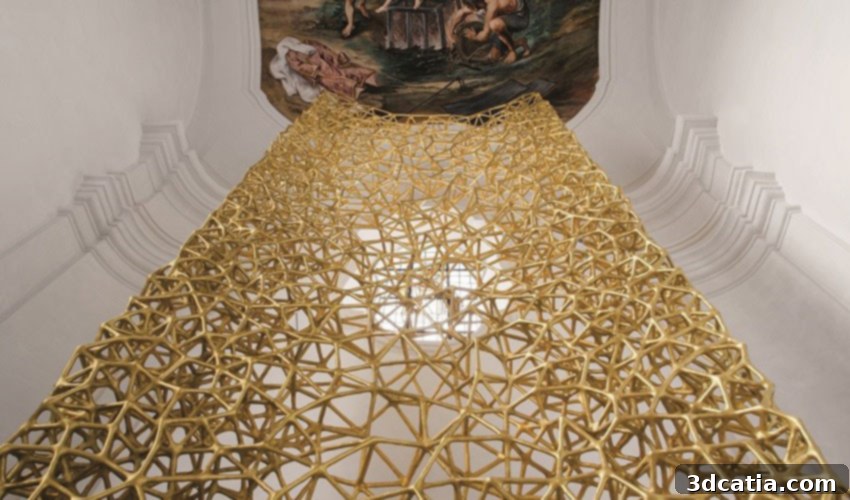
Additive manufacturing, often referred to as 3D printing, is no longer confined to industrial workshops or rapid prototyping labs. Its transformative capabilities are now permeating unexpected domains, including the restoration and creation of sacred art. A striking example of this innovative application can be found in the serene village of Altmühldorf in Bavaria, Germany. Here, within the historical confines of the local church, stands an awe-inspiring 3D printed altarpiece, a testament to the confluence of traditional artistry and cutting-edge technology. This magnificent golden structure, reaching an impressive 8 meters in height and spanning 2.5 meters in width, represents a pioneering effort in digital fabrication for ecclesiastical settings.
The project was conceived by visionary designers Oliver Tessin, along with artists Corbinian Böhm and Michael Gruberen. Their ambitious concept was brought to life through a strategic partnership with FIT AG, a renowned German 3D printing service provider. The altarpiece’s intricate design is a brilliant showcase of topological optimization, a design methodology that allows for the creation of complex geometries with maximum efficiency. Its form strikingly resembles a natural honeycomb, where every branch and intricate detail is meticulously interlocked, creating a structure that is both visually captivating and structurally sound. This blend of organic inspiration and precise engineering highlights the boundless potential of additive manufacturing.
The entire process began with an extensive 3D modeling phase, a critical precursor to the physical printing stage. This digital environment offered unparalleled flexibility, allowing the designers to experiment extensively with various shapes, material properties, and structural configurations. Crucially, it provided the opportunity to rigorously check and optimize the design specifically for additive manufacturing. A fundamental principle in 3D printing design, especially when aiming for cost-effectiveness, is to use as little material as possible while maintaining structural integrity. This approach not only helps in managing expenses but also significantly reduces the need for extensive post-processing steps, which can often be time-consuming and costly.
Topological optimization played a pivotal role in achieving this efficiency. This advanced computational design technique systematically removes material from areas where it is not structurally essential, resulting in a lighter, yet equally robust, final part. For a monumental piece like an altarpiece, this reduction in material directly translates to a significant decrease in overall weight and manufacturing cost – a key advantage that proved instrumental for the project’s feasibility. Traditionally, church restorations or the creation of new sacred elements involve labor-intensive carving, casting, or assembly of heavy materials. Introducing additive manufacturing into such a historical context was indeed revolutionary, and not without its initial hurdles. The project teams faced the considerable challenge of convincing local authorities and the city council that 3D printing technologies were not only a viable method but also a superior approach for this unique application, demonstrating its potential to deliver both aesthetic beauty and structural innovation.
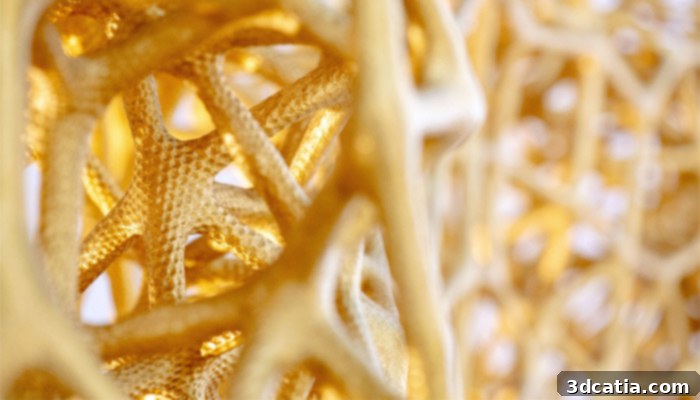
The intricate structure of the 3D printed altarpiece remarkably resembles a natural honeycomb, showcasing the power of topological optimization.
The Advanced Manufacturing Process of the 3D Printed Altarpiece
The journey to realizing the 3D printed altarpiece involved careful consideration of various additive manufacturing technologies. Initially, the architects leading the project were drawn to Wire Arc Additive Manufacturing (WAAM) technology. Their interest stemmed from WAAM’s unique properties, particularly its ability to work with metals and produce large-scale components with distinct visual characteristics. WAAM, being a directed energy deposition process, builds objects layer by layer by melting metal wire with an electric arc, offering robust metallic parts. However, upon consultation with FIT AG’s expert 3D printing department, it became clear that while WAAM offered certain advantages, other processes and materials might prove more beneficial, especially when considering factors such as cost-efficiency, geometric complexity, and the long-term durability of the finished components.
After thorough evaluation, Selective Laser Sintering (SLS) emerged as the most suitable technology for this ambitious project. SLS technology offered an optimal balance of advantages: it produces parts with high mechanical performance, ensures a lightweight final product, and provides an unparalleled degree of design freedom. Unlike WAAM, which works with metal wires, SLS typically uses polymer powders, which a laser selectively fuses layer by layer. This results in parts with excellent isotropic properties, intricate details, and no need for support structures, allowing for maximum design complexity and material efficiency. The ability to create highly complex, interwoven geometries, essential for the honeycomb-like structure of the altarpiece, was a decisive factor in choosing SLS.
FIT AG meticulously executed the 3D printing phase, producing a total of 60 individual parts that collectively form the majestic structure of the altarpiece. These components were fabricated using an EOS P770 machine, a high-performance industrial 3D printer renowned for its large build volume and precision with polymer powders. The chosen material was PA12 (Polyamide 12), a robust and versatile engineering plastic known for its excellent mechanical strength, chemical resistance, and thermal stability. Each of the 60 parts measured approximately 680 x 550 x 380 mm, indicating the substantial scale of the individual components. The sheer volume and complexity of the print job required an impressive commitment of resources, totaling 120 machine days of continuous operation to produce every single component. This figure underscores the industrial capacity and specialized expertise that FIT AG brought to the project, managing a large-scale additive manufacturing endeavor that pushed the boundaries of traditional church restoration.
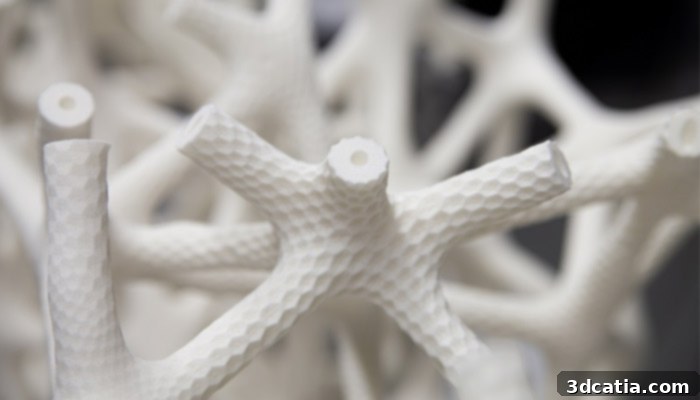
Once the 60 PA12 parts were precisely 3D printed, they underwent a crucial post-processing stage: coating. To achieve the desired aesthetic and ensure long-term durability, the components were meticulously coated with a bronze-aluminium structural alloy using thermal spraying technology. This process involves heating the alloy to a molten state and then spraying it onto the surface of the polyamide parts, creating a robust, metallic layer. Following this, a metallic varnish was applied, not only to enhance the final golden gloss, giving the altarpiece its resplendent appearance, but also to provide an additional layer of protection. This sophisticated coating strategy was paramount for several reasons: it guaranteed the longevity and integrity of the underlying polyamide material over time, provided excellent resistance to oxidation, and offered vital protection against environmental factors such as dust, soot, and moisture, which are common in historic church environments. This innovative approach allowed the designers to leverage the lightweight and design flexibility of polymer 3D printing while achieving the look and durability typically associated with traditional metalwork.
According to the project teams, the assembly process proved to be the most intricate and challenging stage of the entire endeavor. Given that the assembled altarpiece structure weighed a significant 350 kilograms, devising an efficient and secure method for on-site assembly was critical. The design necessitated the joining of the 60 large, individually printed components with precision and strength. This monumental task involved the painstaking manual gluing of no fewer than 2,000 individual connectors. Each connection had to be perfectly aligned and secured to ensure the structural integrity and aesthetic continuity of the eight-meter-high artwork. This labor-intensive manual assembly, juxtaposed with the high-tech 3D printing phase, truly highlighted the hybrid nature of the project – blending advanced digital fabrication with traditional craftsmanship and meticulous human effort. The entire project, from initial concept and design to final installation, spanned a total of six months, demonstrating a remarkable timeline for such a complex and large-scale artistic undertaking. Interestingly, the 3D printing phase, despite its complexity and the large number of parts, was highlighted as the fastest component of the entire project, underscoring the efficiency benefits of additive manufacturing. The final result is nothing short of breathtaking, a harmonious fusion of innovation and tradition.
Bruno Knychalla, a Project Engineer at FIT AG, eloquently summarized the project’s profound impact: “New technologies and spiritual objects are not so often combined. I think that our wide range of technological knowledge and our interdisciplinary team convinced people that we could do something bold and new that leaves an impression of quality craftsmanship with timeless elegance. I think people were really amazed.” This statement captures the essence of the Altmühldorf altarpiece – it transcends a mere technical achievement to become a powerful symbol of how modern innovation can enrich ancient traditions. The successful completion of this project serves as a compelling case study, proving that additive manufacturing is not just for industrial applications but can also play a vital role in preserving cultural heritage and inspiring new forms of artistic expression. It challenges preconceptions about what is possible in sacred art and architectural restoration, opening new avenues for future projects globally. The blend of precision engineering, artistic vision, and robust material science has created a masterpiece that will undoubtedly inspire generations to come, standing as a beacon of digital craftsmanship in a sacred space. More in-depth information about this fascinating project can be found HERE.
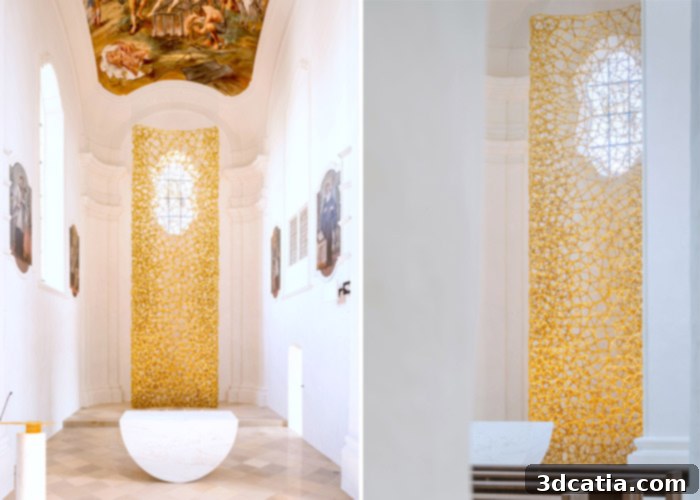
The stunning 3D printed altarpiece, a testament to modern engineering and timeless artistic vision, illuminated within the church | Credits: Studio Ticino
What are your thoughts on this groundbreaking 3D printed altarpiece? Do you believe additive manufacturing holds the key to future innovations in sacred art and architectural preservation? We invite you to share your insights in a comment below or join the discussion on our Facebook and Twitter pages. For all the latest news and developments in the world of 3D printing, remember to sign up for our free weekly Newsletter, delivered straight to your inbox!